
Level 227
HARDHow to solve Sand Loop level 227? Get instant solution for Sand Loop 227 with our step by step solution & video walkthrough. Sand Loop 227 tips and guide.
Play Sand Loop Now
Experience the puzzle challenge firsthand
Game Screenshots
Sand Loop Level Guides
Level Overview: The Night Sky Lilies Challenge
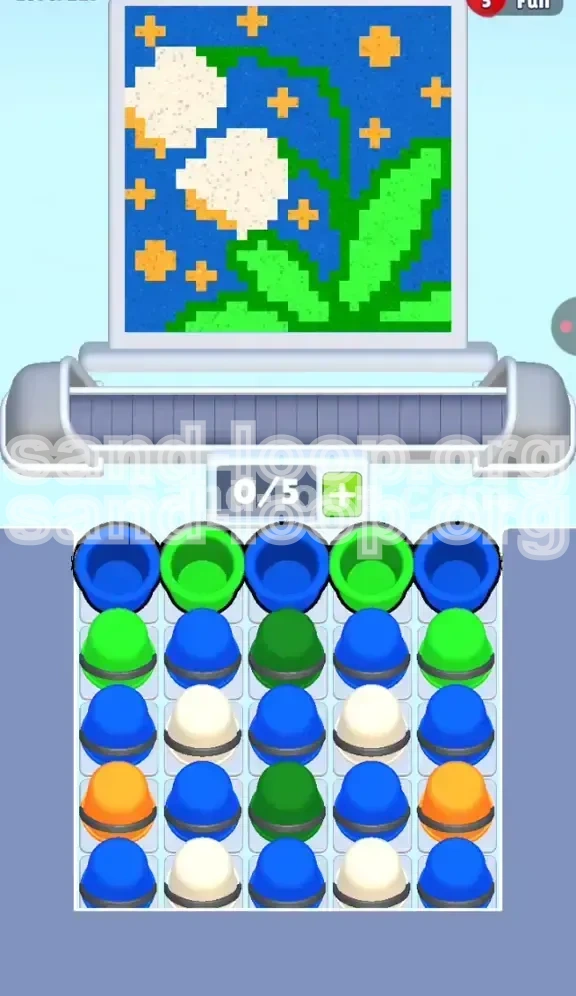
Welcome to the Vertical Digging challenge of Level 227, "The Night Sky Lilies." Unlike traditional speed stages where rapid smashing is key, this level is a test of resource management and patience. The visual aesthetic features pixel art Lily of the Valley flowers set against a deep blue starry sky. However, the challenge lies in the "Digging" mechanic required to access the necessary resources.
This level is characterized by a severe lack of immediate critical resources. The White paint required for the flowers and the Orange paint required for the stars are buried under multiple layers of "overburden"—Blue and Green paint that you must process first. The layout forces a specific rhythm: you cannot simply paint what you want when you want to; you must clear the path to get there. The central tension of this level comes from managing your limited conveyor belt space (5 slots) while digging through stacks that often do not match the current immediate painting needs.
Visual Composition Analysis
Understanding the pixel art layout is crucial for prioritizing your moves. The canvas is divided into three distinct zones that dictate your painting strategy:
The Blue Sky Dominance
Approximately 45-50% of the canvas is dedicated to the dark blue night sky. This is your "safety zone." Because the blue area is so massive, you almost never have to worry about wasting Blue paint. Any time the nozzle requests Blue, you can confidently feed it a cup without fear of overflow. This makes Blue the easiest color to manage, allowing you to focus your mental energy on the tighter resources.
The Green Foundation
The bottom third of the screen features large, contiguous blocks of Green leaves and stems. Similar to the sky, this area is very forgiving. While it occupies less space than the sky (roughly 30-35%), it provides a constant, reliable dump for Green paint throughout the early and mid-game. You should prioritize clearing Green cups early to keep your conveyor moving.
The "Precision" Targets (White & Orange)
The remaining 15-20% of the canvas consists of the high-value targets: the White Lily heads and the Orange Stars. These areas are small, isolated, and unforgiving. The White flowers are clustered in the center, while the Orange stars are scattered like dust in the sky. Missing a timing window on these colors is the primary cause of failure in this level.
Core Mechanic: Vertical Digging
This level introduces the "Alternating Column Stack" obstacle. Your supply tray is organized into five vertical columns, each stacked 3 to 4 cups high. You cannot access the bottom cups without physically removing the top ones first. This forces you to cycle through unwanted colors to get to the ones you need.
The Supply Tray Layout
Your supply tray is not random; it follows a strict pattern that you must memorize to succeed.
- Columns 1, 3, & 5 (Odd Columns): Top layer is Blue, second layer is Green.
- Columns 2 & 4 (Even Columns): Top layer is Green, second layer is Blue.
- Deep Layers: White is buried in the third row (mostly in Col 2 & 4), and Orange is at the very bottom (Row 4) of the edge columns (1 & 5).
Conveyor Belt Constraints
You have a 5-slot conveyor belt capacity. This is your most valuable resource. If you fill it with cups that you cannot use immediately because the nozzle is requesting a different color, you create a deadlock. You must strategically "hold" cups or discard them (by painting them into safe zones) to keep the flow moving.
Clear Objectives: How to Clear Level 227
To achieve a perfect clear on this stage, you must move beyond simply painting pixels and think in terms of "Unblocking." Your primary objective is to excavate the rare colors (White and Orange) from the bottom of the stacks while managing the excess flow of common colors (Blue and Green).
Objective 1: Process the "Overburden"
The first phase of the level is purely about clearing the top layer. You must accept that you will be painting Blue sky and Green leaves before you can even think about the flowers. Your goal here is to clear the first row of cups to reveal the second row. Do not fight the current nozzle color; if it wants Blue, give it Blue from the Odd columns to clear space.
Objective 2: Excavate the White Flowers
Once the top layer is cleared, the White cups become accessible in the middle columns. The mid-game objective is to clear the "bottleneck." You must free up the White cups while the nozzle is still asking for Green or Blue, potentially sacrificing a turn or two to "dig" to the White layer before the nozzle switches to White demand.
Objective 3: The Orange Star Precision Phase
The final objective is the hardest. You must reach the Orange cups at the bottom of Columns 1 and 5. By this point, your conveyor space is likely tight. You must time the extraction of these Orange cups perfectly with the nozzle's request for Orange. Since the Orange stars are small pixel clusters, the window to paint them is very short.
Objective 4: Conveyor Management
Throughout all these phases, you must maintain at least one empty slot on your conveyor. This allows you to pull a new cup without triggering a game-over "full belt" scenario. If you have 5 full cups and none match the current nozzle, you have failed the strategy.
Step-by-Step Walkthrough Guide
This section provides a turn-by-turn strategy for navigating the supply tray and painting the canvas. Follow these steps to maintain rhythm and avoid getting stuck.
Phase 1: The Top Layer Clear (Moves 1-15)
The level begins with a mix of Green and Blue requests. Do not look at the bottom rows yet. Focus entirely on the top cup of every column.
- If the Nozzle is GREEN: Tap Column 2 or Column 4. These have Green on top. This clears the top of the even stacks, revealing Blue underneath.
- If the Nozzle is BLUE: Tap Column 1, 3, or 5. These have Blue on top. This clears the odd stacks, revealing Green underneath.
- The "Weave" Strategy: You will likely alternate between Green and Blue requests. Rapidly switch between Even and Odd columns to match the nozzle. Your goal is to flatten the top layer of the tray completely.
Phase 2: The Mid-Game Dig (Moves 15-30)
Once the top layer is gone, you are looking at a secondary layer of mostly Blue (in even columns) and Green (in odd columns). You now need to look ahead.
- Identify the White Targets: Look at Column 2. Underneath the initial Green (now gone) and Blue, there is a White cup. You need to get to it.
- Strategic Digging: If the nozzle asks for Blue, but the top of Column 2 is Blue, DO NOT take it if you don't need Blue paint yet. Instead, take Blue from an Odd column if available. However, since the nozzle is asking for Blue, you might be forced to clear the Blue cap on Column 2 to reach the White underneath.
- Exposing White: You need to clear the Blue cup from the top of Column 2 and 4 to expose the White cups in the 3rd row. Wait for a Blue nozzle request, then clear Column 2 and 4's second row.
Phase 3: Painting the Flowers (Moves 30-50)
The White cups are now exposed in Columns 2 and 4. The nozzle will eventually shift to the flower clusters in the center of the screen.
- Timing the Switch: Watch the canvas center. When the pixels outline the White flowers, the nozzle will switch to White shortly.
- Stockpiling: If you have space on your conveyor, grab the White cups from Column 2 and 4 even if the nozzle isn't asking for White yet, provided you have room to hold them. If your belt is full, wait.
- Execution: When the nozzle turns White, feed the cups from Column 2 and 4 into the machine. Paint the flower heads completely.
Phase 4: The Deep Dig for Orange (Moves 50-70)
With the flowers done, you need to finish the level. The remaining unpainted pixels are the Orange stars. The resources are deep.
- Locating the Source: The Orange cups are in Row 4 (the bottom) of Column 1 and Column 5.
- Clearing the Path: Column 1 has Blue (Row 1), then Green (Row 2), then likely Blue/Green (Row 3), then Orange (Row 4). You must clear the top 3 cups from these edge columns.
- The Danger: You might clear the path to the Orange cup while the nozzle is asking for Green or Blue. The Orange cup will sit at the top of the stack, "stuck" behind the other colors on your conveyor.
Phase 5: The Final Finish
The nozzle will cycle to the small Orange stars.
- Immediate Action: As soon as the nozzle switches to Orange, tap the exposed Orange cup in Column 1 or 5.
- Single Shot: Send the cup. Paint the star.
- Repeat: Dig out the second Orange cup from the opposite edge column and repeat.
- Cleanup: Use any remaining Blue or Green cups in your tray or conveyor to finish filling in the remaining background pixels.
Color Order and Processing Strategy
The "Fill Order" in Level 227 is not random; it follows a logical progression based on the layering of the supply tray. Understanding this order prevents you from digging for a color you won't need for another 20 turns.
First Priority: Blue (The Sky)
The game starts with Blue because it is the most accessible resource (Columns 1, 3, 5). The nozzle will prioritize the large background areas first. You should process Blue cups aggressively from the Odd columns early on. This clears the tray and fills the largest area of the canvas, reducing the complexity of the board.
Second Priority: Green (The Leaves)
Simultaneously with Blue, the game requests Green for the lower foliage. Green is accessible on top of Columns 2 and 4. The demand for Green is steady but slightly less voluminous than Blue. You should process Green to keep your belt clear, but don't be afraid to "skip" a Green tap if it means clearing a Blue cup that is blocking a White cup you need later.
Third Priority: White (The Flowers)
White appears only after you have dug down to Row 3. The game delays the request for White flowers until the mid-game. You should not worry about White in the first 10-15 turns. Focus on clearing the overburden (Blue/Green) sitting on top of the White cups in Columns 2 and 4.
Fourth Priority: Orange (The Stars)
Orange is the "Boss Key" of this level. It is buried at the bottom of the stacks (Row 4) and is requested last. The nozzle will only switch to Orange when the rest of the canvas is nearly full. This gives you time to dig down to Row 4 of Columns 1 and 5. Do not rush to dig to Orange immediately; you will just clog your conveyor with an unpourable cup.
Understanding the "Bottleneck"
The bottleneck in this level is the transition from Row 2 to Row 3. You must clear the second layer of Blue/Green to reach the White/Orange layer. This transition is where most players get stuck. Ensure you have a clear conveyor belt (2-3 empty slots) before you start clearing Row 2, so you have room to catch the newly exposed Row 3 cups.
Key Tips for Success
Master these advanced techniques to turn a frustrating loss into an easy win. These tips focus on the mechanical nuances of the Sand Loop gameplay style.
The "Trash Can" Strategy
Use the Blue Sky as your trash can. If you have a Blue cup on your conveyor that is taking up space and you need to make room for a different color, simply pour that Blue cup into the sky immediately. The sky is so large (approx. 50% of the level) that you virtually cannot "overfill" it with Blue. This allows you to cycle your conveyor belt rapidly to find the colors you actually need.
Column Isolation Technique
Try to keep your digging focused on one specific "problem column" at a time. If you need to dig to the bottom of Column 1 to get an Orange cup, focus your energy there. Do not tap random columns all over the tray. By systematically clearing Column 1 from top to bottom, you ensure that the cup you need eventually pops up, rather than having it scattered across half-cleared columns.
Conveyor Slot Management
Never let your conveyor belt fill up completely. Always try to keep at least one slot empty. Why? If you have 5 full cups and the nozzle changes to a color that isn't on your belt, you are forced to waste a turn painting a color you don't need to clear a slot. Keeping a buffer allows you to react instantly to nozzle changes.
Pre-Digging for Future Needs
If the nozzle is asking for Green, but you don't need Green paint anymore, use that opportunity to "dig" into a column that *doesn't* have Green on top. Wait, that's impossible—you can only pull the top cup. So, use the Green request to clear a Green cup from a column where the *second* cup is something you need (like White). This is "Pre-Digging"—using a current demand to clear the path for a future demand.
Nozzle Anticipation
Watch the "active painting" area on the canvas. The nozzle usually hints at what is coming next. If it is finishing up a Green leaf patch near the bottom, the next request is likely to be Blue (moving up the canvas) or White (moving to the center). Anticipate this shift and have the appropriate cup ready on your conveyor before the nozzle even switches.
Common Mistakes to Avoid
Level 227 has several "traps" that can ruin a perfect run. Learn these warning signs to prevent frustration.
Mistake 1: The Premature Orange Dig
Many players see the Orange cups at the bottom of the tray and try to dig to them immediately in the first 10 turns. This is a fatal error. You will uncover the Orange cup, but the nozzle won't ask for Orange until the end of the level. The Orange cup will sit on your conveyor, taking up a valuable slot, effectively reducing your capacity to 4 slots for the entire game. Only dig for Orange in the late game.
Mistake 2: Ignoring the Trash Can
Some players try to "save" Blue paint for later, thinking they will run out. You will not run out of Blue paint. The tray is full of it. If a Blue cup is blocking your operations, pour it into the sky immediately. Hoarding Blue paint leads to a clogged conveyor and a deadlock.
Mistake 3: Deadlock by Mismatch
This happens when you tap Columns 1, 3, and 5 (Blue tops) when the nozzle is Green. You now have 3 Blue cups on your belt. The nozzle is still Green. You tap Column 2 (Green top). Now you have 3 Blue and 1 Green. The nozzle switches to Blue. You use the Green cup... wait, you can't. You are stuck with 4 cups you can't use. Always match the top cup color to the nozzle color.
Mistake 4: Panic Filling
When the nozzle switches to White or Orange, players often panic and grab the first cup they see. Be precise. If the nozzle switches to White, ensure you are grabbing the *specific* White cups from Column 2 or 4, not accidentally pulling a stray Blue cup from an adjacent column.
Stuck Solutions and Recovery
Even with a perfect plan, things can go wrong. Here is how to recover from specific bad situations in Level 227.
Problem: Conveyor Belt Full of "Wrong" Colors
You have 5 cups (e.g., Blue and Green) but the nozzle is asking for White.
- Solution: You must "burn" a turn. Look at the canvas. Is there any spot—even a tiny pixel—of Blue or Green left unpainted? If yes, pour a cup there to free up a slot. If the entire Blue/Green area is full, you are in trouble. This highlights the importance of never painting the background 100% early; leave a few "buffer pixels" unfilled specifically for emergency cup dumping.
Problem: White Cups Uncovered but Nozzle Stays Blue
You have dug to the White cups in Col 2/4, but the game keeps asking for Blue.
- Solution: The game script is waiting for you to fill more of the Blue sky before it triggers the White flower phase. Pour more Blue cups from the Odd columns into the sky. Once the "Blue Progress" bar hits a certain threshold (usually around 80%), the nozzle will finally switch to White.
Problem: Orange Cup is Buried and I Can't Reach It
You are at the end of the game, the nozzle is Orange, but the Orange cup is still buried under 2 other cups in Column 1.
- Solution: You messed up the digging order earlier. Now, you must use "Discard Tactics." If you have any empty space in the canvas (or a "buffer pixel" you left), take the top cup off Column 1 and pour it into the buffer space, even if it doesn't match the color perfectly (if the game allows), or just wait for the nozzle to cycle to that top cup's color. This is slow. The better way is to ensure Column 1 is cleared *before* the nozzle switches to Orange.
Speed Run Tips
For players looking to 3-star this level or complete it in the shortest time possible, speed is essential. However, speed in Sand Loop comes from "Flow," not just tapping fast.
Pre-Loading the Conveyor
As soon as the level starts, identify that Columns 2 and 4 contain the eventual White cups. Start clearing these columns slightly earlier than necessary. You want the White cups exposed and sitting on your conveyor (or waiting at the top of the stack) just *before* the nozzle switches to White. This eliminates the digging delay when the color switch happens.
Combining Moves
Don't tap one cup, wait for it to pour, then tap the next. As soon as you tap a cup and it starts moving to the nozzle, immediately tap the next column you want to clear. Queue up your moves while the animation is playing. This "Input Buffering" saves precious seconds over the course of a level.
The "Sky Dump" Speed Trick
When clearing Blue cups, don't aim carefully. Just tap the Blue cup and tap anywhere in the dark blue sky area. Because the sky is a uniform color and connects to itself, you don't need precision. Use "mash tapping" here to clear Blue cups as fast as the game physics will allow, freeing up your attention for the tricky White/Orange logic later.
Memorize the Stack
The stack layout never changes. It is always: Odd: Blue -> Green -> ... Even: Green -> Blue -> White -> ... Memorize this. You should never have to "look" at the tray to see what color is under the current one. You should already know. This allows you to plan 3 moves ahead.
Skip the Perfection
Don't try to fill every single pixel perfectly as you go. It is faster to get the nozzle to 95% completion on a color (letting the "almost full" warning appear) and then switch focus to the next color, relying on the final cleanup phase to fix the last few pixels. This keeps the rhythm of the game high.