
Level 262
HARDHow to solve Sand Loop level 262? Get instant solution for Sand Loop 262 with our step by step solution & video walkthrough. Sand Loop 262 tips and guide.
Play Sand Loop Now
Experience the puzzle challenge firsthand
Game Screenshots
Sand Loop Level Guides
Level Overview: The "Watermelon Cat" Conundrum
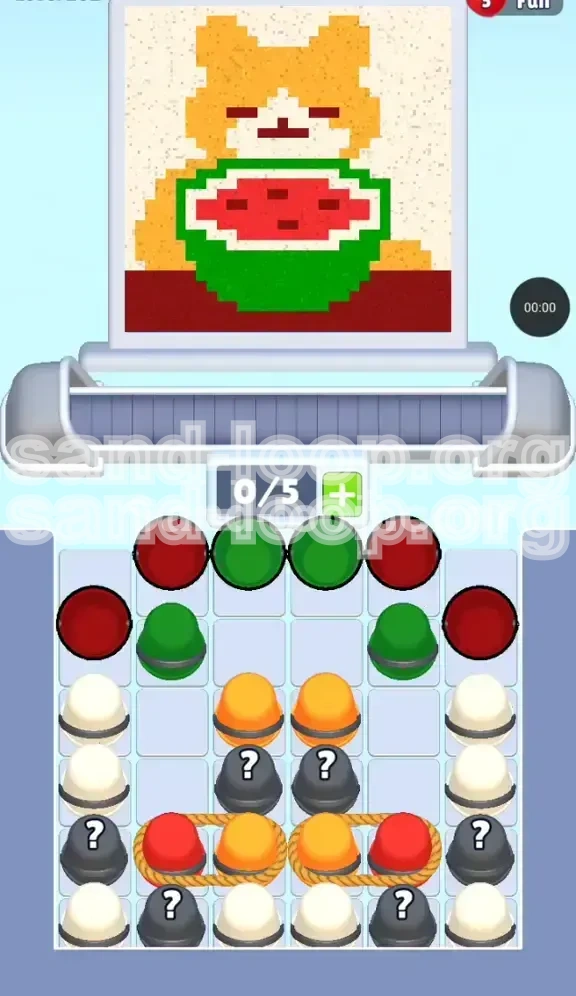
Welcome to the detailed walkthrough for Level 262. This stage is a deceptive blend of adorable aesthetics and punishing logistical management. While the objective image—a pixel art Orange Tabby enjoying a slice of watermelon—looks innocent, the level design is built to test your inventory management skills rather than your reflexes.
This level introduces a specific bottleneck: Roped Pairs. Unlike standard levels where you can pick and choose individual colors to optimize your 5-slot conveyor belt, Level 262 forces you to accept two colors simultaneously at critical junctures. This effectively reduces your active working capacity from 5 slots to 4, or even 3, depending on how you manage the "dead" color.
Core Mechanics Analysis
The primary mechanic here is Slot Economy. You are not fighting against a fast timer; you are fighting against gridlock. If you allow your belt to fill up with the wrong combination of colors, you will create a deadlock where no valid moves are possible.
The Visual Layers
The canvas is divided into distinct color zones. Understanding the hierarchy is crucial. You have the Cream/White background, the Deep Green rind, the Vibrant Red flesh, the Pastel Orange fur, and finally the Black details. The game forces you to paint in a specific top-down order dictated by the cup stack.
The Roped Pair Challenge
This is the defining feature of Level 262. A physical rope connects a Red bucket to an Orange bucket in the stack. Tapping one launches both. This creates a "2-for-1" slot consumption scenario that can ruin your run if your belt is already cluttered.
Mystery Bucket Variables
Scattered throughout the level are grey buckets marked with a question mark. These are wildcards. They contain essential colors (usually Black or White) but their content is only revealed once they hit the conveyor belt, adding a layer of unpredictability to your planning.
Why Players Fail Here
Most failures occur due to Premature Background Clearing. Players instinctively clear the white background first, leaving no buffer space to manage the complex Red/Orange roped pairs later in the level. Saving specific "filler" columns for the end is the secret to success.
Clear Objectives: Your Mission Checklist
To conquer Level 262, you need to move away from random tapping and adopt a strategic, column-based clearing approach. Your goal is to systematically dismantle the cup pyramid while maintaining fluid movement on your conveyor belt.
Objective 1: Expose the Core Colors
Your immediate priority is to clear the top-layer cups to unlock the colors trapped underneath. Specifically, you must clear the initial Green and Red stacks to reveal the Orange cups required for the cat.
Objective 2: Manage the Belt Capacity
At no point should you allow your belt to become static. If you have 5 cups sitting on the belt and none are currently being accepted by the canvas, you have failed the state. Keep the flow moving.
Objective 3: Isolate the Roped Pair
You must create a scenario where your belt is empty enough (0 or 1 cup occupied) to safely accept the Red/Orange roped pair. Attempting to launch this pair when you have 3+ cups on the belt will result in a clog.
Objective 4: Control the Mystery Buckets
Do not treat the grey Mystery Buckets as free resources. Treat them as potential hazards. Only launch them when you have the capacity to absorb a color you might not immediately need.
Objective 5: Final Background Flush
Leave the side columns (mostly White) untouched until the very end. These are your "sanity check"—a safe place to dump cups when the complex color logic of the cat and watermelon is resolved.
Color Order Strategy: The Pouring Hierarchy
In Sand Loop, the order of operations is dictated by the layering of the pixel art. You cannot paint the cat's eyes before you paint its face. Here is the optimized processing order for Level 262:
Priority 1: Deep Green (The Rind)
Always start with the Green cups. The watermelon rind forms the bottom layer of the fruit. If you try to pour Red or Orange first, the game will likely reject them or force you to wait, wasting valuable belt space. Clearing Green first also opens up the stack for subsequent colors.
Priority 2: Vibrant Red (The Flesh & Table)
Once Green is processing, immediately move to Red. This covers the watermelon flesh and the table surface. Note that Red is part of the problematic Roped Pair, so you will be returning to this color later.
Priority 3: Pastel Orange (The Cat)
The Orange fur is the dominant visual feature. You will need a steady stream of Orange. However, because it is roped to Red, you must time your intake to ensure you don't flood your belt with unusable Red while painting the Orange sections.
Priority 4: Cream/White (The Background)
While tempting to clear early, White should be saved for cleanup. The background covers everything else. Painting it too early restricts your ability to fix mistakes or handle overflow.
Priority 5: Black (The Details)
Black is the "finisher." It paints the seeds and the eyes. Because these are small details, the game accepts Black very slowly. Do not launch all your Black buckets at once; they will sit on the belt, blocking other colors. Treat Black as a "drip feed" resource.
Step-by-Step Walkthrough: Phase 1 - The Watermelon
The beginning of the level is straightforward but sets the tempo for the rest of the game. Focus entirely on the center of the screen.
Step 1: The Green Launch
Locate the two Green cups stacked at the very top center. Tap them simultaneously. Since your belt is empty (0/5), both will load immediately. The nozzle will begin painting the rind. Use this time to survey the rest of the stack.
Step 2: Clearing the Red Flesh
Directly adjacent or below the Greens (depending on stack variation) are the Red cups. Tap the outer Red cups next. Do not tap the center stack yet if it contains other colors. By launching Red now, you start the table and flesh painting while the Green is still processing.
Step 3: The First Mystery Bucket
As the top layers clear, you will see a Grey '?' bucket become accessible. Tap only one of them. Watch it closely as it lands on the belt.
- If it turns White: Send it to the back of the queue or use it to fill tiny background gaps if the sensor allows.
- If it turns Black: Great! Let it creep forward slowly for the seeds.
Step 4: Managing the Overflow
At this stage, you likely have 3 or 4 cups on the belt. If the belt is full, stop tapping. Wait for the nozzle to finish pouring a color and clear a slot. Never force a tap when the belt is full; this is how accidents happen.
Step 5: Vertical Clearing
Focus on the center vertical column. Your goal is to drill down through the stack to free up the Orange cups. Ignore the side columns for now—they are your reserve fuel.
Step-by-Step Walkthrough: Phase 2 - The Roped Pair Crisis
This is the most critical phase of Level 262. You are now approaching the Red/Orange connection.
Step 1: Belt Emptying Protocol
Before you touch the roped cups, you must reduce your belt count to 0 or 1. If you have 3 cups waiting to be poured, you are not ready. Wait for the current colors to finish.
Step 2: Identifying the Rope
Look for the Red and Orange buckets connected by a visual rope or link. Usually, the Orange is on top or side-by-side with Red.
Step 3: The Double Tap
Tap the pair. Both will fly onto the belt. Since you prepared by clearing space, you now have 2 cups on a 5-slot belt. This gives you 3 slots of buffer, which is a healthy position to be in.
Step 4: The "Wait" Game
The game will prioritize one color over the other. Usually, it will paint the Red (table/background elements) first, or switch between them. If one cup finishes and the other is still waiting, do not fill the empty slots with new colors immediately. You need that empty slot to rotate the belt if the sensor gets picky.
Step 5: Cycle the Second Color
If the Red is done but Orange is still queued, and you accidentally filled the belt with White, you might block the Orange from reaching the nozzle. Keep the path clear. Let the second color of the pair pour completely before launching the next wave.
Step-by-Step Walkthrough: Phase 3 - Cleanup and Finishing
The hard part is over. Now it is a matter of efficient resource management to clear the board.
Step 1: The Mystery Bucket Sweep
Now that the main structures (Cat and Watermelon) are defined, you can aggressively tap the remaining Mystery Buckets. If they turn into colors you've already finished, the game will usually auto-clear them or pour them rapidly as "overflow" points.
Step 2: The White Pillars
Remember those side columns we told you to ignore? Now is the time. Tap the left and right White stacks rapidly. Since the main colorful elements are done, the canvas is hungry for background color. These will pour quickly.
Step 3: Handling the Leftovers
You might be left with a single odd cup (e.g., a lone Green or Black). Just let it ride. The sensor will eventually trigger the last pixel needed.
Step 4: Victory Lap
Watch the completion percentage climb. Once it hits 100%, the level ends immediately. You don't need to clear every single cup from the belt, just the ones required to finish the painting.
Key Tips for Success
To master Level 262, keep these strategic nuggets in mind. They differentiate a novice player from a Sand Loop expert.
The 40% Capacity Rule
Try to keep your belt utilization below 40% (2 cups or fewer) whenever possible. This gives you the flexibility to handle the Roped Pairs without panicking. A full belt is a death sentence in this level.
The "Non-Touch" Strategy
Discipline is key. Physically restrain yourself from tapping the side White columns. They look tempting because they are easy targets, but they are your strategic reserve. Using them early is the #1 cause of failure.
Visualizing the "Nozzle Block"
Understand that the nozzle can be blocked by colors. If you have a Black cup at the front but the canvas currently needs Red, the Black cup acts as a plug. You must clear the Red demand to move the Black plug.
Speed vs. Accuracy
Do not speed run this level. Speed running Level 262 often leads to the "Roped Pair Jam." It is better to wait 5 seconds for a cup to finish than to restart the level because you forced a tap.
Color Stacking
If you have multiple Black cups, try to space them out. Don't let them bunch up on the belt. Since Black pours slowly (seeds/eyes), a cluster of Black cups will create a traffic jam that takes minutes to resolve.
Common Mistakes to Avoid
Learn from the errors of others. Avoiding these common pitfalls will save you time and frustration.
The "Full Belt" Fallacy
Many players think a full belt is efficient because "all cups are in play." In Level 262, a full belt means you have zero control. You cannot react if a Mystery Bucket turns into a useless color.
Ignoring the Stack Depth
Don't just look at the top cup. Look at what is underneath. If tapping a top cup reveals a Roped Pair that you aren't ready for, you have just trapped yourself. Always think two moves ahead.
Misinterpreting the Mystery Buckets
Do not gamble. Tapping three Mystery Buckets in a row hoping for a Black cup is a high-risk strategy. If you get three White cups instead, you have just clogged your belt with paint you can't use yet.
Wasting the Roped Pair Opportunity
Some players clear the entire board *except* the Roped Pair, hoping to save it for last. This is dangerous. If you are left with only a Roped Pair and a full belt of wrong colors, you cannot clear space. Deal with the pair while you still have some maneuverability.
Forgetting the "Tap" Cooldown
If you tap a cup and it doesn't move immediately, do not tap it again frantically. The game has a short animation delay. Frantic tapping can lead to accidental double-launches.
Solutions When You Get Stuck
Feeling trapped? The paint isn't moving? Here is how to diagnose and fix the gridlock.
Scenario 1: The Color Lock
Symptom: The nozzle is hovering over the canvas, but no paint is coming out.
Diagnosis: The front cup on the belt does not match the current unpainted pixels on the canvas.
Fix: You need to clear the backlog. Look at the canvas—what color does it actually need right now? Find that cup in your belt stack. If it's buried behind others, you may have to wait (or restart if you realized you made a strategic error 3 minutes ago).
Scenario 2: The Mystery Curse
Symptom: You have 5 grey cups on the belt, and none are revealing useful colors.
Fix: There is no fix other than patience. Let them pour one by one. Do not add more cups to the belt. This is a slow penalty phase.
Scenario 3: The 1% Struggle
Symptom: You are at 99% completion, and one tiny pixel refuses to fill.
Fix: This is usually a single pixel of Black or White. Check the cat's eyes or the watermelon seeds. Ensure you haven't accidentally blocked a Black cup behind a wall of other colors. Let the belt cycle until that specific color reaches the front.
Speed Run Tips for the Pros
Once you have beaten the level, come back for the speed challenge. Here is how to shave seconds off your time.
The "Reset" trick
If the initial stack looks unfavorable (e.g., Roped Pairs are too high up), force quit and restart immediately. Don't waste 3 minutes on a bad layout seed.
Queue Loading
While the nozzle is pouring Green, tap the Red cups. While pouring Red, tap the Mystery Buckets. Always have the next action ready while the current one is executing. Downtime is the enemy.
Pre-loading the Roped Pair
Advanced players can tap the Roped Pair when the belt has 2/5 cups, provided those 2 cups are just about to finish pouring. It requires tight timing but saves a full belt cycle.
Aggressive Mystery Tapping
In a speed run, you tap Mystery Buckets immediately. You don't wait to see what they are. If they turn bad, you eat the time loss. If they turn good (Black), you gain a massive lead. This is high-risk, high-reward.