
Level 293
HARDHow to solve Sand Loop level 293? Get instant solution for Sand Loop 293 with our step by step solution & video walkthrough. Sand Loop 293 tips and guide.
Play Sand Loop Now
Experience the puzzle challenge firsthand
Game Screenshots
Sand Loop Level Guides
Level 293 Overview: The Autumn Forest Challenge
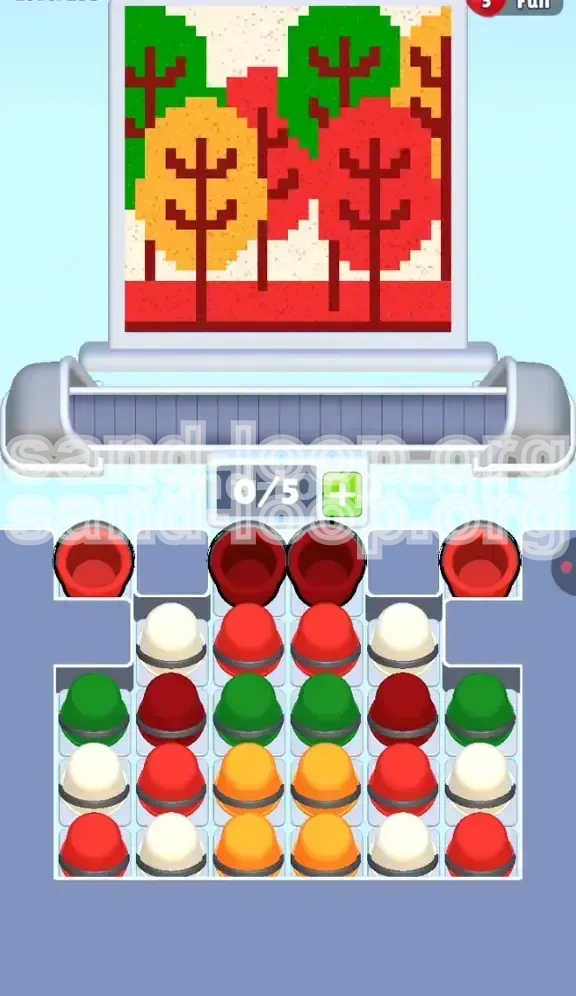
Welcome to the Autumn Forest, a stage that demands precision over speed. Level 293 is a classic Logic Sorting puzzle that separates the impatient players from the strategists. Unlike the standard "smash and grab" ice-breaking levels, this stage requires you to construct a picturesque scene featuring pixelated trees in red, orange, and green set against a stark white sky. The difficulty here is deceptive; while there are no bombs or locked doors to worry about, the sheer density of the color palette and the strict 0/5 Slot Capacity on your conveyor belt create a logistical puzzle that can easily clog your system if you aren't paying attention.
Visual Breakdown of the Canvas
The target image is composed of five distinct layers that must be poured in a specific sequence to avoid pixel bleeding. The canvas is dominated by vertical elements, specifically the tree trunks, which act as the skeleton for the rest of the image. If you examine the preview screen closely, you will notice that the background is not a solid block but a complex negative space that requires precision filling.
The 0/5 Slot Constraint
This is the most critical mechanic in this level. You are limited to five active cups on the belt at any given time. This means you cannot simply pull every color you see onto the belt. You must manage your queue aggressively, ensuring that you never have a "traffic jam" of colors waiting to be poured while a critical cup remains buried in the supply tray.
Color Palette Analysis
You will be dealing with a seasonal palette that is visually similar but functionally distinct. The colors include Bright Red for the ground floor, Mustard Yellow/Orange for the primary canopy, Forest Green for the background vegetation, Dark Red/Maroon for the tree trunks, and White for the sky. The challenge is distinguishing between the Bright Red and the Dark Red at a glance, as mixing them up will ruin the definition of the trees.
The "Central Column" Obstacle
The supply tray is designed to frustrate you. The colors you need most urgently—the Oranges and Dark Reds—are buried in the center columns of the tray. The edges are lined with White cups, which are essentially "trap" items for the early game. If you clear the edges first, you will fill your belt with sky color before you have built the trees, leading to a deadlock.
Why Logic Beats Speed
In this level, tapping the wrong cup can set you back significantly more than a simple time penalty. Pouring the background White before the tree trunks are established will result in a muddy, undefined image where the trees blend into the sky. Patience is your greatest asset here. You must resist the urge to clear the tray and instead focus on the dependency chain of the artwork.
Primary Objectives and Win Conditions
To secure the 100% completion rating on Level 293, you need to do more than just fill the canvas; you need to respect the layering of the artwork. The game engine calculates your precision based on how cleanly you transition between colors.
Establish the Foundation First
Your immediate goal is to secure the bottom of the canvas. The Bright Red ground strip is the anchor of the image. It covers approximately 15% of the total canvas area and serves as the base upon which the trees sit. If you try to pour the sky or the leaves before the ground is set, you risk having the ground color bleed upwards into the trunks, creating floating trees.
Define the Vertical Structures
Once the ground is laid, your priority shifts to the Dark Red tree trunks. These are thin, vertical lines that cut through the center of the image. They must be sharp and distinct. The objective here is to create separation between the left and right sides of the forest. If these are blurry, the entire image looks flat.
Layer the Canopy Correctly
The foliage is not a single layer; it is a depth stack. The Green trees sit at the back, the Orange/Yellow trees sit in the middle, and the Bright Red leaves sit in the foreground. You must pour in this order: Green first to set the background, then Orange to fill the volume, and finally Bright Red to add texture. Pouring them out of order will hide the Green trees entirely.
Fill the Negative Space
The White Sky is your final objective. This color should occupy roughly 30% of the screen, filling all the gaps between the leaves and around the tree tops. The objective is to pour this color last so that it acts as a finishing seal, correcting any minor pixel overflows from the previous steps.
Maintain Belt Velocity
You must keep the conveyor belt moving. Stalling creates a backlog where colors pile up. The objective is to always have 1 or 2 slots open on your belt to allow for the extraction of buried cups. If your belt is full, you cannot dig into the center of the tray to get the crucial Orange cups.
Step-by-Step Walkthrough: The Construction Phase
This section provides the exact sequence of moves required to beat the level. Follow these steps in order, and do not skip ahead.
Phase 1: The Red Foundation
Start the level by scanning the very top row of the supply tray. You will see two Bright Red cups flanking the center. Do not touch the Dark Red cups in the middle yet. Tap the two Bright Red cups immediately. Pull them onto the belt. As soon as they are on the belt, tap them to pour. This creates the solid floor of the forest. This is the safest move you can make and clears the top row for access to the deeper layers.
Phase 2: Accessing the Trunks
With the top corners cleared, the center Dark Red cups are now accessible. However, do not pull them yet if your belt is full. Wait for the Red cups to finish pouring. Once you have a free slot, tap the Dark Red cups in the center top row. Pour these immediately after the ground. They will shoot straight up, creating the trunks. Doing this second ensures the trunks sit "on top" of the ground visually, rather than blending into it.
Phase 3: Excavating the Green
Now look at the second and third rows. You will see Green cups starting to appear. Your goal is to clear the path to the bottom of the tray. Tap the Green cups to pull them onto the belt. Pour these into the upper-middle section of the canvas. This establishes the background trees. Don't worry if it looks messy; the Orange trees will cover most of this up.
Phase 4: The Great Orange Dig
This is the hardest part of the level. The Orange cups needed for the main canopy are buried in Rows 4 and 5, trapped behind Reds and Greens. You must clear the preceding cups to make them fall down. Keep pouring Green and Dark Red until the Orange cups drop into the clickable zone. Once an Orange cup appears in the bottom row, prioritize it above all else. Pull it and pour it to fill the bulk of the tree bodies.
Phase 5: The Sky Cleanup
Only after the trees are fully formed should you look at the White cups. By now, the White cups that were on the edges have likely shifted or become accessible. Pull the White cups onto the belt. Pour them slowly into the remaining empty spaces. Since the trees are already there, the White pixels will automatically flow around them, filling the sky without corrupting the tree shapes.
The Critical Color Order Protocol
The specific order in which you process the five colors is the mathematical key to solving Level 293. Deviating from this hierarchy is the most common reason for failure.
Priority 1: Bright Red (Ground)
Why first? Because it is the lowest pixel layer. In the game's rendering logic, bottom layers usually take precedence or define the boundary. Pouring this first creates a "hard stop" for the rest of your liquids. It covers the bottom 15% of the screen and prevents the tree trunks from looking like they are floating in a void.
Priority 2: Dark Red (Trunks)
Why second? Because trunks are linear and thin. They need to flow uninterrupted from the ground up. If you pour leaves first, the trunks will have to "fight" through the existing pixels, often resulting in broken, jagged lines. Pouring trunks second ensures they go straight up the center of the canvas.
Priority 3: Forest Green (Background)
Why third? Because Green is the darkest of the foliage colors and sits furthest back in the "3D" space of the image. By pouring it third, you establish the volume behind the main trees. If you save Green for last, it will overwrite the lighter Orange and Red leaves, ruining the contrast.
Priority 4: Mustard Orange (Foreground)
Why fourth? This is the "meat" of the image. The Orange trees cover the largest surface area. They need to be poured after the Green so they don't get hidden, but before the Sky, so they don't get outlined in white. This color provides the transition between the dark trunks and the bright leaves.
Priority 5: White (Sky)
Why last? White is the "eraser" and the background combined. If you pour it too early, it creates white islands that break up the flow of your tree colors. By saving it for last, you allow it to fill the "negative space"—the gaps between branches and leaves—creating a crisp, clean contrast that makes the autumn colors pop.
Essential Tips for Mastering Level 293
These tips are designed to help you manage the resources on the screen and avoid common pitfalls that drain your time.
Manage Your Slot Capacity Aggressively
Never let your belt reach 5/5 cups unless you are about to pour immediately. A full belt is a frozen belt. Always try to keep 1 slot open. This allows you to grab a cup the second it drops into the bottom row of the supply tray. If you are at 5/5, you have to wait for a cup to finish pouring before you can grab the new one, losing precious seconds.
Ignore the "Edge" Temptation
The game designers placed White cups on the far left and right edges of the tray to tempt you. They are easy to tap and clear. Resist this urge. Clearing the edges first clogs your belt with White, leaving you no room to maneuver the Red and Orange cups you actually need for the center of the image. Pretend the edge columns don't exist until the very end.
Pre-Clearing for the Drop
Think two steps ahead. If you see an Orange cup trapped behind two Green cups, don't just stare at it. Clear the Greens immediately. The physics of the supply tray mean that clearing the top cups makes the bottom cups fall. Be the catalyst for the drop. Force the Orange cups into the playable zone by clearing the debris above them.
Utilize the "Pause" Tactic
If you feel the supply tray is becoming a jumbled mess of colors, take your finger off the screen for a second. Look at the bottom row of the tray. Identify the ONE color you need most (usually Orange or Dark Red) and plan your next three taps solely to liberate that specific cup. Don't tap randomly; tap with purpose.
Watch for Color Bleeding
Keep an eye on the canvas as you pour. If you notice the Dark Red trunks are starting to look thick or blurry, stop pouring Red immediately. It means you are over-saturating that area. Switch to a different color, like Green, to give the Red pixels time to settle and dry before you continue.
Common Mistakes and Stuck Solutions
Even experienced players can find themselves in a bind on this level. Here is how to troubleshoot the most common failure points.
The "Full Belt" Lockdown
The Problem: You have 5 cups on the belt, but none of them are currently pouring, and the cup you need (Orange) is stuck in the tray. You can't tap the tray because your belt is full.
The Solution: You must sacrifice a cup. Look at your belt. Is there a cup there that is low priority? Perhaps a White cup you grabbed too early? Pour it immediately, even if it's not perfectly placed, just to free up the slot. Or, if you have a duplicate color on the belt, pour one quickly. Creating space is the only way to unlock the tray.
The "Invisible Tree" Error
The Problem: You poured the trees, but they look faint or you can't see the trunks.
The Solution: You likely poured the White Sky too early, or you mixed the White with the trunk colors. Unfortunately, you can't "un-pour." You must restart the level. Focus on getting the Dark Red trunks down first, and keep the White cups far away from the belt until the very last second.
Trapped Color Syndrome
The Problem: You need an Orange cup, but it's physically blocked by a configuration of Reds that you can't clear because your belt is full of Greens.
The Solution: This is a sequencing error. You poured the Greens too early without securing the Reds/Oranges first. To fix this in future runs, prioritize the "Central Column" colors (Reds and Oranges) over the side colors (Greens and Whites) whenever possible.
Pixel Spillage at the Bottom
The Problem: The ground looks uneven, or the tree trunks are bleeding into the floor.
The Solution: Ensure the Bright Red ground is 100% finished before you start the Dark Red trunks. If the ground isn't solid, the trunk liquid will seep into the empty red pixels, making the trunks look like they are flaring out at the base.
Speed Run Strategies and Shortcuts
Once you have beaten the level and want to optimize your time for a high score, use these advanced techniques.
The "Tap-While-Pouring" Technique
Don't wait for a cup to finish pouring before tapping the supply tray. As soon as a cup starts pouring, you regain control of the input. Use this split second to tap the next cup you need. This queues up your next action, effectively doubling your processing speed.
Batch Processing Identical Colors
If you have two Bright Red cups on the belt and two more available in the tray, tap them both rapidly. Pouring the same color in succession is faster than alternating colors because you don't have to adjust your aim as much. Group your Red moves, then your Green moves, then your Orange moves.
Memorize the Supply Tray Layout
The supply tray in Level 293 is static; it doesn't randomize. Memorize where the Orange cups are buried (Rows 4 and 5, Center). This allows you to clear the path to them without having to stop and look. You will be tapping the Greens in Row 3 instinctively just to get to the Orange below.
Minimize Micro-Movements
Keep your pouring cursor as still as possible. Constantly dragging the cup back and forth wastes milliseconds. Find the "sweet spot" for the tree trunks (the vertical center) and hold it there. Let the conveyor belt move the cup under the spout, rather than moving the spout over the cup.
The Reset Rule
If you make a mistake in the first 10 seconds (e.g., pull a White cup early), restart immediately. Do not try to recover. In a speed run, a bad start is irrecoverable because you will spend the rest of the level fighting the belt capacity. A perfect restart is faster than a messy finish.