
Level 302
HARDHow to solve Sand Loop level 302? Get instant solution for Sand Loop 302 with our step by step solution & video walkthrough. Sand Loop 302 tips and guide.
Play Sand Loop Now
Experience the puzzle challenge firsthand
Game Screenshots
Sand Loop Level Guides
Level 302 Overview: The Pixel Cat Challenge
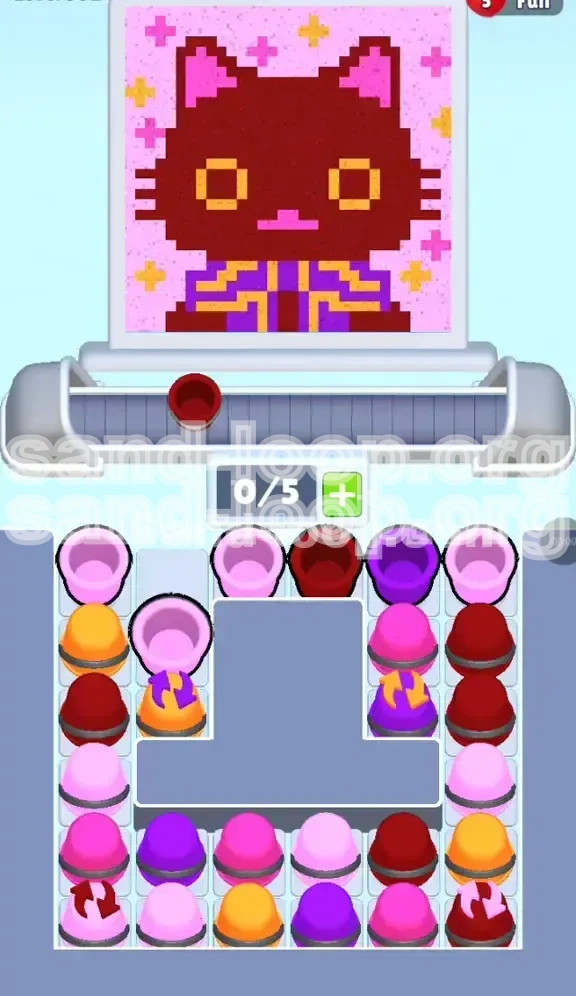
Welcome to Level 302, commonly known as the "Pixel Cat" stage. This level is a significant test of your slot management skills rather than your pouring speed. At first glance, the symmetrical layout of a Dark Red cat head against a Light Pink background seems inviting, but the stage is plagued by a severe restriction on open slots (often starting at 0/5 capacity depending on your progress) and a supply tray packed with interdependent stacks.
The defining feature of this level is the introduction of "Loop Cups" mechanic, specifically for the Purple color. If you manage your conveyor belt space poorly, you will face a deadlock that forces a restart. Unlike previous levels where you could simply tap rapidly, Level 302 requires you to pause, plan your sequence, and treat the game loop like a puzzle. The "Pixel Cat" aesthetic is deceptive; it requires precise separation of the Dark Red body, the Purple and Yellow collar, and the Light Pink background without any bleed-over.
The "Slot Economy" Crisis
In Level 302, the most critical resource is not your sand, but your empty tray slots. Because the cups are stacked densely, you cannot simply clear the board. You must adopt a "One-In, One-Out" mentality. The game will likely spawn a Loop Cup (Purple) that cycles back into your tray. If you have 5/5 slots full when that cup returns, the game jams. You must strictly ration your slots, keeping at least one slot open at all times to accommodate the returning Loop Cup.
Visual Breakdown of the Canvas
The canvas is divided into three distinct zones that require different handling. The largest zone is the Dark Red area, comprising the cat's head and ears. This accounts for approximately 60% of the total sand volume. The secondary zone is the Light Pink background, which fills the negative space around the cat. The tertiary zones are the details: the Purple and Yellow collar stripes and the Yellow eyes. Understanding this volume distribution is key; you cannot waste time on the eyes until the main body is established.
The Loop Cup Mechanic
This stage introduces a specific mechanic symbolized by a recycling icon on the cup. When you pour a Loop Cup, it does not vanish after emptying. Instead, it travels back to the start of the conveyor belt or a supply slot. This is beneficial for infinite sand, but dangerous for slot management. In Level 302, the Purple cup is a Loop Cup. You must treat it as a "permanent resident" of your tray. If you block its return path, you lose.
Color Distribution Analysis
- Dark Red (High Volume): The primary color. You will need a continuous stream of this to form the cat's head.
- Light Pink (Medium Volume): Used for the background and inner ears. It acts as the border for the red.
- Purple (Precision/Low Volume): Used for the collar. This is a Loop Cup color.
- Yellow (Precision/Low Volume): Used for eyes and collar trim. Small, targeted amounts are required.
Strategic Objectives: How to Beat Level 302
To conquer the Pixel Cat challenge, you need a clear set of goals before you even tap the first cup. Many players fail because they focus on "filling" the canvas rather than "managing" the supply. Your primary objective is to prevent the conveyor belt from jamming while systematically filling the cat's features.
Prevent Conveyor Jams
Your top priority is to ensure that a returning cup always has a place to land. Since the Purple cup is a Looper, you effectively have one fewer slot than the counter displays. If you have 5 slots, treat it as if you only have 4. Never let the counter hit maximum capacity if a Looper is active on the belt. If you see the belt moving but cups not despawning, stop immediately and wait for space to clear.
Establish Boundaries First
Do not try to finish one color completely before starting another. The stacks are mixed, forcing you to alternate. Your goal is to establish the "shape" of the cat. This means pouring enough Dark Red to define the head, but stopping before it overflows into the collar or eyes. You want to create a solid border of Red so that when you pour the Light Pink background, it doesn't bleed into the cat's body.
Isolate the "Danger Colors"
Yellow and Purple are dangerous because they are surrounded by large areas of Red and Pink. If you pour a Purple cup while the nozzle is drifting over a Red area, you create a permanent stain that is hard to fix. Your objective is to reserve these cups for moments when you have full control over the nozzle, usually when the larger areas are 90% full and the risk of spillover is lower.
Master the "Tap-Wait" Rhythm
Level 302 is not a speed run. The winning strategy is a "Tap-Wait" rhythm. Tap a cup, watch it pour, and wait for it to exit the tray before tapping the next. This discipline prevents the stack-up that causes the game over screen. You must resist the urge to tap ahead, even if the game feels slow. Patience is the metric that wins this level.
Clear the Top Layer
The supply tray is a "U" shape. The cups you need are buried under the top layer. You cannot access the essential Red or Yellow cups until you clear the initial Light Pink and Dark Red blockers sitting on top. Your first objective is purely mechanical: clear the top row to expose the ingredients you actually need for the details.
Step-by-Step Walkthrough: The Phase Strategy
This guide breaks Level 302 down into three distinct phases: The Clearing Phase, The Main Body Phase, and The Detail Phase. Follow this order to ensure a smooth victory.
Phase 1: The Clearing (The "U" Shape)
When the level starts, look at the supply tray. You will see a "U" formation of cups with a central blocker (often a unusable color or a stack). The top row is mostly Light Pink and Dark Red.
- Action: Tap the Light Pink cups located on the outer edges first. These will begin filling the background.
- Why: Removing these Pink cups lowers the stack height, revealing the Purple and Yellow cups buried underneath in the corners.
- Tip: Do not tap more than 3 cups at once. You need to keep the flow moving so the cups can recycle or disappear.
Phase 2: Establishing the Dark Red Base
Once the top layer of Pink is cleared, you will see a cluster of Dark Red cups. This is the heavy lifting phase.
- Action: Begin tapping Dark Red cups aggressively to fill the cat's head and ears.
- Target: Fill the Red zone to about 80% capacity. Do not aim for 100% yet, as the nozzle might drift.
- Watch Out: Avoid getting Red sand on the Yellow eye slots or the Purple collar area at the bottom. If you accidentally start filling the collar, stop pouring Red immediately.
Phase 3: The Collar and Loop Cup Management
This is the most dangerous part of the level. You will now uncover the Purple Loop Cup and the Yellow cups.
- Identify the Looper: Locate the Purple cup with the recycling arrow. This is your key tool for the collar.
- The Sequence: Tap the Purple cup. It will pour and then return to the tray. Crucial: Wait for it to return before tapping the next cup.
- Yellow Precision: While the Purple is recycling/returning, tap a Yellow cup for the eyes or collar trim. Do not have Purple and Yellow on the belt at the same time if possible, as their nozzles might cross streams.
Phase 4: The Final Flush
Once the cat is fully formed (Red body, Purple/Yellow details), you will likely have scattered patches of empty background remaining.
- Action: Use any remaining Light Pink cups to fill the void.
- Safety: Since the detailed areas (Cat, Collar) are full, overfilling the Pink background is much safer now. It won't bleed into the finished areas because they are already saturated.
Color Order and Sequencing Guide
The order in which you process colors is the single most deciding factor in beating Level 302. Because the "Pixel Cat" has specific layered colors, pouring out of order will result in contamination.
The "Body First" Rule
Always prioritize Dark Red first. The Red pixels form the largest contiguous block. If you fill the background (Pink) or the collar (Purple) before the Red body is established, you run the risk of the Red sand "drowning" the smaller details later. Red is the bully of this level; it needs the most space and the most time. Get it done early so you can focus on the delicate details afterward.
The Background "Sandwich" Method
Think of the Light Pink background as the bread of a sandwich. You pour a little bit at the start (Phase 1) to clear the stacks, and the rest at the end (Phase 4). Do not try to finish the background in one go. The stacks don't allow it. You are forced to switch to Red to clear the middle of the tray. Treat Pink as an intermittent task you do whenever the main Red path is blocked or cooling down.
The Detail Sequence: Purple then Yellow
When handling the collar and eyes, follow a strict hierarchy: Purple before Yellow. Purple is a Loop Cup, meaning it returns. This gives you infinite attempts to get the collar stripes right. Yellow is often a one-time-use cup (unless it's also a Looper, but usually Purple is the main one). Pour your Purple stripes, refine them, and once they are perfect, use the Yellow to fill the gaps. If you pour Yellow first, the Purple return might accidentally drift over it and ruin the bright yellow contrast.
Interpreting the Stack Order
The game forces your hand by stacking colors. If you see a Purple cup on top of a Red cup, you must deal with the Purple first. However, you don't always have to pour it immediately. You can temporarily move a cup to an open slot (if you have one) to access the cup beneath it. This is an advanced technique called "Stack Swapping." Use this only if you have 2+ open slots.
Key Tips, Mistakes, and Solutions
Even with a strategy, things can go wrong. Here is a breakdown of how to optimize your play and fix common issues.
Speed Run Tips
- Pre-loading: While a cup is pouring, look at the tray and identify the next cup you need. Have your finger hovering over it before the current pour finishes.
- The "Double Tap" Risk: Never double tap to speed up the Loop Cup return. The game engine needs a moment to register the empty slot. Rapid tapping causes logic errors.
- Focus on the Red: Spend 70% of your active attention on the Dark Red flow. If Red is moving, the level is moving. The other colors are just maintenance.
Common Mistakes to Avoid
- The "Full Tray" Error: This is the #1 cause of failure. Players tap 5 cups because they are eager, then the 6th cup (the Loop Cup) tries to return and crashes the game. Solution: Always keep 1 slot empty. Always.
- Yellow Bleeding: Pouring Yellow too early into the eyes. If the surrounding Red isn't high enough, the Yellow will spread out into a shapeless blob. Solution: Build up the Red "walls" of the face first to contain the Yellow.
- Ignoring the Loop Icon: Treating the Purple cup like a normal cup and being surprised when it comes back. Solution: Audit every cup you tap. If it has the arrow, assume it stays in your inventory forever.
Stuck Solutions: How to Unjam Your Board
What if you are mid-game, the board is a mess, and you are stuck?
- Problem: No cups can pour because the wrong color is in the nozzle position. Solution: Look for a "Garbage" spot or a background area that is already the correct color. Pour the excess sand there to clear the cup, even if it doesn't progress the image. Clearing the cup is better than being stuck.
- Problem: You have 5/5 slots and no Loop Cups are active to clear space. Solution: You must wait. Let a cup pour completely. Do not tap anything. The game requires a cycle to reset. If you are truly hard stuck, you may need to restart the level, as 302 punishes slot mismanagement heavily.
Final Advice
Level 302 is a test of patience. The "Pixel Cat" is not going anywhere. If you slow down, manage your slots, and respect the Loop Cup, the victory will come naturally. Focus on the "Red Flow," and the rest of the colors will fall into place.