
Level 387
HARDHow to solve Sand Loop level 387? Get instant solution for Sand Loop 387 with our step by step solution & video walkthrough. Sand Loop 387 tips and guide.
Play Sand Loop Now
Experience the puzzle challenge firsthand
Game Screenshots
Sand Loop Level Guides
Level Overview: The Autumn Acorn Challenge
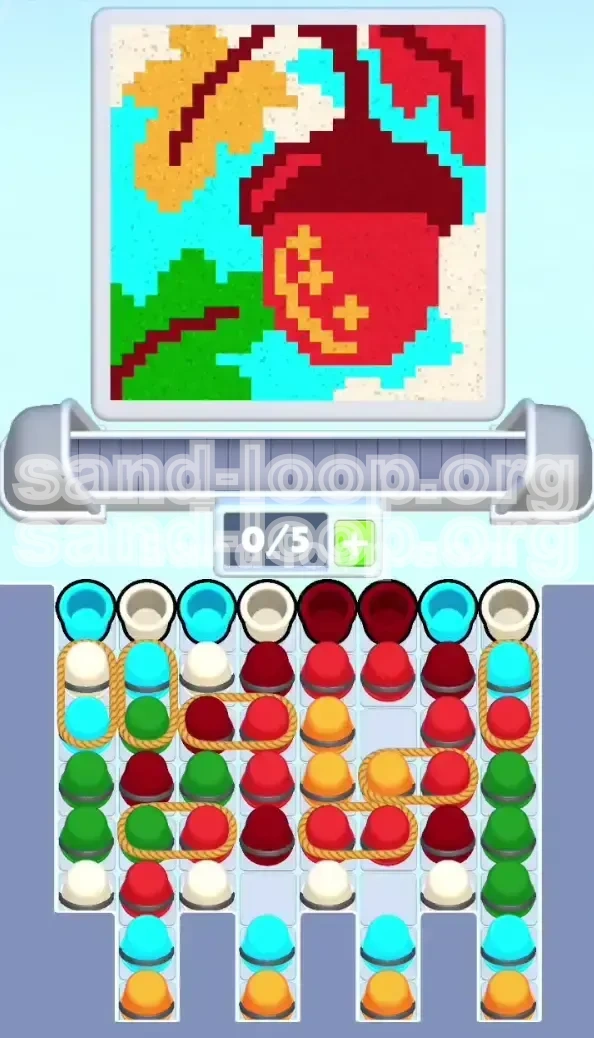
Welcome to Level 387, a stage defined by its vibrant autumn aesthetic and punishing logistical puzzles. This level features a crisp pixel art design of a large red acorn hanging from a branch, flanked by seasonal foliage. While the visual appeal suggests a relaxing time, the gameplay mechanics here are strictly tactical. You are not fighting against a fast timer; you are fighting against a restrictive 5-slot conveyor belt capacity and a complex network of Rope Constraints that link your supply cups together. Success in this level depends less on reflexes and more on your ability to plan moves ahead to avoid jamming your supply line.
The 5-Slot Capacity Limit
The most critical mechanic in Level 387 is the severe restriction on your conveyor belt. You only have five available slots to hold cups waiting to be poured. In many levels, you can afford to let cups pile up, but here, exceeding this limit or filling it with the wrong colors will bring your progress to a halt. The limit forces you to process colors in a very specific rhythm to prevent a deadlock where you cannot summon the necessary cup because the belt is full of unusable paint.
Rope Constraint Mechanics
Approximately 70% of the cups in the central supply columns are tethered together by "Rope Bonds." These are physical links where taking one cup immediately drags its partner onto the belt as well. This creates a "dependency hell" where attempting to fetch a specific color—like Bright Red—might accidentally force a Gold cup onto the belt that you aren't ready to use. Managing these pairs is the core logistical challenge of the level.
Visual Breakdown: The Acorn Canvas
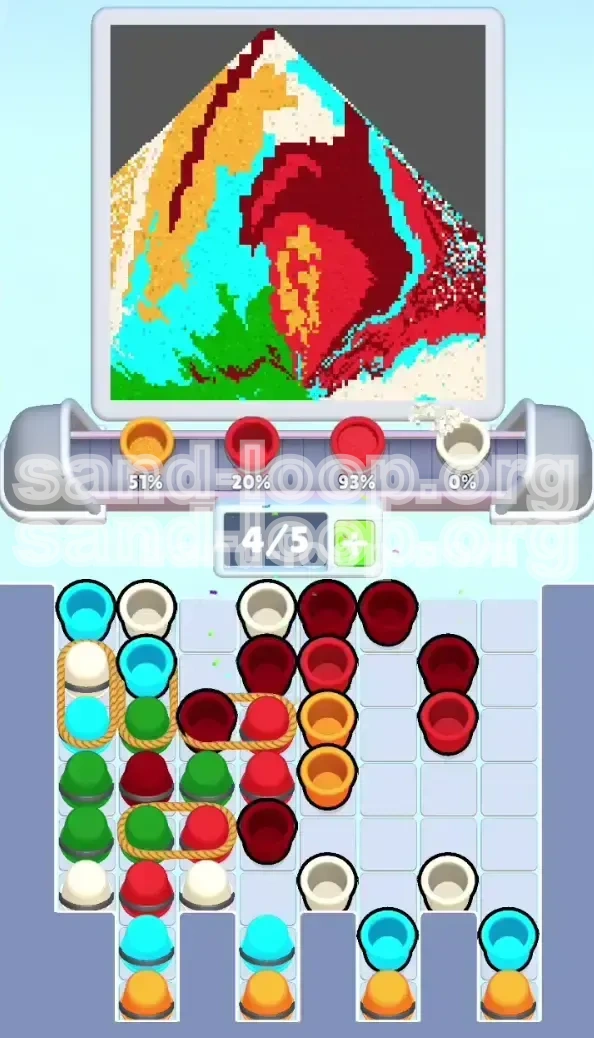
The target image is deceptively complex. It features a large acorn as the focal point, requiring a mix of Bright Red for the body and Dark Burgundy for the cap. The leaves on the side introduce Mustard Gold and Green, while the background requires a mix of Cyan and White. The challenge is that the Acorn Body uses a mix of Red and Gold pixel-by-pixel. If you pour the main colors too aggressively without setting up the details, you will trap pixels and fail the level.
Core Difficulty: The Center Tangle
The difficulty in this stage is concentrated in the center columns. The Red and Gold cups required for the acorn are tied together in the middle of the tray. Because these colors are needed early and often, the center tends to get clogged with "double pulls" (taking two cups at once). If you pull a roped pair when you have 4 slots filled, you will jam the machine. The game demands that you keep the belt clear to handle these double payloads.
The "Stem Trap" Risk
One of the most common failure points involves the thin stem lines and leaf veins. These require Dark Burgundy paint. If the nozzle is hovering over the large Red Acorn body when you send a Burgundy cup, the game may dump the dark paint into the red area, effectively ruining the color purity of the acorn. You must time your Burgundy pours to coincide only when the nozzle is positioned over the stem and leaf areas.
Clear Objectives for Completion
To beat Level 387, you cannot simply tap cups randomly. You need a structured approach that prioritizes specific sections of the canvas to keep the flow moving. Your primary goal is to clear the "Roped" cups in the center without clogging your belt, while simultaneously managing the background colors to keep the rhythm steady.
Primary Objective: Unclog the Center
Your first major goal is to clear the tethered cups in the middle columns (Red and Gold). These colors are essential for the acorn and the top leaf, but they are physically tied together. You must create enough empty slots on your conveyor belt to accommodate these "double drops" safely. Failing to clear the center quickly will lead to a deadlock where you cannot access the colors needed for the bottom half of the image.
Secondary Objective: Preserve Burgundy for Details
Do not use the Dark Burgundy cups for filling large empty spaces. You must treat Burgundy as a "precision resource." Your objective is to save this specific color solely for the acorn cap, the stem, and the leaf veins. If you waste Burgundy on the background or main body, you will likely run out when the nozzle demands the fine details, forcing a restart.
Tertiary Objective: Manage Background Cyan
The Cyan (Blue) cups act as both a background color and a blocker. In the left columns, Cyan cups sit on top of the Green cups needed for the bottom leaf. You must systematically clear the Cyan cups to "dig" down to the Green layer. However, you should only pour Cyan when the nozzle is actually over the sky background, not when it is hovering over the leaves.
Final Objective: The Sky Fill
Once the acorn and leaves are fully rendered, the remaining space is the background. This consists of Cyan and White/Cream. The final phase is a "cleanup run" where you must empty the remaining cups from the tray. The challenge here is ensuring that no pixels of the main acorn or leaves were missed during the earlier phases. Any missed pixels will prevent the level from completing, even if the background looks full.
Step-by-Step Instructions
Follow this specific sequence of actions to navigate the supply tray and fill the canvas efficiently. This walkthrough prioritizes keeping the conveyor belt moving to prevent jams.
Phase 1: The Top Cap Strategy
Start the level by identifying the Dark Burgundy cups at the top of the central columns. The game logic will almost always target the acorn cap and the stem lines first.
- Action: Locate the Dark Burgundy cups in the central column.
- Check: Ensure you have at least 2 empty slots on your belt.
- Tap: Tap the Burgundy cups. If they are roped to another color (like Red), both will arrive.
- Pour: Allow the game to fill the acorn cap and stem veins.
Phase 2: The Red-Gold Protocol
Once the cap is started, the nozzle will likely move to the main body of the acorn (Bright Red) or the details (Gold). These cups are frequently roped together in the tray.
- Assess: Look at your belt. If you have 3 or more cups, wait. Do not tap the center yet.
- Pull: When you have 2 or fewer cups, tap the Red-Gold pair in the center.
- Process: The game will pour the Red for the acorn body and Gold for the leaf details or acorn "face" pattern.
- Warning: Watch the nozzle. If it starts filling Gold crosses inside the Red acorn, let it finish. Do not interrupt.
Phase 3: Digging for Green
The lower left leaf requires Green paint, but these cups are buried under Cyan cups in the tray.
- Locate: Find the Green cups in the lower left or center-left columns.
- Clear: You will likely need to tap and discard or pour Cyan cups that are blocking the Green.
- Tapping: Only tap the Green cups when the nozzle is hovering over the green leaf area.
- Timing: If the nozzle is on the acorn, use a "Wait Cycle" (tapping a safe color like White on the edges) to pass the time until the nozzle moves to the leaf.
Phase 4: The Background Unblocking
With the main features filled, the nozzle will start scanning the background for Cyan and White.
- Cyan First: Prioritize Cyan cups. They fill the sky and often block access to remaining trapped cups in the tray.
- Edge Management: Use the White/Cream cups on the far edges (Columns 1 and 8) to fill time. These are usually safe to tap and pour without affecting the main image.
- Clean Up: As the background fills, check for any "holes" in the acorn or leaves. If the nozzle gets stuck on a background pixel but you have a Red cup on the belt, you may need to strategically pour Red to "move" the nozzle off the background spot.
Color Order and Processing
Understanding the priority of colors is crucial for anticipating the game's next move. The nozzle does not move randomly; it follows a logic based on pixel connectivity and color availability.
Priority 1: Dark Burgundy (The Outline)
Burgundy is always the highest priority at the start because it defines the edges and stems. The game attempts to "lock in" the boundaries of the shapes before filling them. You should expect to process 40-50% of your Burgundy supply in the first 20% of the level. Do not hoard it; if it's on the belt and the nozzle is near the stem, pour it.
Priority 2: Bright Red (The Mass)
Once the outlines are established, the bulk of the work is filling the acorn body with Bright Red. This is your "bread and butter" color. However, be aware that Red is frequently tied to Gold via ropes. When you process Red, you are implicitly committing to processing Gold immediately after. Ensure you have space for both.
Priority 3: Mustard Gold (The Details)
Gold serves a dual purpose: filling the left leaf and creating the "cross" patterns on the acorn. Because the Gold patterns on the acorn are isolated pixels, they can be tricky. The game will often toggle between Red and Gold rapidly during the mid-game. Do not try to force Red if the game is demanding Gold for a specific pixel; you will waste time and clog the belt.
Priority 4: Green (The Secondary Feature)
Green is processed primarily in the mid-to-late game. It is usually physically blocked by Cyan in the supply tray, meaning you naturally process it later. The nozzle won't aggressively seek the Green leaf until the Red Acorn is mostly finished. Use this to your advantage; don't stress about digging for Green until the Red section is calming down.
Priority 5: Cyan and White (The Fillers)
These colors are the "mop-up crew." They fill the remaining negative space. They have the lowest processing priority unless they are the only color available on the belt. You can safely let these cups sit on the belt until the very end, provided they aren't blocking you from pulling new cups from the tray.
Key Tips and Common Mistakes
Mastering Level 387 requires avoiding specific pitfalls that players frequently encounter. These tips focus on maintaining flow and preventing game-ending errors.
The "Double Tap" Mistake
The most common error is tapping a roped cup without checking the slot count. If you have 4 cups on the belt and you tap a roped pair (2 cups), the game will attempt to load a 6th cup. This causes a jam or forces an incorrect pour. Tip: Always count your slots. If you have 3 or 4 cups full, focus on pouring and emptying the belt before you tap anything in the roped center columns.
Misjudging the Nozzle Path
Players often try to force a color when the nozzle is moving away from the target area. For example, forcing Burgundy when the nozzle is over the White background. Tip: If the nozzle is moving away from your desired target, tap a "Filler" color (like White or Cyan) on the far edges of the tray. This buys time for the nozzle to swing back around to the area where you actually need to pour the complex colors.
Ignoring the Rope Chains
Sometimes players ignore the rope visuals and treat every cup as an individual. This leads to accidental summons. Tip: Visually trace the rope before you tap. If you see a rope connecting a Red cup to a Gold cup, and you only need Red right now, you must be prepared to handle Gold immediately. If you can't handle Gold, don't tap Red yet.
Wasting Precious Sand
In the late game, you might be tempted to pour leftover Burgundy into the background just to get rid of it. Tip: Don't do this. If you pour Dark Burgundy into a White or Cyan background, it creates a permanent stain that is very hard to fix. It is better to let the cup sit on the belt and wait for a "No Match" cycle (where the game skips it) than to ruin the background purity. Wait for the nozzle to pass over a stem or vein line to dispose of the last drops naturally.
Stuck Solutions and Speed Run Tips
If you find yourself stuck with a full belt and no moves, or if you are aiming for a three-star speed run, these advanced strategies will help you optimize your gameplay.
Solution: The Belt Jam
If your 5 slots are full and the nozzle won't accept any of the colors you have (e.g., you have Red, but the nozzle wants Cyan), you are in a "Soft Lock." Fix: Look at the very top or bottom of the screen (Columns 1, 2, 7, 8). Are there any loose, unroped cups there? Tap one even if you don't need it. This forces the game to cycle the belt. Sometimes, bringing a new cup onto the belt (and bumping an old one off or triggering a merge) can reset the nozzle's target priority.
Solution: The "Dig Down" Technique
When you need a specific color (like Green) that is buried under three layers of other colors in the tray, you can't wait forever. Technique: Rapidly tap the top blocking cups (e.g., Cyan and White). Pour them immediately, even if it means slightly overfilling the background. This aggressively clears the tray columns, revealing the trapped Green cups much faster than waiting for natural rotation.
Speed Run Tip: The Center Focus
For a fast time, ignore the background entirely for the first 50% of the level. Strategy: Pour exclusively from the center columns (Red, Gold, Burgundy). Only tap the edge columns (Cyan, White) when you absolutely need to burn a turn or clear a jam. By focusing your taps on the center, you maximize the efficiency of the rope pairs, pulling two necessary cups at once rather than wasting taps on single background cups.
Speed Run Tip: Nozzle Prediction
Learn the nozzle's pattern. It typically moves in a zig-zag or spiral motion. Tip: If the nozzle just finished the top left leaf, it is statistically most likely to move to the top right or the center next. Pre-load your belt with the color for that *next* area before the nozzle even gets there. For example, as the nozzle finishes the Green leaf, start tapping Red cups so they are ready on the belt when the nozzle swings back to the Acorn.