
Level 397
HARDHow to solve Sand Loop level 397? Get instant solution for Sand Loop 397 with our step by step solution & video walkthrough. Sand Loop 397 tips and guide.
Play Sand Loop Now
Experience the puzzle challenge firsthand
Game Screenshots
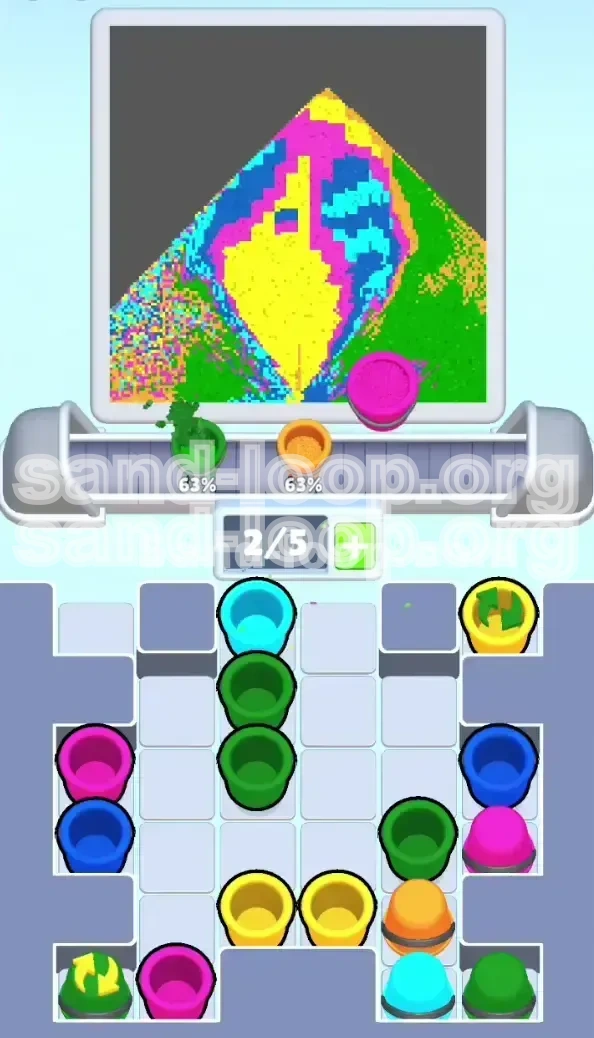
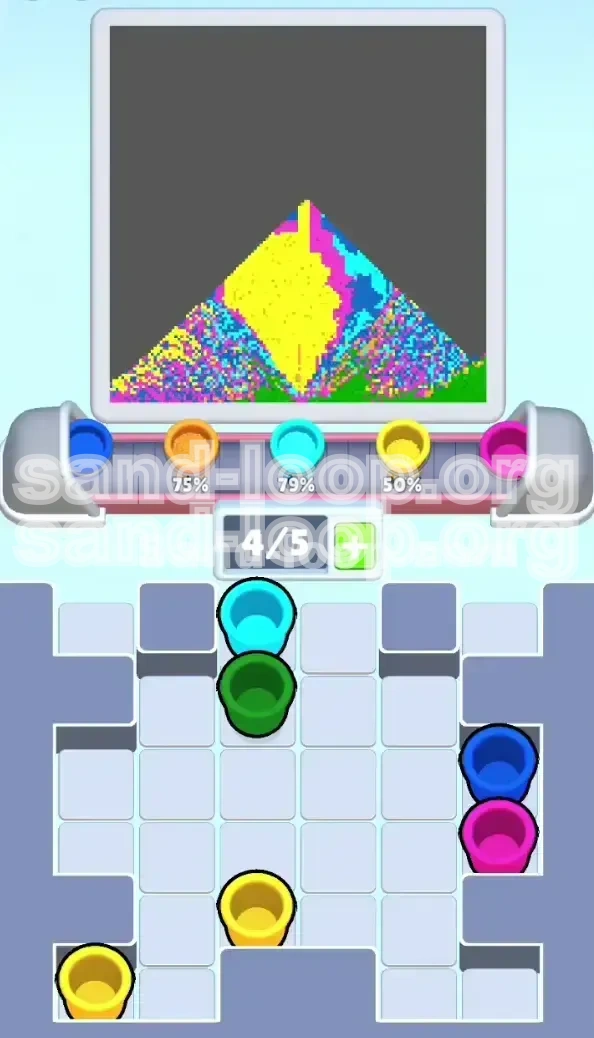
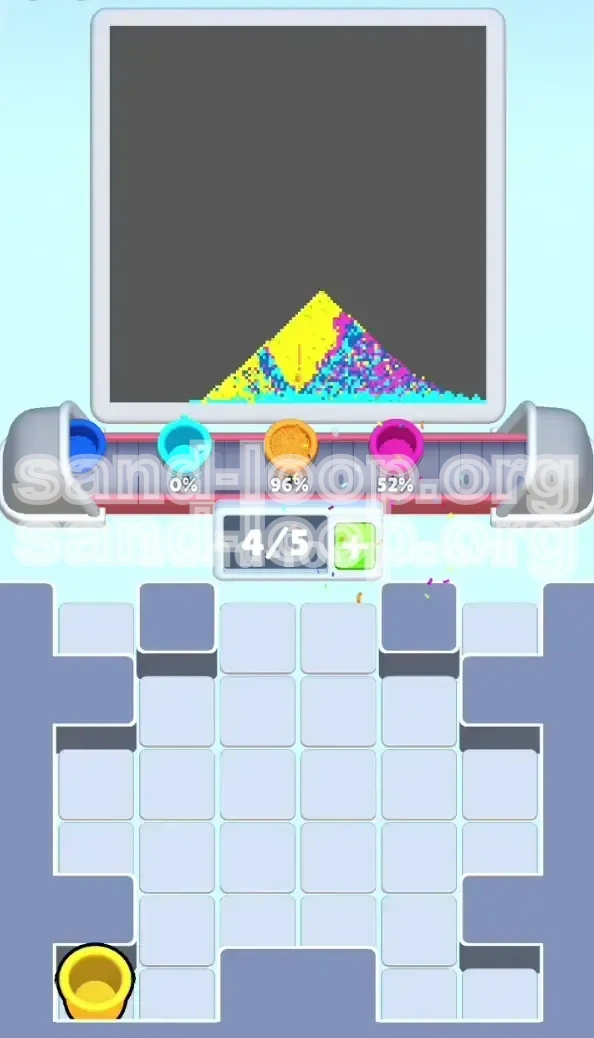
Sand Loop Level Guides
Level Overview: The Neon Glitch Pyramid Challenge
Sand Loop Level 397 introduces a significant difficulty spike by combining a complex geometric shape with a restrictive capacity limit. Unlike previous levels where you could rely on rapid tapping and intuition, this stage—known as the "Neon Glitch Pyramid"—demands strict resource management and spatial awareness. The visual design is a retro-style, pixelated triangle composed of high-contrast neon colors that bleed into one another if layered incorrectly.
The primary constraint here is the 5-Slot Capacity limit on your Conveyor Belt. The Supply Tray is designed to bottleneck your progress, specifically with a vertical stack of Green cups blocking access to essential Yellow sand. If you indiscriminately fill your belt, you will face a "No Moves" deadlock before the pyramid is even 40% complete. Speed is secondary to rhythm; this guide focuses on maintaining a flow that clears blockages while systematically filling the pyramid from the core outward.
Visual Breakdown of the Pyramid
Understanding the target image is crucial for prioritizing your color selection. The pyramid is not a solid block; it is a layered geometric arrangement:
- The Core (Center): A large, diamond-shaped Yellow zone that anchors the image. This represents approximately 40% of the total fill area.
- The Wings (Upper Mid): Jagged extensions of Magenta and Cyan that frame the Yellow core. These require precision to avoid bleeding into the center.
- The Shadow (Right): A thin strip of Dark Blue running along the right edge, adding depth but representing a small volume (less than 5% of total sand).
- The Base (Bottom): A chaotic, checkered pattern of Green and Orange that serves as the foundation.
The Capacity Bottleneck
The most dangerous mechanic in Level 397 is the "Stack Lock." In the Supply Tray, three Green Cups are stacked vertically in the center column. Directly beneath them are two critical Yellow Cups. You cannot access the Yellow cups until the Green stack is cleared. However, the Green areas of the pyramid are small and located at the bottom. If you move all three Green cups to the belt at once, you will occupy 60% of your capacity with sand you cannot use immediately, causing a deadlock.
Belt Lag and Dispenser Timing
The distance between the Supply Tray and the Sand Dispensers is longer than in previous stages. This creates a "Conveyor Lag" of roughly 1.5 seconds. Players often fail by tapping the next cup before the previous one has cleared the dispenser nozzle. This lag must be calculated into your rhythm; otherwise, you will mistakenly think you have an open slot and jam the belt with a 6th item.
Percentage Completion Tracking
The game tracks completion percentage per color. A common mistake is filling small details (like the Dark Blue shading) to 100% while the main Yellow core is still empty. This leaves you with a tray full of low-priority colors and no way to finish the level. The winning strategy requires ignoring the small details until the main mass of the pyramid (Yellow and Magenta) is at least 80% full.
Strategic Objectives and Prioritization
Before you tap a single cup, you need a mental roadmap. Completing the Neon Glitch Pyramid is an exercise in triage. You must prioritize colors based on the surface area they cover and their location in the Supply Tray.
Objective 1: Unlock the Yellow Core
Your immediate priority is not to fill the pyramid, but to unlock the supply line. The Yellow sand is the most critical resource, accounting for nearly half the image. Since the Yellow cups are trapped behind the Green stack, your primary objective is to clear the Green cups from the tray without clogging your belt. You cannot start painting in earnest until the Yellow stream is flowing.
Objective 2: Stabilize the Center Mass
Once the Yellow cups are accessible, your goal is to fill the central diamond. Completing the center first creates a visual anchor. If you leave the center empty and work on the edges (Cyan/Magenta), you risk "contaminating" the empty center zones with edge colors, making it harder to see where the Yellow needs to go. Aim to get the Yellow percentage to 100% before you touch the bottom corners.
Objective 3: Manage the Checkered Base
The Green and Orange base is designed to break your combo. These colors occupy the bottom corners and are arranged in a checkered pattern. If you pour two Green cups in succession, you will overfill the Green zones and block the Orange zones. You must alternate these colors or use the Recycle Cup to dump excess if the wrong cup arrives.
Objective 4: Precision Detailing
Dark Blue and small Magenta accents should be treated as "cleanup" steps. These colors are needed in tiny amounts (often just single pixel lines). If you process these early, they take up valuable belt space that could be used for bulk filling. Leave these details for the very end when you have fewer cups on the belt and can afford to wait for the precise pour.
Step-by-Step Walkthrough: The "Stack Break" Method
This walkthrough follows the most reliable path to clear the Supply Tray blockage and fill the pyramid efficiently. Follow these steps in order to avoid the "No Moves" deadlock.
Phase 1: The Initial Clear (Moves 1-3)
The game starts with a specific tray layout. Do not touch the center Green stack yet. If you do, you will fill your belt instantly.
- Tap the Cyan Cup (Top Center): This is your safe move. It is not blocking anything critical. Move it to the belt.
- Tap the Magenta Cup (Top Left): Immediately follow the Cyan with the Magenta cup located on the left side. This ensures you have two colors flowing.
- Wait and Observe: Do not tap anything else. Watch the belt. You should have 2/5 slots filled. This gives you the buffer you need to start the dangerous shuffling process.
Phase 2: The Green Stack Shuffle
This is the most critical phase. You must clear the three Green Cups blocking the Yellow Cups at the bottom of the tray.
- Tap the Top Green Cup: Move the first Green cup from the stack to the belt. You now have 3/5 slots filled.
- Deploy the Recycle Cup: Look at the top right of the tray. There is a Recycle Cup (marked with yellow arrows). Tap it now. Do not wait. The Recycle cup acts as a placeholder that moves to the belt but cycles back, effectively clearing the tray slot without adding permanent sand to the belt.
- Buffer the Pour: As the Green cup pours, do not tap the second Green cup immediately. Wait until the Green cup is roughly 50% poured. This manages the belt traffic.
- Repeat the Cycle: Once the Recycle cup has done its job or moved, tap the second Green cup. Repeat the buffer wait. Then the third. By the end of this sequence, the Green stack is gone, and the Yellow Cups are revealed.
Phase 3: The Yellow Flood
With the Green stack removed, you have access to the two Yellow Cups at the bottom of the center column.
- Claim the Yellow Cups: Tap both Yellow cups immediately. They are the key to the level.
- Focus on the Center: As the Yellow sand pours, focus your pouring exclusively on the central diamond. Ignore the wings. Ignore the base. Fill the center until it is solid yellow.
- Manage Magenta: While Yellow is pouring, you will likely have a Magenta cup on the belt from Phase 1. Pour this into the upper "wings" of the pyramid.
Phase 4: Clearing the Backlog
At this point, your belt should have a mix of colors, and the tray is revealing the bottom row.
- Check the Right Side: You likely have Dark Blue and Cyan cups available. Move them to the belt to clear the tray.
- Use the Yellow Recycle Cup: If you find yourself with a belt full of unwanted colors (e.g., you need Orange but have a Dark Blue cup stuck), look for the Yellow Recycle Cup in the bottom left of the tray. Use it to clear a slot.
- Final Polish: Once the center and wings are full, shift your attention to the bottom corners. Alternate Green and Orange to finish the checkered base.
Color Processing Order and Logic
Knowing what to do is different from knowing when to do it. The order in which you process colors dictates your success rate. This section details the ideal processing hierarchy.
Priority Tier 1: Yellow (The Core)
Status: Critical
Volume: High
Action: Yellow is your "Tier 1" priority. It has the largest surface area and is located in the geometric center of the pyramid. Because it is trapped behind the Green stack, it is the most time-sensitive resource. If you run out of Yellow sand while the center is only 50% full, you will be forced to recycle other cups to get back to it, wasting precious time.
Priority Tier 2: Magenta (The Frame)
Status: High
Volume: Medium
Action: Magenta acts as the frame for the Yellow core. It should be processed immediately after or alongside Yellow. The reason for this high priority is positioning. Magenta zones surround the Yellow. If you fill the bottom (Green/Orange) first, you create a "border" that makes it harder to aim the Magenta correctly without overshooting. Always frame the center before filling the floor.
Priority Tier 3: Cyan (The Accent)
Status: Medium
Volume: Low/Medium
Action: Cyan is generally used for the right-side accents and upper-left details. It is less critical than Magenta but more important than the base colors. It serves as a bridge between the core and the background. Process Cyan when you have a lull in Yellow/Magenta pouring, but avoid letting Cyan cups sit on the belt if they are blocking a Yellow cup.
Priority Tier 4: Green and Orange (The Base)
Status: Low
Volume: Low
Action: These are your "Tier 4" colors. They are located at the very bottom of the pyramid. The reason they are low priority is risk. The checkered pattern at the bottom requires you to stop pouring frequently to switch colors. If you start with Green and Orange, you will spend 50% of your time micro-managing tiny corners while your main belt slots are clogged. Leave the floor for last.
Priority Tier 5: Dark Blue (The Detail)
Status: Filler
Volume: Very Low
Action: Dark Blue is essentially a filler color used for thin shading lines. It requires very little sand. Do not process a Dark Blue cup until you have absolutely nothing else to do, or if you need to clear the tray slot and have capacity to spare. It is the perfect color to pour while waiting for a high-priority color to cycle through the dispenser.
Advanced Tactics and Common Pitfalls
To master Level 397, you must move beyond the basic steps and understand the flow of the game. This section covers the finer points of execution that separate a clear from a restart.
The "4/5ths" Safety Rule
Never let your belt capacity reach 5/5. In fact, try to keep it at 3/5 or 4/5 at maximum. If you have 4 cups on the belt and the 5th is currently pouring, stop tapping. Wait for the first cup to finish and clear the belt before tapping the next cup from the tray. The "No Moves" screen triggers when the belt is full and the dispensers are blocked by a cup that cannot pour. Keeping one slot open acts as a pressure valve for the system.
Common Mistake: The Early Base Fill
A very common failure pattern is filling the Green and Orange base corners first. Players do this because they see the cups available in the tray. However, this is a trap. Once the base is filled, the "fluid" nature of the sand simulation makes it harder to fill the upper sections without the sand rolling down and obscuring the bottom lines. Always work Top-to-Bottom (Center -> Wings -> Base) to ensure clean lines.
What to Do When Stuck
If you find yourself with a full belt of "useless" colors (e.g., you have Dark Blue and Green, but you need Yellow):
- Stop Tapping: Do not add more chaos.
- Identify the Blocker: Which cup on the belt is preventing you from getting what you need?
- Check the Recycle Cup: Is the Recycle Cup available in the tray? If yes, tap it. It will travel up the belt and "eat" the blocker, or at least cycle it out, giving you a fresh chance to pull the correct color.
- Strategic Pouring: If you must pour a "useless" color, pour it into a corner of the pyramid that is already correct. It won't help completion, but it gets the cup off the belt.
Speed Run Tips
For players looking to optimize their time:
- Pre-loading: While the Cyan cup is pouring in Phase 1, you can already have your finger hovering over the Magenta cup. Reduce the delay between taps to the bare minimum (about 0.5 seconds) to keep the belt constantly moving.
- Bulk Pouring: When filling the Yellow center, don't let go of the screen. Keep the dispenser flowing until the cup is 100% empty. Only stop if you risk overfilling the specific zone.
- Ignore Perfection: You don't need 100% pixel-perfect coverage for the "Stage Complete" trigger. The game is forgiving. If the Yellow zone is 95% full, move on. Spending 30 seconds hunting for that last 5% is slower than clearing the board and letting the auto-complete handle the rest.