
Level 399
HARDHow to solve Sand Loop level 399? Get instant solution for Sand Loop 399 with our step by step solution & video walkthrough. Sand Loop 399 tips and guide.
Play Sand Loop Now
Experience the puzzle challenge firsthand
Game Screenshots
Sand Loop Level Guides
Level Overview: The Rubber Duck Logic Puzzle
Level 399 of Sand Loop, often referred to as "The Rubber Duck Challenge," represents a significant spike in logical difficulty compared to previous stages. You are no longer just matching colors; you are managing a complex logistical pipeline.
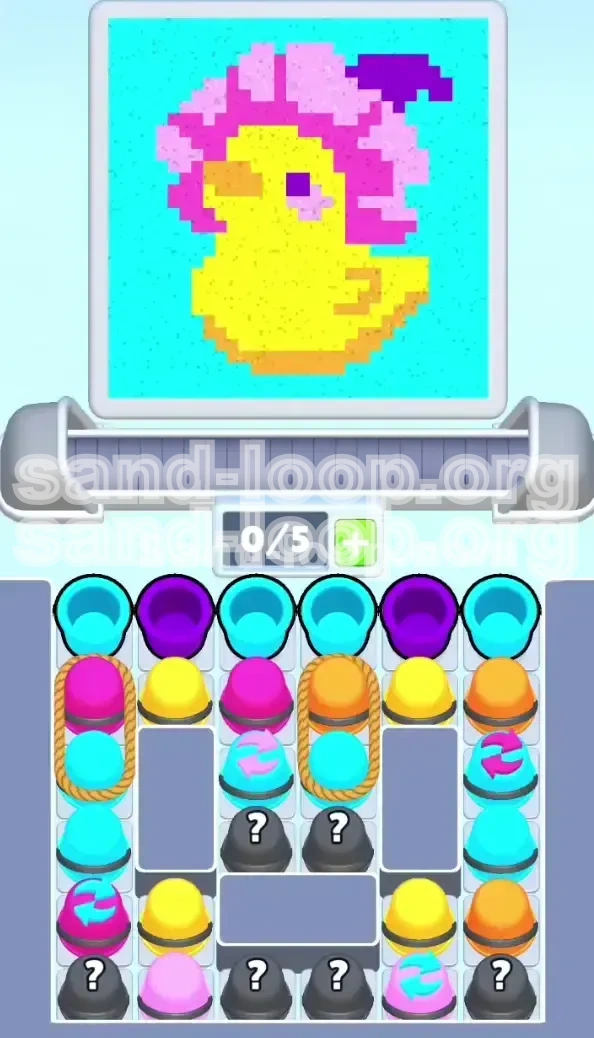
This level features a pixel-art depiction of a yellow rubber duck wearing a frilly pink shower cap, set against a deep cyan background. The grid is tight, and the margin for error is virtually non-existent. The primary difficulty arises from the strict 5-slot conveyor queue limit. In this level, queue management (Slot Economy) is actually more important than color matching. If you accidentally clog your conveyor with the wrong colors early on, you will create a deadlock that forces an immediate restart.
The Visual Layout Analysis
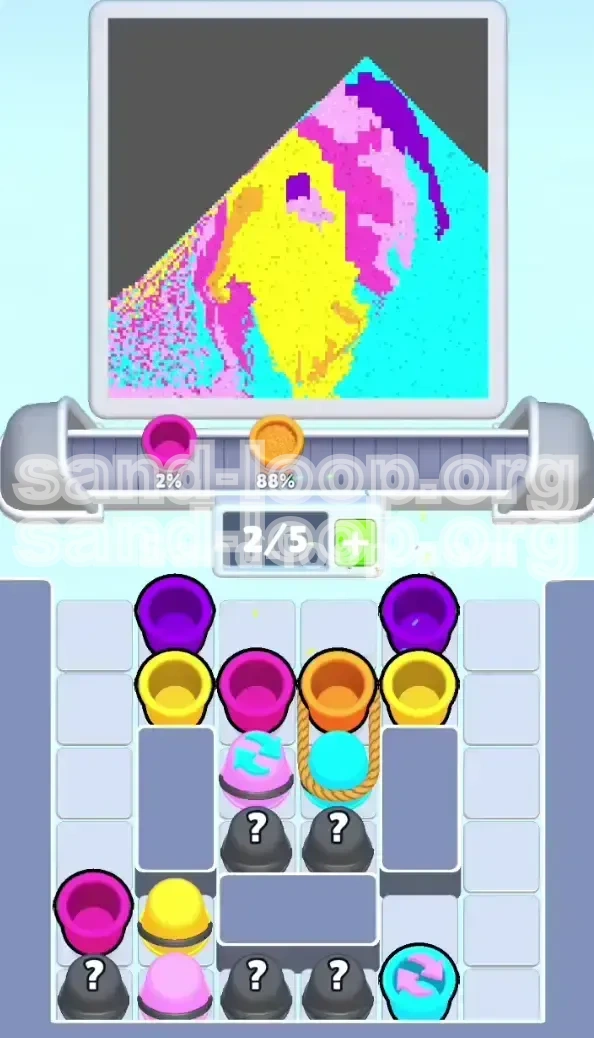
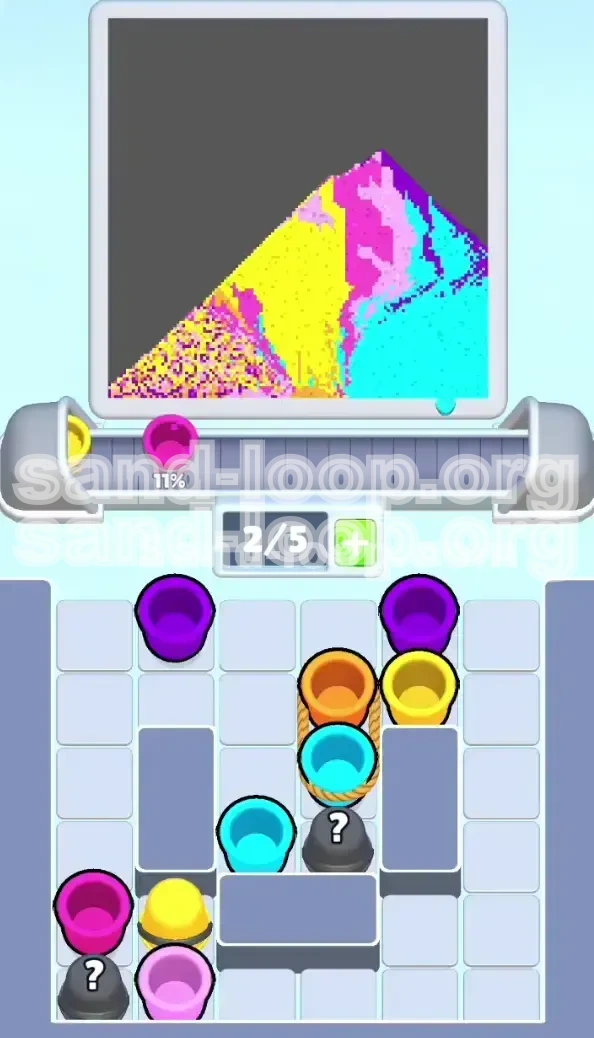
The grid is divided into two distinct horizontal zones. The top zone is where the rubber duck art is formed, heavily reliant on Yellow, Magenta, and Light Pink. The bottom zone is a chaotic mix of supply cups, roped pairs, and mystery blocks. Understanding the vertical connection between these two zones is critical. You cannot simply tap cups at random; you must clear vertical shafts to allow specific colors to flow upward toward the canvas placement zones.
Slot Economy Priority
In most puzzle games, you can get away with holding one or two items. In Level 399, holding two slots can be fatal. You need to keep at least 3 slots open at all times to handle the "Cascading Effect" of the bottom rows. When a Mystery Cup reveals itself, it often triggers a chain reaction. If your belt is full, that chain reaction gets blocked, stopping your production and ruining your combo multiplier.
The Roping Mechanic
This level introduces "Roped Dependencies." Approximately 40% of the bottom grid is composed of cups tied together vertically. A Magenta cup might be tied to a Cyan cup. The rule is strict: you cannot access the bottom cup (Cyan) until the top cup (Magenta) is processed. This means you are often forced to accept a color you don't necessarily need immediately (Magenta) just to unlock the color you do need (Cyan). This forced intake is the number one cause of failed runs.
Color Distribution Statistics
Understanding the volume of colors helps in planning. The level consists of roughly:
- 45% Cyan: The background filler. It is everywhere, but often obstructed.
- 30% Yellow: The duck body. This is your primary focus early on.
- 15% Magenta/Light Pink: The shower cap details. High value, low volume.
- 10% Purple/Orange: Rare accents. The "run killers" if mishandled.
Clear Objectives: What You Must Achieve
To secure the win in Level 399, you must move beyond simple tapping and execute a specific strategy. Your goal is not just to clear the board, but to clear the board while maintaining a high combo score and avoiding queue stalls.
Objective 1: The Yellow Foundation
Your first major milestone is establishing the Yellow body of the duck. This involves clearing roughly 30-40 Yellow cups from the middle and lower sections of the board. You must prioritize freeing these cups over clearing Cyan background elements. If you focus on Cyan first, you will clog your conveyor with background paint before you have finished the main subject, leading to a loss.
Objective 2: Managing the Roped Bottleneck
You must clear the "Roped Columns" located in the bottom-left and bottom-right quadrants. These columns act as gates. You cannot effectively clear the bottom 20% of the board until you cut the ropes on the top cups of these columns. Objective 2 is to clear these ropes without filling your queue with the resulting bottom cups.
Objective 3: Precise Accent Placement
The difference between a 2-star and a 3-star rating lies in the Purple and Orange accents. You must reserve exactly 1 slot in your queue for the moment the Purple eye and Orange beak are ready to be painted. Missing this window often results in these colors getting buried under Cyan cups, requiring you to waste moves digging them out later.
Objective 4: The Cyan Flood
The final 20% of the level is a "Cyan Flood." Once the duck is complete, the board state changes, and the remaining 50+ cups turn into clearable Cyan. Your objective here is speed. You must have an empty queue ready to accept this massive influx of background color to finish the level within the time limit.
Step-by-Step Instructions: The Execution Guide
Follow this sequence exactly. Deviating from the early steps is the most common reason players get stuck.
Phase 1: The Opening Break (Moves 1-15)
The start of the level is deceptive. The board looks open, but looks are deceiving.
- Step 1: Ignore the background Cyan cups at the top edge. Do not tap them.
- Step 2: Locate the "Magenta Anchor." This is the roped Magenta cup in the middle-left. Tap it immediately. This sends Magenta to the belt but frees up a vertical column.
- Step 3: Look for the "Yellow Clusters" in rows 3 and 4. Tap these to load your belt with Yellow. You need 3 Yellow cups on the belt immediately to start painting the body.
- Step 4: Do not tap the Purple cup yet. I repeat, do not tap Purple. It is a trap early on. It will sit in your belt blocking a slot that you need for Yellow.
- Step 5: Identify the "Orange Anchor" on the right side. Leave it alone. Tapping it now releases a Cyan cup that you don't need yet.
Phase 2: Breaking the Middle Grid (Moves 16-35)
Once the initial Yellow cups are loaded, the board will settle. Now you must expand your workspace.
- Step 6: Clear the "Mystery Row." This is usually the 5th row from the top. Tap the cups sitting directly ON TOP of the mystery cups. Do not tap the mystery cups themselves yet. This reveals their color.
- Step 7: Assess the reveals. If the mystery cups revealed as Yellow or Magenta, tap them immediately. If they revealed as Cyan, leave them alone. Cyan is your "late game" color.
- Step 8: You should now have a partially painted duck body and a conveyor belt carrying 2-3 cups. Ensure you are processing the cups on the belt. If the belt is full, you must stop tapping the board.
- Step 9: Return to the left side. The column you freed in Step 1 should now have shifted. Tap the newly exposed Yellow cups.
Phase 3: The Rope Cutting Strategy (Moves 36-60)
This is the most dangerous phase. The board is tighter, and your queue is vulnerable.
- Step 10: Check your canvas. Is the shower cap (Pink/Magenta) ready to be painted? If yes, proceed to Step 11. If no, keep clearing Yellow.
- Step 11: Cut the right-side rope (Orange tied to Cyan). This is risky. Send the Orange up the belt to paint the beak. The Cyan cup underneath will slide into your queue. This is unavoidable.
- Step 12: Immediately use that Cyan cup on the background edges if the canvas allows. If the canvas doesn't accept Cyan yet, you must hold it in the queue, reducing your working slots to 4.
- Step 13: Locate the Light Pink cups. They are often trapped under single-use Directional Cups. Tap the Directional Cup (Arrow) to shift the grid alignment, freeing the Light Pink cup.
Phase 4: The End Game Sprint (Moves 61+)
The duck is done. Now you just need to survive the cleanup.
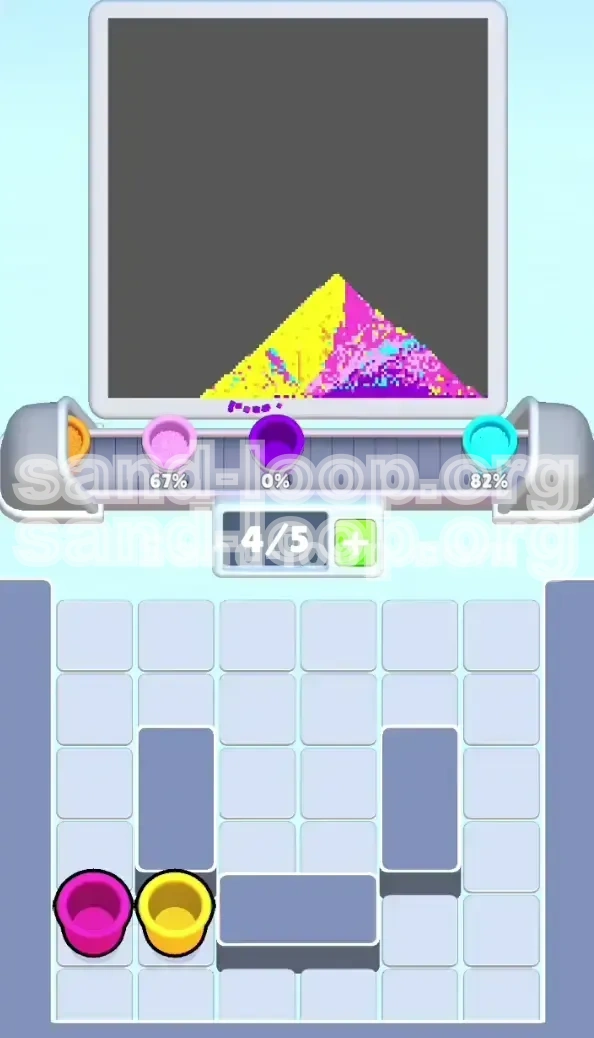
- Step 14: With the main art complete, the game logic shifts. The remaining 90% of the board is effectively garbage data (Cyan).
- Step 15: Spam tap. You can now rapidly tap any remaining columns. The ropes are gone, the mysteries are revealed, and the colors are homogenous.
- Step 16: Watch for "Straggler Accents." Sometimes one Purple or Orange cup remains trapped in a corner. Keep one eye on the conveyor to ensure you don't accidentally let a required accent cup cycle off the belt and back into the queue (if the queue is full).
Color Order: The Logical Sequence
One of the most confusing aspects of Level 399 is knowing which color to prioritize when multiple options are available. The visual noise of the grid can make it hard to see the correct path. Follow this hierarchy strictly to minimize queue conflicts.
Priority 1: The "Structural" Colors (Yellow & Magenta)
These colors form the actual objects in the picture. Yellow is the structural base. Magenta defines the boundaries of the shower cap. You should process these colors even if the canvas isn't *immediately* asking for them, provided you have queue space. Why? Because they clear the most physical space on the grid, freeing other cups to fall. Rule of thumb: If you see a Yellow cup and a Cyan cup, and you have space, always take the Yellow first.
Priority 2: The "Detail" Colors (Orange, Light Pink, Purple)
These are high-risk, high-reward. Orange is needed in very specific, small quantities (the beak). Light Pink creates the frills. Purple is the rarest. You should only process these when the canvas explicitly flashes the corresponding pixel. If you load these onto your belt too early, they become "dead weight," occupying a valuable slot that prevents you from picking up a necessary Yellow cup. Warning: Never hold more than one Detail Color at a time.
Priority 3: The "Filler" Color (Cyan)
Cyan is the enemy of progress in the early game. While it is the most abundant color, it serves no purpose until the duck is fully formed. Processing Cyan early creates a queue traffic jam. You must treat Cyan cups as "rocks" or obstacles for the first 60% of the level. Only clear them if they are blocking a critical vertical column that holds Yellow or Magenta underneath.
The "Rope" Exception
There is one exception to the priority rules: The Roped Cups. If a Cyan cup is tied underneath a Magenta cup, and you need the space, you MUST process the Magenta (Priority 1) and accept the Cyan (Priority 3) into your queue. This is the only time you should willingly take Cyan early. To mitigate the clog, try to time this for when your queue is completely empty, so the Cyan arrives, sits in the first slot, and you can immediately send it back up if the canvas accepts it, or just hold it without blocking other inputs.
Key Tips, Mistakes, and Solutions
Even with a perfect strategy, RNG (Random Number Generation) and physics can sometimes throw you a curveball. This section covers the "What ifs" of Level 399.
Common Mistake: The "Blind Tap"
The most common error in Sand Loop is tapping a cup without checking what is falling behind it. In Level 399, tapping a cup at the top of the board might cause a Purple cup to fall into a "Dead Column"—a vertical shaft that is blocked by a rope at the bottom. Once a cup falls into a dead column, you cannot retrieve it until you cut the rope at the bottom. This can delay a critical color by 20-30 moves. Tip: Always scan the entire vertical column before tapping the top cup.
Common Mistake: Ignoring the "Next Cup" Preview
At the top of your conveyor belt, there is often a preview of the next cup coming up (or you can infer it based on what you just tapped). A common mistake is looking only at the color currently on the belt. You must look one step ahead. If you have a Purple cup on the belt, and the *next* cup coming is Yellow, but your canvas needs Magenta, you need to plan for that Yellow cup. Do not let it sit on the belt; if your queue is full, you are stuck. Tip: Keep the flow moving. Don't let the belt stop.
Stuck Solution: The "Queue Reset" Maneuver
Sometimes, despite your best efforts, you get stuck. Your queue is full of (Cyan, Cyan, Purple) but the canvas needs Yellow. No Yellow cups are accessible. What do you do? The Solution: You must perform a "Queue Reset." Look at the canvas. Can you paint a single Cyan pixel? Do it. Even if it's not optimal. Do it just to clear ONE slot in your queue. Once you have one empty slot, a whole new avenue of moves opens up. You can tap a new cup, pulling a fresh color into the queue, breaking the deadlock. Sometimes, making a "useless" move is the only way to unlock a useful one.
Stuck Solution: Mystery Cup Reveals
Have you ever tapped a Mystery Cup and it turned into the exact color you didn't want? You are staring at a Purple cup you didn't need, and now it's blocking the belt. The Solution: Don't panic. Look at the grid. Is there *any* Purple pixel left on the canvas? Even a tiny one? If yes, send it there. If no, you have to "park" it. You must let it sit in your queue until the board shifts enough to create a valid move. To prevent this, always try to reveal Mystery Cups when you have 2 or more empty queue slots, giving you flexibility.
Speed Run Tips: For the Pros
Once you have beaten the level, you might want to improve your time or score. These advanced tips focus on efficiency and rhythm.
Optimization: Pre-loading the Belt
Advanced players don't wait for the canvas to ask for a color before finding it. They "Pre-load." While your current cup is being processed by the painter, your eyes should be scanning the grid for the *next* color. By the time the painter is free, you should have already tapped the source cup. This keeps the "Painter Efficiency" at 100%. If the painter ever waits for a cup, you are losing time.
Shortcuts: The Chain Reaction
Look for opportunities to trigger "Chain Reactions." Sometimes, a specific cup is holding up a vertical stack of 4 or 5 other cups. If you can tap that specific cup, you will immediately load 5 cups onto your belt. This is faster than tapping 5 separate individual cups scattered across the board. Tip: The Roped Columns are excellent for this. Cutting the rope on a tall column releases a massive payload of colors all at once. Time this with an empty queue for a massive speed boost.
Shortcuts: Ignoring Small Details
Counter-intuitively, to get a faster time, you might need to ignore small details temporarily. If the canvas needs a tiny, single-pixel Purple dot, but finding that Purple cup requires digging through a stack of Cyan, skip it. Keep working on the large Yellow areas. Often, clearing the large areas will shift the grid naturally, bringing the needed Purple cup into an accessible position later on. Context switching (constantly changing target colors) kills your rhythm. Stick to one color family (e.g., all Yellows) as long as possible before switching.