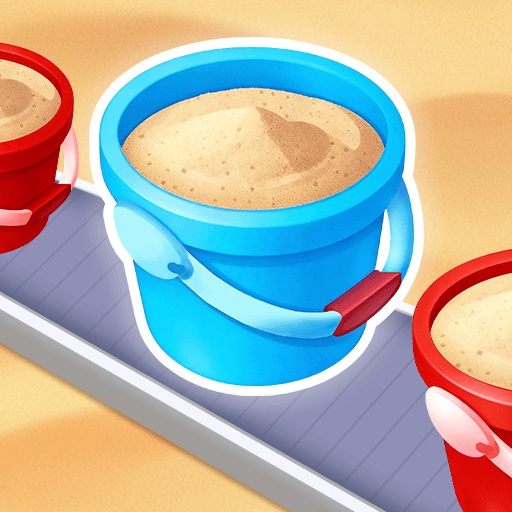
Sand Loop is a fascinating puzzle game that challenges your brain rather than your reflexes. It is not about fighting enemies or building decks; it is about the flow. The core of the game is simple: colorful sand flows along conveyor belts, and your job is to sort this sand into the correct containers using switches, conveyors, and gravity.
As a player who has moved past the basics, you might find yourself stuck on harder levels. You understand the controls, but the puzzles feel impossible. This is where understanding Level Design becomes your secret weapon. By understanding how the creators build these puzzles, you can learn to solve them faster and more efficiently.
This guide will break down the art behind the levels, helping you see the game through the eyes of a designer.
1. Understanding the "Flow" State
In Sand Loop, "flow" is everything. The game is essentially a simulation of physics. The sand behaves like a liquid, but it moves in chunks. When you look at a level, do not just see a static image; imagine a movie of the sand moving.
The Concept of Throughput
Every level is built around the idea of Throughput. This is the amount of sand the system can handle without getting clogged.
- High Throughput: Wide conveyors moving fast.
- Low Throughput: Narrow paths, slow speeds, or sharp turns.
If you try to push too much sand through a low-throughput area, the game will back up, and you will fail. It is like pouring a bucket of water into a small funnel; if you pour too fast, it overflows.
Identifying Bottlenecks
Designers love to hide bottlenecks in plain sight. These are points where the flow is naturally restricted.
- The Merge Point: Where two conveyor belts join into one. This is a classic bottleneck.
- The Interchange: Where sand has to cross over another path.
- The Switch: A gate that changes direction.
Pro Tip: When you start a level, pause immediately. Look for the narrowest point on the map. That is usually where your strategy needs to focus.
2. The Three Pillars of Puzzle Logic
Sand Loop levels are not random. They are constructed using three specific elements. We call these the "Three Pillars." Understanding these helps you deconstruct any level.
1. Timing and Rhythm
Sand does not arrive all at once; it comes in waves. The level design is often synced to a specific beat.
- The Pulse: Watch the sand spawn. Is it continuous? Does it come in bursts?
- The Delay: Switches often have a delay. When you flip a switch, the sand might take a few seconds to react.
It's like... conducting an orchestra. You are not playing every instrument; you are telling them when to start and stop. If you flip a switch too early, the sand arrives before the container is ready.
2. Spatial Awareness
This is about knowing where things are in relation to each other. The 2D plane often tricks your eyes.
- Verticality: Just because a container is at the bottom doesn't mean sand falls straight into it.
- Cross-Contamination: The biggest enemy in Sand Loop is mixing colors. One stray grain of red sand in a blue container can ruin a perfect score.
Pro Tip: Trace the path with your finger before you start the machine. If your finger crosses a path of a different color, you have a potential collision risk.
3. Resource Management
You have limited tools. You cannot build new conveyors; you can only control what is there.
- Switches: These are your primary tools. Use them to divert flow.
- Speed Controls: Some levels allow you to speed up or slow down belts.
- Gates: Barriers that open and close.
Strategy: Don't hoard your interactions. A common mistake is waiting for the "perfect moment." In Sand Loop, the perfect moment is the one you create.
3. Advanced Techniques for Sorting
Once you grasp the basics, you need advanced techniques to beat the harder levels. These strategies rely on the physics engine of the game.
The "Batching" Strategy
Instead of sorting grain by grain, sort in groups.
- Let a pile of sand build up on a conveyor.
- Flip the switch to send the whole pile to Container A.
- Flip it back to catch the next color for Container B.
This is efficient because it reduces the number of switch clicks. It minimizes the risk of "mixed sand" during the transition.
The "Overflow" Method
Sometimes, the best way to sort is to let a little bit spill.
- Intentional Spilling: If a container is full, diverting the flow might be harder than just letting the excess spill onto a waste belt (if the level has one).
- Pressure Release: If a conveyor is jammed, briefly opening a gate to release pressure can clear the jam.
Using "Dead Time"
"Dead time" is the gap between waves of sand.
- Use this time to reset your switches.
- Check your containers. Are they filling up evenly?
- Plan your next three moves.
It's like... a red light at a traffic intersection. When the light is red (Dead Time), you don't just sit there; you check your GPS, you change the radio station, you get ready for the green light.
4. Analyzing Level Architecture
To truly master the game, you need to think like an architect. Levels are built with specific "zones." Identifying these zones simplifies the chaos.
The Source Zone
This is where the sand appears. It is usually at the top or the left side of the screen.
- Mixed Source: Sand comes out mixed together (e.g., Red and Blue mixed). This requires immediate splitting.
- Pure Source: Sand comes out in pure chunks (e.g., 5 seconds of Red, then 5 seconds of Blue). This requires timing.
The Processing Zone
This is the middle of the map. This is where the "sorting" happens.
- Look for loops here. The name "Sand Loop" comes from the circular paths often found in this zone.
- Loops are useful for delaying sand. If Container A is full, send the sand on a loop until it is empty.
The Sink Zone
These are the containers at the end.
- Static Sinks: Containers that stay in one place.
- Moving Sinks: Containers that move on conveyor belts. These require predictive timing.
Comparison of Level Zones:
| Zone Name | Primary Function | Player Challenge | Key Interaction |
|---|---|---|---|
| Source | Generates sand | Predicting the mix rate | Observation |
| Processing | Sorts and routes | Managing collisions | Switching |
| Sink | Collects sand | Preventing overflows | Timing |
5. Practical Tips for Stuck Players
If you are stuck on a level, do not just keep trying the same thing. The game is testing a specific logic, and you are missing it.
1. The "One Switch" Rule
If a level has multiple switches, ignore them. Focus on just one switch.
- What does this single switch control?
- If I leave it alone, what happens?
- If I flip it once, what happens?
Often, solving one part of the puzzle reveals the solution for the rest.
2. Watch the "Lead Grain"
The first grain of sand is the most important. It tells you where the flow is going.
- If the lead grain goes to the wrong place, the whole pile is lost.
- If the lead grain succeeds, the rest usually follows (unless there is a blockage).
3. Reverse Engineering
Look at the containers first.
- There are 3 Red containers and 1 Blue container.
- This means 75% of your effort should be on Red sand.
- Build your strategy backwards from the container, not forwards from the source.
4. Manage the "Clump"
Sand in this game moves in clumps.
- A big clump is hard to steer.
- A small clump is agile.
- Use switches to break big clumps into smaller, manageable pieces.
6. The Psychology of a Puzzle Solver
Finally, let's talk about your mindset. Sand Loop is a game of patience. Getting frustrated makes you click buttons randomly, which leads to failure.
Embrace the Failure
When the sand mixes, don't restart immediately. Watch the rest of the level.
- Where did it go wrong?
- Was it a timing error? Or a logic error?
- Learning why you failed is more valuable than the success itself.
The "Zen" of Flow
There is a satisfaction in watching a perfect loop run.
- The goal is not just to win; the goal is to create a smooth, uninterrupted flow.
- When you achieve this, the level feels like it solves itself.
Trust the Design
The levels are designed to be solvable. If it looks impossible, you are missing a mechanic.
- Is there a hidden switch?
- Can you speed up a belt?
- Is there a waste disposal you missed?
Frequently Asked Questions (FAQ)
Q: The sand moves too fast, I can't react in time. What should I do? A: Do not try to react to every grain. Instead, look at the pattern of the flow. If the sand flows in a 5-second loop, set your switches to a 5-second rhythm. It is about timing, not speed.
Q: I keep mixing colors at the intersection. How do I fix this? A: You likely have a "collision" issue. Use a "buffer zone." Let the first color pass completely and enter a holding loop or container before letting the second color enter the intersection. Never have two colors on the same switch track at the same time.
Q: How do I deal with levels where containers move? A: You must use "predictive timing." Watch the moving container's cycle. If it takes 10 seconds to arrive at the drop-off point, release your sand 10 seconds before it gets there. You have to lead the target.
Q: Is there a way to restart a specific part of the level without restarting the whole level? A: No, usually not. But you can use the "Pause" function to your advantage. Pause the moment things go wrong, analyze the mess, and plan your reset. This saves mental energy.
Q: What is the secret to beating the "Loop" levels? A: The secret is Synchronization. The loops are usually timed to match the spawn rate of the sand. Don't fight the loop; adjust your switches to match the loop's natural timing. Think of the loop as a clock, and schedule your switches like an appointment book.
Conclusion
Sand Loop is more than just a game about moving dirt; it is a study of cause and effect. By understanding the Flow, mastering the Three Pillars, and analyzing the Level Architecture, you can transform from a confused beginner into a logical master.
Remember, every puzzle has a logic. The sand is not your enemy; it is just a force of nature waiting to be guided. Take a deep breath, look at the conveyor belts, and find the flow. The solution is always there, hidden in the design.