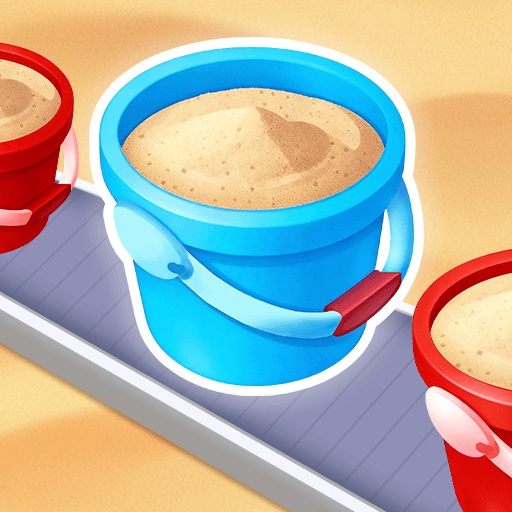
Sand Loop is more than just a relaxing game about watching colorful grains fall into buckets. While it looks peaceful on the surface, it is actually a rigorous workout for your brain. It is a puzzle game that demands you manage chaos, organize systems, and think logically under pressure.
This article explores the immense cognitive value hidden within the gameplay of Sand Loop. We will look at how controlling conveyors and sorting sand trains specific mental skills that are useful in real life. Whether you are a casual player or a dedicated puzzle solver, understanding these benefits will change how you play.
1. Enhancing Executive Function Through Resource Management
The core of Sand Loop is about managing a continuous flow of resources. This is not a turn-based game where you can think forever. The sand keeps flowing. This gameplay mechanic directly trains your "Executive Function"—the brain's command center responsible for managing time and attention.
When you play, you are forced to make rapid decisions about prioritization. You cannot save every grain of sand immediately. You must choose which color to sort first and which one can wait. This constant decision-making process improves your ability to prioritize tasks in the real world.
Here is how Sand Loop trains your mental management skills:
- Real-time Prioritization: You must quickly identify the most urgent task, like saving a rare color of sand before it spills.
- Resource Allocation: Your conveyors are limited resources. Deciding where to place them teaches you to use limited tools efficiently.
- Impulse Control: The game rewards patience. rushing often causes clogs. You learn to suppress the urge to act immediately and wait for the right opening.
Think of it like being an air traffic controller. You have multiple "planes" (sand streams) coming in at once, and you must direct them to the right "runway" (container) without causing a crash.
2. Boosting Logical Thinking with "If-Then" Scenarios
Sand Loop is a logic machine. Every switch you flip or conveyor you turn has a direct consequence. To succeed, you must master "If-Then" reasoning. This is the foundation of coding and computer science, but in Sand Loop, it is visual and tactile.
The game teaches you to see patterns. You aren't just reacting to the current moment; you are predicting the future. You have to think: "If I switch this conveyor belt to the left, then the blue sand will mix with the red sand, and I will lose."
This type of thinking strengthens your prefrontal cortex, the area of the brain responsible for planning and prediction.
Key logical skills developed include:
- Sequential Thinking: You learn that Step A must happen before Step B can succeed. You cannot fill the container until the path is clear.
- Cause and Effect: The game provides immediate feedback. If you make a logic error, the sand spills. This helps you calibrate your thinking quickly.
- System Optimization: You constantly look for the most efficient path. It is like solving a maze where the walls keep moving.
By playing regularly, you get better at breaking down complex problems into small, manageable steps. You stop looking at the messy pile of sand and start seeing the individual lines of logic that can solve the puzzle.
3. Spatial Reasoning and Physics Intuition
Sand Loop uses a physics engine that mimics how real granular materials behave. Sand piles up, slides down slopes, and flows at different speeds depending on the angle. This requires you to use strong spatial reasoning skills. You must visualize the path of the sand in your head before it actually happens.
This is not an abstract skill. It is the same kind of thinking used by architects and engineers. You have to understand 3D space on a 2D screen.
How the game improves spatial awareness:
- Trajectory Prediction: You learn to estimate exactly where the sand will land when a conveyor belt moves.
- Volume Estimation: You learn to judge how much sand a container can hold before it overflows.
- Angle Analysis: You understand that changing the angle of a chute changes the speed of the flow.
It is like pouring water from one bottle to another without spilling. You have to calculate the speed, the angle, and the distance all at once. Sand Loop gamifies this physical intuition, making you sharper at judging movement and space.
4. Strategic Planning and Anticipation
Beginners often play Sand Loop by reacting to whatever is happening right in front of them. However, advanced players know that the real value lies in anticipation. The game trains you to look ahead and plan your moves three or four steps in advance.
This is the difference between tactics (short-term moves) and strategy (long-term planning). You have to set up your system so that it handles the flow automatically, allowing you to focus on new problems as they arise.
The strategic benefits include:
- Pattern Recognition: You spot recurring configurations of sand and know exactly which strategy works best.
- Future Simulation: In your mind, you fast-forward the game 10 seconds to see if your plan will work.
- Crisis Prevention: You see a bottleneck forming before it becomes a jam, allowing you to fix it proactively.
This skill translates directly to real-world problem solving. Instead of putting out fires all day, you learn to build systems that prevent fires from starting in the first place.
5. Advanced Techniques for Mental Growth
To truly get the cognitive benefits of Sand Loop, you need to move past the basics. You need to treat each level as a brain training exercise. Here are some advanced concepts that will sharpen your mind even further.
The "Split and Merge" Strategy
Sometimes you have too much sand for one conveyor. Instead of panicking, you can split the stream into two smaller streams. This teaches you that breaking a big problem into smaller parts makes it solvable.
The "Buffer Zone" Concept
You can use an empty container as a temporary holding spot. This trains your working memory. You have to remember that the sand in the buffer is temporary and needs to be moved later. It is like juggling; you keep one ball in the air while you organize the others.
Practical Tips for Improvement
To maximize your brain training, try these approaches during your next session:
- Pause and Plan: Before the level starts, look at the whole map for 10 seconds. Do not touch anything until you have a mental route planned.
- The "Undo" Analysis: When you make a mistake and restart, do not just rush back in. Ask yourself exactly why your previous plan failed.
- Minimize Movement: Try to solve the puzzle using the fewest number of switch flips possible. Efficiency equals intelligence in this game.
Comparison of Cognitive Skills
To help you understand the specific benefits, here is a breakdown of the mental muscles you are building while playing:
| Cognitive Skill | How Sand Loop Trains It | Real-World Application |
|---|---|---|
| Divided Attention | Monitoring multiple sand streams simultaneously | Driving a car or cooking a complex meal |
| Problem Solving | Figuring out how to unclog a jammed path | Debugging code or fixing a broken appliance |
| Fluid Intelligence | Adapting to new, unpredictable layouts | Learning a new language or navigating a new city |
| Perceptual Speed | Spotting a color mismatch quickly | Proofreading a document or quality control |
Frequently Asked Questions (FAQ)
Q: I keep getting stuck on levels with mixed colors. What am I doing wrong? A: You are likely trying to sort the sand too late in the process. The key is to separate the colors as early as possible. Look for the point where the stream splits and direct the colors there. Do not let them mix in the first place.
Q: Is it better to play fast or slow? A: For brain training, slow is actually better. Playing slowly allows your brain to engage in "System 2" thinking—deep, logical analysis. Once you have mastered the logic, speed will come naturally.
Q: Does this game actually help with math skills? A: Yes, indirectly. It deals with rates of flow, geometry, and resource management. It reinforces the logic behind math without making you do calculations.
Q: How do I deal with the frustration of losing? A: Reframe failure as data. In Sand Loop, failing shows you exactly what does not work. Every time you spill sand, you have learned a rule about the physics of the game. This is the essence of the scientific method.
Conclusion
Sand Loop is a deceptive game. It looks like a simple diversion, but it is actually a sophisticated tool for cognitive development. By demanding that you manage resources, visualize physics, and plan logically, it strengthens the very skills needed for success in daily life.
The next time you load up the game and watch the digital sand fall, remember: you are not just playing. You are training your brain to be more organized, more logical, and more efficient. You are learning to find order in chaos, one grain of sand at a time.