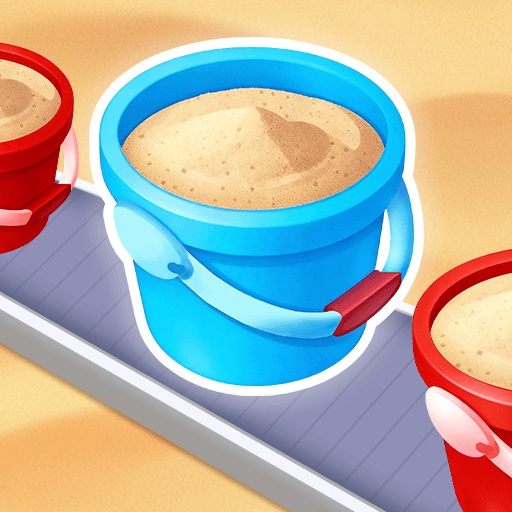
So, you have decided to step into the world of the Sand Loop Championship. Maybe you saw the flashy tournament streams, or perhaps a friend challenged you to see who could sort sand faster. But now, looking at the screen, you might feel a bit overwhelmed. The sand is piling up, the conveyors are moving, and suddenly everything feels chaotic.
Do not worry. This is not a fighting game where you need lightning-fast reflexes to block a punch. Sand Loop is a game of logic, physics, and patience. It is like being a traffic controller, but instead of cars, you are managing colorful grains of sand.
This guide is designed to solve the biggest problems new players face when they start competing. We will break down complex strategies into simple steps so you can go from a confused beginner to a confident sorter.
1. Understanding the Physics: Why Does the Sand Pile Up?
The most common complaint from new players is: "My sand keeps overflowing!" To fix this, you need to understand how the game physics works. It is not just about moving sand from point A to point B; it is about managing flow rates.
Think of the sand like water coming out of a faucet. If you pour water into a funnel faster than the funnel can drain it, the water will spill over. In Sand Loop, the conveyors are your funnels.
Here is how to master the flow:
-
Observe the Source Speed Look at where the sand is coming from. Is it a fast stream or a slow trickle?
- If the source is fast, your output conveyors need to be fast or wide.
- If the source is slow, you have more time to plan your route.
-
Avoid "Dead Ends" Never direct a conveyor belt into a wall or a blocked switch.
- Sand has physical weight in this game. If it hits a barrier, it piles up.
- Once a pile forms, it blocks new sand, causing a chain reaction of jams.
-
The "Funnel" Effect When two conveyors merge into one, the combined amount of sand must fit on the single track.
- It is like merging lanes on a highway. If both lanes are full, traffic stops.
- Make sure the receiving conveyor is long enough to handle the extra volume.
Pro Tip: If you see sand starting to pile up at a junction, immediately slow down the input conveyor or divert some flow to another path. It is easier to manage a steady stream than to clear a massive blockage.
2. The Art of Switching: Timing is Everything
Switches are the most powerful tools in your arsenal, but they are also the biggest source of mistakes. A switch directs sand from one path to another. Using them correctly separates the novices from the pros.
Many beginners treat switches like light switches—either on or off. But in Sand Loop, you should think of switches like a railway junction. You need to plan the timing perfectly.
Here is a strategy to use switches effectively:
-
The Color Batch Method Instead of switching for every single grain of sand, wait for a group of the same color.
- Let the red sand accumulate for a second.
- Flip the switch to send the whole "batch" of red to the correct bucket.
- This saves wear on your machinery and keeps the flow smooth.
-
Anticipate the Mix Look ahead at the conveyor belt.
- If you see a cluster of blue sand approaching a switch, get ready.
- Do not wait until the sand is at the switch to flip it. Flip it a second early so the sand flows smoothly without hitting a wall.
-
Avoid Rapid Switching Flipping a switch back and forth too quickly can cause physics glitches or jams.
- Make a decision and stick to it for a few seconds.
- Let the sand settle into its new path before you consider changing it again.
3. Level Layout Strategy: Map Before You Click
One major mistake in tournaments is panic-clicking. Players see sand flowing and start randomly placing conveyors or flipping switches without a plan. This is like trying to build a house while the bricks are falling from the sky.
Before the level starts or the sand begins to flow, take five seconds to look at the map.
Ask yourself these three questions:
- Where are the containers?
- Where is the main source of sand?
- What is the shortest path between them?
Creating "Main Highways"
You want to create a "main highway" for your most abundant color.
- Identify the Majority Color: Look at the incoming stream. Is 60% of it yellow? Build a direct, unobstructed path for the yellow sand straight to its container.
- Use the "Spur" Method: For the less common colors (like the rare blue or red grains), use smaller "spur" lines that branch off the main highway.
- Keep it Simple: A long, winding belt might look cool, but it is risky. The longer the distance, the more chances there are for a jam. Straight lines are your friends.
Dealing with Elevation and Gravity
Some advanced tournament maps use gravity. Sand might fall down onto a lower conveyor.
- Catch It Wide: When sand falls from a height, it spreads out. Place your catching conveyor slightly wider or move it back and forth to catch all the grains.
- Don't Fight Gravity: If sand is falling to the left, do not try to force it immediately to the right with a sharp turn. Let it fall, catch it, and then gently curve it. It is like catching an egg; you need to go with the motion.
4. Solving the "Mixed Color" Crisis
This is the moment that causes most players to lose. The sand arrives in a mixed stream—red, blue, and yellow all mixed together. How do you separate them?
You cannot separate mixed sand once it is on the same belt. You have to prevent the mix from happening in the first place. However, if the game gives you a mixed source, you need a specific setup.
The "Sieve" Technique
Think of this as a colander in a kitchen sink. You need to filter out what you do not want.
- Prioritize One Color: Choose one color (e.g., Red) to be your "primary" color for that specific belt.
- Set the Switch: Configure the switch to let Red pass straight through.
- Divert the Rest: Any sand that is NOT Red (so, Blue and Yellow) gets diverted to a secondary loop.
- Repeat: On that secondary loop, separate the Blue from the Yellow.
This creates a hierarchy of sorting. It takes longer, but it is the only way to ensure 100% accuracy.
5. Advanced Tournament Tips: Efficiency vs. Speed
In the Sand Loop Championship, you are often scored on two things: how much sand you sorted and how much you wasted (spilled). Speed is good, but efficiency is better.
Do not rush. It sounds contradictory, but the fastest players are usually the calmest. If you rush, you make mistakes. Mistakes cause jams. Jams take forever to fix.
Here is a comparison of two playstyles:
| Playstyle | Description | Risk Level | Tournament Score |
|---|---|---|---|
| The Rusher | Flips switches constantly, places conveyors randomly without a plan. | High | Low (High spillage) |
| The Architect | Plans a layout, creates smooth curves, waits for batches. | Low | High (High precision) |
Managing "Sand Anxiety"
When you see the sand pile nearing the top of the screen, your heart rate goes up. This is "Sand Anxiety."
- The Pause Trick: If the game allows pausing in single-player or practice modes, use it to breathe.
- Focus on One Block: If everything is going wrong, ignore the mess and focus on fixing one blockage. Once that flows, move to the next.
- Accept Small Losses: Sometimes, 5% of the sand will spill. Do not risk 100% of the sand to save that 5%. Let the small spill go and save the rest.
6. Essential Tools and Upgrades
As you progress in the tournament, you will unlock different tools. Using the right tool for the job is crucial.
-
The Speed Booster
- What it does: Makes a specific conveyor move faster.
- When to use it: Use this on long straight paths to prevent sand from bunching up. Do not use it on sharp curves, or the sand will fly off the track.
-
The Multi-Switch
- What it does: Allows you to split flow into three directions instead of two.
- When to use it: This is great for the "Mixed Color" problems we discussed earlier. It lets you filter three colors at once.
-
The Wide Chute
- What it does: A wider entrance for your container.
- When to use it: If you have a high-speed flow, the sand might miss the standard container. The wide chute acts like a larger bucket, catching more sand.
Frequently Asked Questions (FAQ)
Q: I keep losing because the sand piles up at the beginning of the level. What am I doing wrong? A: You are likely trying to sort too early. Do not put a switch or a turn right at the source. Let the sand flow onto a straight "buffer" belt first. This gives you a few seconds of breathing room to sort the colors before they hit the decision point.
Q: Is it better to use many small conveyors or a few long ones? A: In most cases, fewer long conveyors are better. Every connection between two conveyors is a potential point of failure where sand can get stuck. Long, smooth curves are much more efficient than jagged, short segments.
Q: How do I handle levels where the sand source moves? A: This is a hard challenge! You need to build a "receiving" platform that is wider than the source. Imagine the source is a sprinkler; you want to build a long tray that catches the water no matter where the sprinkler points. Once the sand is on your wide tray, you can funnel it into your sorting system.
Q: What is the "Golden Rule" of Sand Loop? A: Flow over speed. If the sand is flowing smoothly, the speed will take care of itself. If you chase speed, you break the flow, and everything stops.
Conclusion
The Sand Loop Championship is not about being the fastest person in the world; it is about being the most organized. It is a puzzle game that rewards patience and logical thinking. By understanding the physics of the sand, mastering your switches, and planning your layouts before you panic, you will find yourself climbing the leaderboards in no time.
Remember, every grain of sand has a destination. Your job is just to clear the path. Good luck, and may your conveyors always be clear