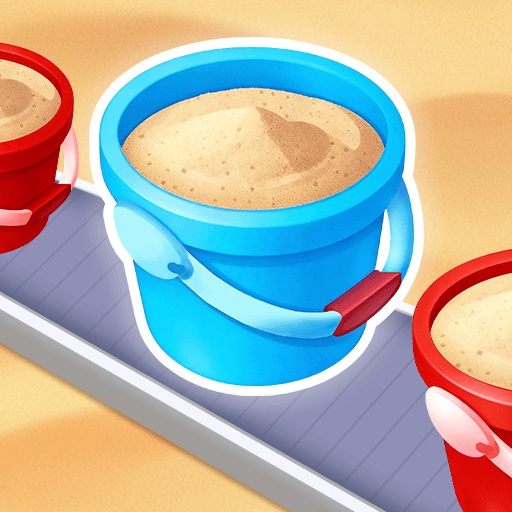
Welcome to the sandy, shifting world of Sand Loop. If you are reading this, you have probably found yourself staring at a screen full of colorful particles, wondering why your sand keeps mixing up when you try to move it. Do not worry, we have all been there.
Sand Loop is not a game about fighting bad guys or memorizing complex card combos. It is a game about observation, physics, and flow. The heart of this game is the conveyor belt system. Think of yourself as a traffic controller, but instead of cars, you are managing tons of tiny, flowing sand grains.
Today, we are going to break down exactly how these conveyor belts work. We will look at the different types you will encounter, when to use them, and how to think like a puzzle solver to get that satisfying "Perfect" rating.
Understanding the Basics: What is a Conveyor?
Before we dive into the fancy stuff, we need to talk about the basics. In Sand Loop, the conveyor belt is your primary tool for moving sand from point A to point B. It sounds simple, right? Just put a belt down and the sand moves.
However, the physics in this game are surprisingly realistic. The sand has weight, momentum, and friction.
- Speed Matters: Not all belts move at the same speed.
- Capacity Limits: Belts can get clogged if you pour too much sand on them at once.
- Gravity is Real: If a belt is tilted downward, the sand will slide faster. If it is tilted upward, it might slide back down if the speed is too low.
Think of the conveyor belt like a slide at a water park. If the water (sand) flows too fast, it splashes everywhere. If it is too slow, it gets stuck. Your job is to find that perfect flow.
The Four Main Types of Belts
In the game, you will quickly realize that one type of belt cannot solve every puzzle. The developers have given us a few different tools to work with. Let's break them down one by one.
The Standard Belt
This is the bread and butter of Sand Loop. It is reliable, steady, and does exactly what you expect.
- Best for: Moving sand in a straight line.
- Speed: Medium.
- Cost: Low.
Use this belt when you just need to bridge a gap between two containers. It does not have any special tricks, but it is the most stable way to transport your materials.
The Express Belt
This is the faster version of the standard belt. When you place this down, the sand zips across the screen.
- Best for: Long distances.
- Speed: High.
- Risk: Sand can fly off the edges at corners.
Imagine trying to carry a tray of drinks while running. That is essentially what the Express Belt does. It is great for moving sand quickly across the map, but you have to be careful. If you make a sharp turn, the momentum might throw the sand right off the side because it is moving too fast to grip the belt.
The Splitter
This is where the real puzzle solving begins. The Splitter is a special belt segment that divides the flow of sand into two directions.
- Best for: Separating mixed colors.
- Function: 50/50 split usually.
- Strategy: Essential for sorting levels.
Think of the Splitter like a fork in the road. If you have a pile of red and blue sand coming from a single source, you cannot just dump them into a bucket. You need to use the Splitter to divide the stream, giving you two manageable piles to work with.
The Reversing Belt
This belt is a tricky one. It changes direction based on a timer or a switch.
- Best for: Alternating routes.
- Function: Switches between Left and Right.
- Difficulty: High.
Using this belt is like playing a game of catch and throw. You have to time your other switches so that when the belt reverses, the sand has a clear path. If you mess up the timing, the sand will just crash into a wall or fall off the edge.
How to Use Belts for Sorting Strategies
Now that we know what the belts are, how do we actually use them to solve the puzzles? The core goal of Sand Loop is sorting. You have red sand, blue sand, and green sand, and they are all mixed up. You need to get the red sand into the red bucket, and so on.
The Funnel Method
This is the most common strategy for beginners. You use your belts to create a narrow funnel.
- Start with a wide belt to catch the sand.
- Use Splitter belts to narrow the stream down.
- Direct the thin stream into the specific colored container.
It is like using a funnel to put oil in your car. You pour a lot in, but it comes out in a neat, thin line.
The Overpass Technique
Sometimes, the map is crowded. You have red sand going across the screen, but you need to move blue sand right through the middle of it. If they touch, you lose.
This is where you build bridges or tunnels using belts.
- Build a straight line for the first color.
- Build a raised belt (using the game's elevation tools) for the second color.
- Let the first color pass safely underneath.
This strategy requires you to think in 3D. You are building layers of flow so the sand never touches until it reaches the correct bucket.
Timing is Everything
For levels using the Reversing Belt or automatic switches, you cannot just set it and forget it. You have to watch the cycle.
- Watch the pattern of the falling sand.
- Wait for the gap between two different colors.
- Flip the switch to change the belt direction.
It is like jumping rope. You have to time your jump (or switch flip) perfectly so you do not trip over the rope (or mix the sand).
Common Mistakes to Avoid
We learn by making mistakes, but maybe I can help you make a few less of them. Here are the most common errors new players make when building their conveyor systems.
1. Overloading the Belt
Just because you can connect a source to a belt does not mean you should. If you pour sand onto a belt faster than it can move it away, the sand will pile up and spill over the sides.
- The Fix: Use a slower source or a faster belt.
- The Sign: If you see sand stacking up high, your belt is overloaded.
2. Sharp Turns on Fast Belts
Remember the Express Belt? If you make a 90-degree turn immediately after the sand speeds up, physics will take over. The sand will keep going straight, right off the track.
- The Fix: Use gradual curves.
- The Rule: The faster the belt, the wider the turn must be.
3. Forgetting Gravity
Sand is heavy. If you point a belt straight up, the sand might slide back down before it reaches the top.
- The Fix: Use a "stepped" design for going up (like a staircase).
- The Tip: High friction belts are better for climbing steep hills.
Advanced Tips for the Pros
Once you have mastered the basics, you can start using some advanced techniques to really show off your scores.
The Cascade Setup
Instead of using motors for every single belt, try to let gravity do some of the work. You can tilt belts downward to create a "waterfall" effect.
- Place a belt high up.
- Tilt it downward.
- Let the sand fall into the next belt naturally.
This saves energy and often looks really cool when you watch the simulation run. It is like a Rube Goldberg machine.
Syncing Switches
In later levels, you will have multiple switches that need to be flipped in a specific order.
- Hit Switch A to start the flow.
- Wait 3 seconds.
- Hit Switch B to divert the flow.
Practice makes perfect here. Do not rush. Watch the sand flow for a full cycle before you start flipping switches.
Summary of Belt Types
To help you remember, here is a quick reference guide for the belts we discussed.
| Belt Type | Speed | Best Use Case | Risk Level |
|---|---|---|---|
| Standard | Medium | General transport, straight lines | Low |
| Express | High | Long distance travel | Medium (Sand can fly off) |
| Splitter | Medium | Separating mixed sand piles | Low |
| Reversing | Variable | Alternating paths, timing puzzles | High (Requires timing) |
Frequently Asked Questions (FAQ)
Q: I keep mixing the red and blue sand at the last second. What is happening? A: This is usually a "collision" issue. Check the end of your belts. If the red belt and blue belt are too close, the sand piles will touch each other. Try moving the containers further apart or using a "dropping" technique where the sand falls straight down into the bucket.
Q: Why does my sand keep piling up at the start of the belt? A: Your input speed is higher than your output speed. You are feeding the belt more sand than it can handle. Try upgrading the belt to an Express belt or slowing down the source of the sand.
Q: Can I stop the sand flow completely? A: Yes. Most levels have a "Pause" button or a master switch. However, simply pausing the flow usually does not solve the puzzle; you need to route the sand correctly. Think of pausing as a way to give yourself time to think, not a solution itself.
Q: How do I deal with levels that have three different colors? A: Prioritize. Usually, you want to separate the color that has the most sand first. For example, if you have 50% Red, 30% Blue, and 20% Green, get the Red sand into its own belt system first. Once the bulk is moved, the smaller piles are easier to manage.
Final Thoughts
Sand Loop is a game that rewards patience and planning. The conveyor belts are your tools, but your brain is the real engine. Do not get frustrated if a level takes you a few tries. Even the best players have had their sand spill onto the floor.
Next time you load up the game, take a moment to look at the whole map. Plan your route, choose the right belt for the job, and watch the physics work its magic. Good luck, and happy sorting