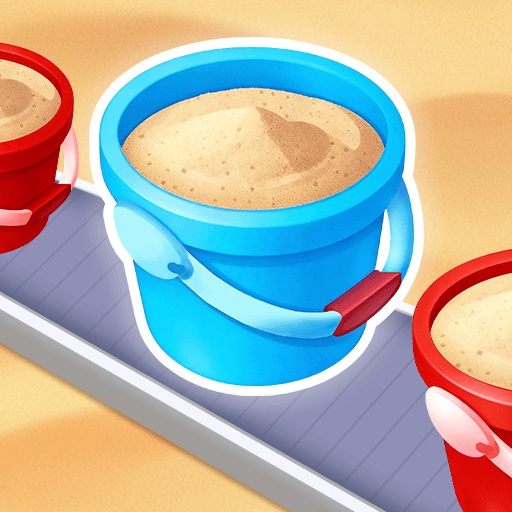
Sand Loop is not just a game about moving colorful pixels from point A to point B. It is a complex simulation of physics, logic, and timing. While the game looks calm and relaxing, becoming a top-tier player requires the precision of an engineer and the foresight of a chess grandmaster.
This guide moves beyond basic tutorials. We are going to dive deep into the mechanics that separate a good player from a perfect scorer. We will analyze how the game’s physics engine works "under the hood" and how you can exploit these rules to solve even the most tangled puzzles.
1. Understanding the Engine: How Sand Actually Behaves
To master Sand Loop, you must first understand that the sand is not a liquid. It is a collection of individual physics objects. This distinction is crucial because it explains why sand piles up the way it does.
Think of the sand grains like people walking through a narrow door.
- If you push too hard (too much speed), they jam.
- If you let them flow naturally, they spread out evenly.
Here are the core physics concepts you need to internalize:
- The Angle of Repose: This is the steepest angle at which sand can pile up without collapsing. In Sand Loop, you must calculate this angle constantly. If you try to stack sand too steeply, it will avalanche down the sides, contaminating other colors.
- Flow Rate vs. Pressure: Increasing the conveyor speed does not always mean faster sorting. If the input speed is higher than the output speed of your container, pressure builds up.
- Collision Cascades: One grain of red sand hitting a pile can cause a chain reaction. If that pile is unstable, the red grain might knock a blue grain into the wrong bin.
The Golden Rule: It is always better to have a thin, steady stream of sand than a thick, clumpy one. A thin stream gives you time to react; a clump is an accident waiting to happen.
2. The Art of Conveyor Control
Conveyors are your primary tool, but they are often misunderstood. Many players treat them like simple roads. In reality, they are accelerators. When sand lands on a belt, it inherits the belt's speed and momentum.
To achieve 100% completion on difficult levels, you need to use advanced steering techniques.
The Braking Technique
This is the single most important skill for high-level play.
- The Concept: When you need to drop sand into a specific small container, do not let the conveyor run at full speed right up to the edge.
- The Action: Slow down or reverse the belt briefly just before the drop-off point.
- The Result: The sand loses its forward momentum. Instead of "shooting" off the edge and flying everywhere, it gently slides off the belt. This gives you pixel-perfect accuracy.
The S-Curve Maneuver
When you have limited space to navigate, use the S-Curve.
- Place a conveyor going Left.
- Immediately place the next conveyor going Right.
- The sand will wiggle or "snake" down the path.
- Why use this?: It effectively lengthens the travel distance without taking up more screen space. It also slows down the sand slightly due to the friction of changing directions, giving you more control over the timing.
3. Logic Gates and Switch Timing
In the mid-to-late game, puzzles introduce switches that control diverters. This is where the game shifts from physics to logic. You are essentially building a computer circuit.
The Batch Processing Method
Do not try to sort every color simultaneously. It is impossible for the human brain to track that many variables. Instead, use "Batch Processing."
- Analyze the Source: Look at the main flow. Is it mostly Red with some Blue? Or is it 50/50?
- Prioritize the Majority: Set your switches to guide the majority color (e.g., Red) straight to the destination.
- Intercept the Minority: Manually toggle switches only when the minority color (e.g., Blue) appears.
- Flush the System: Once the batch is done, change the setup for the next color.
The Rhythm of Toggling
Switches in Sand Loop are not instant. They often have a slight delay or animation.
- Anticipate the Flow: You must click the switch before the sand arrives, not when it is there.
- Visualizing the Gap: Look for gaps between different colored clumps on the conveyor. These gaps are your "windows of opportunity" to toggle the switch safely.
It is like catching a ball. You start moving your hand to where the ball will be, not where it is right now.
4. Dealing with "Impossible" Tangles
Sometimes, despite your best efforts, the sand gets mixed. You might have a pile of Purple sand sitting on top of a pile of Yellow sand. How do you fix this without restarting?
The "Drip" Extraction Strategy
Never try to scoop out a large chunk of sand. You will inevitably pull some of the bottom color with it. Instead, use the Drip method.
- Lower the Output: Reduce the speed of the conveyor underneath the mixed pile to its minimum setting.
- Patience is Key: Let gravity do the work. The bottom layer (Yellow) will naturally touch the belt first and move away.
- Catch the Top: Once the bottom layer is exposed, quickly redirect the conveyor to catch the top layer (Purple) into a new container.
Using Obstacles as Filters
If a level provides movable obstacles or barriers, don't just use them to hold sand back. Use them to filter.
- Place a barrier low enough to stop big clumps but high enough to let single grains pass underneath.
- This acts as a sieve, breaking apart clumps and letting you sort the grains one by one.
5. Advanced Optimization Tips
Once you have solved the puzzle, how do you get the highest score? The game usually rewards speed and efficiency.
Efficiency Metrics
To maximize your score, focus on these three metrics:
| Metric | Why It Matters | How to Improve |
|---|---|---|
| Purity | The percentage of correct sand in the bin. | Use the "Braking Technique" to avoid overfilling and spillage. |
| Flow Time | How fast the level is completed. | Don't watch the sand. Watch the source. If the source is empty, speed up all belts immediately. |
| Moves | Number of conveyor/switch changes. | Plan your route before placing the first belt. Fewer edits mean a higher score. |
Mental Mapping
Before you touch a single conveyor, pause the game.
- Visualize the path of the Red sand.
- Visualize the path of the Blue sand.
- Do these paths cross?
- If they cross, can one go over the other using a raised conveyor, or must they cross at different times?
By spending 10 seconds thinking, you save 2 minutes of trial and error.
6. Common Pitfalls and How to Avoid Them
Even experienced players make mistakes. Here are the most common reasons for failing a level:
- The "Waterfall" Error: Creating a setup where sand falls too far. When sand falls a long distance, it bounces and scatters.
- Fix: Keep your drop distances short. Use conveyors to bridge gaps rather than letting gravity do the work.
- The Deadlock: Creating a loop where sand goes around in circles forever.
- Fix: Always ensure your conveyors point generally "downward" or toward an exit, never in a perfect circle unless you are intentionally buffering sand.
- Switch Lag: Forgetting that switches take time to move.
- Fix: Time your clicks to the beat of the sand flow. Click, wait, click.
Frequently Asked Questions (FAQ)
Q: I keep getting small amounts of the wrong color in my bin. How do I stop this "contamination"? A: This is usually caused by sand bouncing off the pile already in the bin. To fix it, use the "Braking Technique" mentioned above. Slow the conveyor down so the sand lands gently instead of bouncing. Alternatively, aim for the side of the bin, not the center of the pile.
Q: The level is too chaotic. I can't tell where the sand is going. A: Pause frequently. There is no penalty for pausing to think. Treat it like a strategy game. Hit pause, look at the mess, identify the biggest clump of one color, and build a route specifically for that clump.
Q: How do I handle levels where multiple colors come out at the exact same time? A: You cannot separate them by speed. You must separate them by space. Use a "Splitter" conveyor setup. Place a conveyor that pushes the top layer of the sand stream to the left, and let the bottom layer continue straight. This separates the stream into two layers, which you can then sort individually.
Q: Is it better to use long conveyors or many short ones? A: Generally, short conveyors are better. They give you more control points. If you use one long conveyor, you are committed to that path. With short ones, you can adjust the angle or speed at any moment to correct a mistake.
Conclusion
Mastering Sand Loop is about respecting the physics. It is a game that rewards patience, observation, and gentle control over brute force. The sand wants to flow; your job is to give it a path, not to force it. Remember the "Braking Technique," use "Batch Processing" for logic puzzles, and always plan your route before you start building.
By applying these strategies, you will see your completion rates rise and your stress levels drop. Now, go back to the game and show those sand grains who is boss.