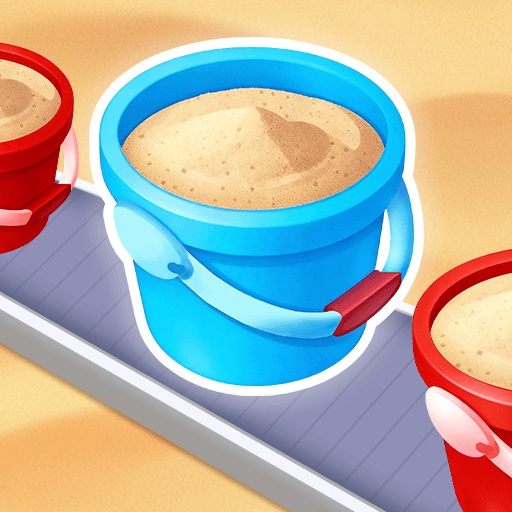
The landscape of puzzle gaming has just shifted with the release of the latest version of Sand Loop. For those of us obsessed with efficiency, leaderboards, and the perfect flow, this update is not just a patch—it is a complete overhaul of the game's physics engine and logic systems. This isn't just about watching colorful sand fall into jars anymore; it is about high-velocity logistics and split-second decision-making.
In this analysis, we are going to break down exactly what has changed in the new version. We will look at how the updated conveyor mechanics affect your run times, analyze the new physics of the sand particles, and provide hard-hitting strategies to help you dominate the speedrunning leaderboards.
1. The Physics Overhaul: Fluid Dynamics 2.0
The most immediate change you will notice in the latest version is the "feel" of the sand. In previous versions, sand particles moved somewhat independently. Now, the developers have introduced a new "Fluid Dynamics" system that changes how we approach sorting puzzles.
- Increased Particle Cohesion: Sand grains now stick together slightly when moving at high speeds.
- Momentum Conservation: When you redirect a conveyor belt, the sand doesn't just turn; it carries its forward momentum, creating a "drift" effect.
- Friction Changes: Sand piles up steeper but flows faster once it hits a critical angle.
Why this matters for speed:
Think of the old sand like dry rice, and the new sand like wet, heavy snow. In the past, you could flick a switch and the sand would obey instantly. Now, it is like driving a heavy truck. You have to brake early before a turn, or the sand will overshoot the container because of its momentum.
This change punishes "twitchy" play. If you are spamming the switch button to wiggle sand into a hole, you will fail. The new version rewards players who plan a smooth, continuous path for the sand to follow. It is no longer about reaction speed; it is about anticipation.
2. Advanced Conveyor Logic and Control Systems
The conveyor belts have received a massive upgrade in terms of logic and responsiveness. The developers have tweaked the latency and added new mechanics that allow for more complex routing strategies.
Variable Speed Belts
The update introduces belts that change speed based on the amount of sand currently on them. This is a game-changer for optimizing your throughput.
- Light Load = High Speed: When a belt is empty, it moves at 150% speed to get sand to the sorter quickly.
- Heavy Load = Low Speed: As the weight increases, the belt slows down to prevent jams.
Strategic Insight:
You can use this mechanic to your advantage. Instead of letting sand pile up, try to keep the flow "trickle-style" to maintain that high-speed bonus. It is like managing traffic on a highway; if you let everyone drive at once, you get a jam. If you space them out, everyone moves faster.
The New "Pulse" Mechanic
A brand-new feature in this version is the "Pulse" activation. Instead of just toggling a belt ON or OFF, you can now send a "pulse" that vibrates the belt for one second.
- Unclogging Jams: A quick pulse can break up static clumps of sand without stopping the flow.
- Fine Tuning: You can use a pulse to nudge a stray grain into the correct chute without redirecting the entire main stream.
This is critical for advanced levels where stopping the flow to fix one grain ruins your entire time. The Pulse mechanic allows for micro-corrections on the fly.
3. Analyzing the New "Chaos Mode" for Speedrunners
For the competitive players, the new version adds "Chaos Mode." This is where the real challenge lies. In this mode, the game introduces random events that disrupt your perfect loops.
Types of Chaos Events:
- Power Surges: Random conveyors shut down for 3 seconds.
- Wind Gusts: A lateral force pushes sand off open belts.
- Color Shifts: Occasionally, red sand becomes blue sand for a brief period.
How to adapt your strategy:
You cannot memorize a perfect route for Chaos Mode because it changes every time. Instead, you need to build "redundancy" into your sorting setup.
- Buffer Zones: Always leave a little empty space in your containers. If a color shifts unexpectedly, you need a place to dump the bad sand temporarily.
- Parallel Processing: Don't rely on a single line of conveyors. Set up two separate paths so that if one fails during a Power Surge, the other keeps working.
4. Optimization Strategies for the New Meta
With the physics changes and new mechanics, old strategies from previous versions are now obsolete. To achieve top ranks in the latest version, you need to adopt a new set of protocols.
Prioritize Flow Over Speed
It sounds counter-intuitive for a speed game, but slowing down actually makes you faster. Because of the new momentum physics, sudden stops cause sand to spill.
- Avoid sharp angles: Use 45-degree turns instead of 90-degree turns whenever possible.
- Don't overfill containers: An overflowing container creates a "floor" of sand that redirects future flow, usually into the wrong bin.
The "Split and Merge" Technique
This is the new meta technique used by top players. Instead of sorting all sand at once, you split the stream into two smaller streams.
- Split the main conveyor into two lines using a splitter gate.
- Sort Line A for Color 1 and Line B for Color 2.
- Merge the leftovers back together for the final sort.
Why this works:
By reducing the volume on each belt, you keep the belts in that "Light Load = High Speed" zone we discussed earlier. It keeps the momentum manageable and prevents the heavy friction slowdowns caused by deep piles of sand.
5. Tool and Equipment Comparison
The update also rebalanced the tools you can place on the grid. Here is a comparison of the most effective tools for the new physics engine.
| Tool Name | Update Change | Best Use Case | Speedrunning Viability |
|---|---|---|---|
| Standard Conveyor | Physics updated for momentum | General transport | High - The backbone of any route |
| The Hopper | Increased capacity | Buffering large amounts of sand | Medium - Good for safety, bad for speed |
| Pulse Emitter | New Item | Breaking jams, micro-adjustments | Very High - Essential for Chaos Mode |
| Color Gate | Faster reaction time | Filtering specific colors | High - Required for advanced sorting |
| Gravity Tube | Friction reduced | Fast vertical drops | High - Faster than conveyors for drops |
Key Takeaway: The Pulse Emitter is the MVP of this update. Learning to place Pulse Emitters near sharp corners will save you seconds on every complex level.
Frequently Asked Questions (FAQ)
Q: I keep getting jams at the intersections where conveyors meet. How do I fix this? A: This is likely due to the new "momentum carry" physics. The sand is moving too fast to make the turn. Try placing a Pulse Emitter right before the intersection to vibrate the sand into a single file line, or slow down the feeding belt slightly.
Q: Is the "Chaos Mode" suitable for beginners? A: Not really. Chaos Mode requires you to fully understand the basic mechanics first. We recommend mastering the standard levels and getting a 3-star rating on all of them before attempting Chaos Mode. It is designed for players looking for a hardcore logic challenge.
Q: How do I deal with the "Wind Gust" event in Chaos Mode? A: Wind Gusts only affect sand that is not covered. If you know a level has a Wind Gust risk, build your conveyors against walls or use the covered tunnels (if unlocked) to protect your sand from being blown off the belt.
Q: Does the "Split and Merge" technique work on mobile devices? A: Yes, but it requires quick fingers. On touch screens, we recommend zooming in to make sure you hit the small splitter switches accurately. The new hitboxes for switches are larger in this update, which helps, but precision is still key.
Conclusion
The latest version of Sand Loop is a significant step forward for the genre. It successfully bridges the gap between a relaxing puzzle game and a high-stakes logistics simulator. The introduction of Fluid Dynamics 2.0, the Pulse mechanic, and the Chaos Mode gives the game a much higher skill ceiling.
For the speed demons out there, the message is clear: stop treating the sand like individual pixels and start treating it like a fluid. Master the flow, respect the momentum, and use the new tools to control the chaos. The leaderboards are waiting for you to rewrite them.