
Level 230
HARDHow to solve Sand Loop level 230? Get instant solution for Sand Loop 230 with our step by step solution & video walkthrough. Sand Loop 230 tips and guide.
Play Sand Loop Now
Experience the puzzle challenge firsthand
Game Screenshots
Sand Loop Level Guides
Level Overview: The Cozy Cottage Challenge
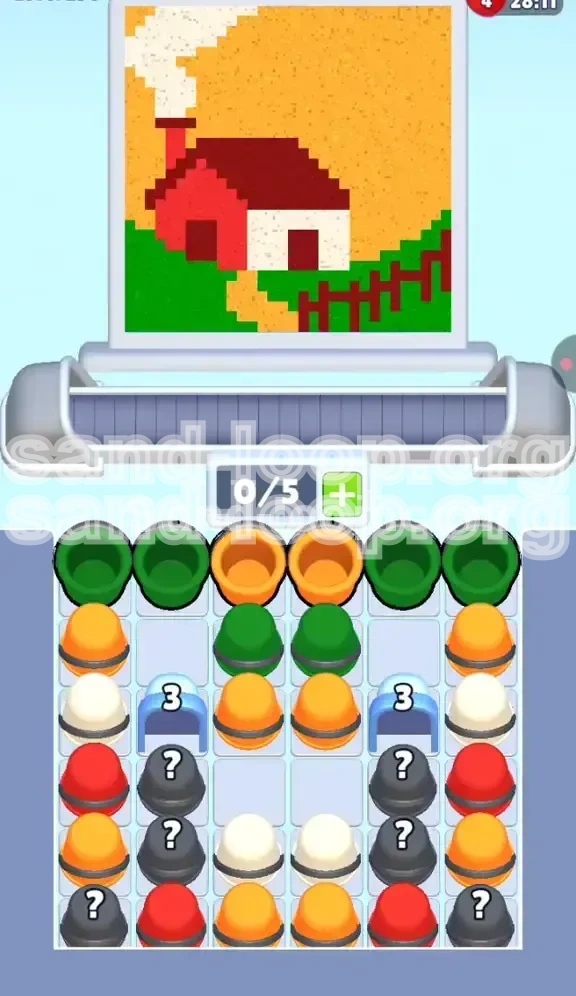
Welcome to Level 230, a stage that requires patience rather than speed. This level is classified as a Digging Stage, meaning your primary enemy is not the clock, but the physical depth of the sand tray. You are tasked with reconstructing a pixel art scene known as the "Cozy Cottage," featuring a bright red house, a white facade, and a distinctive chimney against a vibrant sunset sky.
The Visual Composition
The target image is deceptively simple. It consists of four main color blocks: a massive yellow/orange sky, a green foreground for the grass, a central red structure for the house and roof, and white details for the front wall and smoke. The complexity arises because the colors you need most (Red and White) are buried the deepest, while the background colors (Green and Orange) clutter the top layers, threatening to clog your conveyor belt before you can even start building the house.
Core Mechanics: Digging Depth
Unlike time-attack levels, here you must manage the verticality of the puzzle. The tray is layered like an onion. You cannot simply pick and choose the colors you want; you must mechanically remove the top layers of "dirt" (the grass and sky colors) to expose the "treasure" (the house colors) underneath. If you fail to clear the top layers efficiently, the conveyor belt will jam with unusable background colors.
Obstacle Analysis: Ice and Mystery
This stage introduces two specific mechanics designed to slow you down: Ice Blocks and Mystery Cups. The Ice Blocks, marked with a "3", act as gatekeepers in the middle of the tray. They block access to the lower tiers until you clear adjacent cups. The Mystery Cups, which appear grey with a question mark, are high-risk gambles that usually contain the critical Red cups needed for the final phase of the level.
Winning Conditions
To achieve a three-star rating on this level, you must complete the painting without letting the conveyor belt overflow. The margin for error is roughly 2-3 wrong moves. You need to maintain a rhythm of "dig and dump"—digging up the necessary colors and dumping the unnecessary ones quickly to keep the belt moving. Efficiency is measured by how quickly you can break the Ice Blocks to access the Red layer.
Step-by-Step Walkthrough: Phase 1 - The Landscape
The first third of the level is entirely about removing the environmental noise. You cannot build the cottage until the sky and grass are gone.
Step 1: The Center Strike
As the level begins, ignore the outer edges. Look directly at the center of the top row. You will see a pattern of Green - Green - Orange - Orange - Green - Green. Tap the two Orange cups in the absolute center first. This is the most efficient way to start clearing the massive yellow sky area. By starting here, you open up the center column for future drops.
Step 2: Clearing the Flanks
Immediately after tapping the center Oranges, move your attention to the Green cups on the far left and far right. Since the grass in the image only covers the bottom corners, you do not need these cups for long. Clear them aggressively. Do not hold onto Green cups hoping to save them for later; the tray is full of them, and you need the conveyor belt space.
Step 3: Uncovering the Ice Blocks
After the first few rows are cleared, you will expose the Ice Blocks in the subsequent rows. These are marked with the number "3". You will notice banded Orange and Green cups sitting directly on top of these blocks. Do not waste moves on cups that are not touching the Ice yet. Focus entirely on the cups that are physically adjacent to the Ice Blocks. Every tap on these cups lowers the counter, bringing you closer to the middle layer.
Step 4: Managing the Belt
During this phase, your 5-slot conveyor belt will fill up rapidly with Orange and Green. Do not let these colors sit. If the pour point is currently over a green patch of grass and you have a Green cup, use it. If not, click the cup to "dump" it (turn it into sand) to make room for the next cup coming down the chute. Never let the belt get full; a full belt means no new cups spawn, which stops you from digging.
Step-by-Step Walkthrough: Phase 2 - Breaking Through
Once the top landscape is removed, you hit the hard mechanical barrier of the level. This is the most critical phase where runs often fail due to poor planning.
Step 5: The Ice Block Strategy
The Ice Blocks act as a dam. They must be destroyed to access the White and Red cups below. The strategy here is Proximity Triggering. You must clear the cups sandwiched between the two Ice Blocks first. Usually, these are Orange or Green banded cups. By clearing the center, you allow gravity to pull new cups down against the Ice Blocks, accelerating the process of lowering the counter from 3 to 0.
Step 6: The White Cup Reveal
The moment the Ice Blocks shatter, you will gain access to the White Cups. These are located in the middle rows. However, you must be careful. The White cups are used for the house wall and the smoke. If the smoke cloud on the canvas is not currently passing under the pour point, do not pick up the White cup yet. Let it sit in the tray for a second until the canvas is ready. Picking it up too early clogs your belt.
Step 7: Mystery Cup Introduction
As you dig deeper, grey Mystery Cups will start appearing. This is the danger zone. In Level 230, Mystery Cups frequently contain the Red color you need for the roof. However, they can also turn into useless Green. To survive this, ensure you have at least 2 empty slots on your conveyor belt before you tap a Mystery Cup. This gives you the buffer needed if the cup turns into a color you can't use immediately.
Step 8: The Mid-Level Jam
A common issue here is having a conveyor belt filled with Orange cups while you are waiting for White or Red. If you find yourself stuck, look at the canvas. Is there any remaining sky? If yes, use the Orange cups to finish it. If the sky is done, you must sacrifice (dump) the Orange cups manually to free up space for the colors you actually need.
Step-by-Step Walkthrough: Phase 3 - The Construction
You are now in the home stretch. The Ice is gone, the sky is clear, and you have access to the building materials.
Step 9: The Roof and Walls
Prioritize the Red Cups for the roof. The roof is a large surface area, so it consumes Red cups quickly. Unlike the fence, the roof is forgiving. Pour Red whenever the roof is under the pour point. Do not save Red cups for the roof at the expense of the fence; the roof requires volume, so keeping the flow steady is better than hoarding.
Step 10: Handling the Chimney Smoke
The chimney smoke requires White cups. Since the smoke is a small detail at the top of the house, it requires precise timing. Wait for the smoke graphic to cycle into the pouring area. If you have a White cup ready, tap it the moment the smoke appears. If you miss the timing, the White cup will ride your belt to the end and fall off, wasting precious resources.
Step 11: The Fence Crisis
The final obstacle is the red fence in the bottom right corner. It is small and intricate. The challenge here is that by the time you reach the bottom of the tray, you might run out of visible Red cups. You will likely have to rely on Mystery Cups to provide the final few Red doses. Tap Mystery Cups only when you have an open slot and are ready to pour immediately onto the fence.
Step 12: Final Cleanup
At the very end, you will likely have a few scattered pixels of Green or Orange left on the canvas, or perhaps a few stray pixels of the house unpainted. Use whatever remaining cups are in the tray or coming down the chute to fill these gaps. Do not worry about color efficiency here; just clear the board to finish the level.
Key Tips and Strategy Analysis
To master Level 230, you need to understand the math behind the color distribution.
Tip 1: The 60/40 Rule
Approximately 60% of your tray consists of background colors (Green/Orange), while only 40% consists of objective colors (Red/White). This imbalance means you must be aggressive about discarding background colors. Do not treat every cup as precious. Treat Green and Orange as "trash" that needs to be processed to get to the "treasure" underneath.
Tip 2: Conveyor Belt Management
Your conveyor belt has 5 slots. A pro strategy is to keep 1 slot empty at all times during the digging phase. This "buffer slot" allows you to quickly grab a critical color (like a White cup revealed from ice) without having to dump a current cup first. If your belt is full (5/5), you are playing too slowly and risking a game over.
Tip 3: Ice Block Proximity Math
The Ice Blocks have a count of 3. This means you need exactly 3 adjacent clears to break them. Plan your moves so that you are always clearing a cup next to the ice. If you have a choice between clearing a cup on the far left (no ice) or a cup in the center (touching ice), always choose the center. It is mathematically more efficient for progression.
Tip 4: Mystery Cup Probability
Based on the level design, Mystery Cups in the bottom half have a high probability (estimated 70%) of turning into Red. However, there is still a 30% chance they turn into Green. Never tap a Mystery Cup when your belt is full. If you tap a Mystery Cup and get a Green when you need Red, and you have no empty slots, that Green cup will block you from picking up the Red cup that spawns right behind it.
Tip 5: Timing the Smoke
The smoke moves in a loop. Do not stare at the tray; watch the canvas. The visual cue for the smoke is subtle. If you are holding a White cup and the smoke is not in the pouring zone, look at the roof or fence instead. Do not let the White cup occupy a slot if you can help it; drop it if you must, to keep the belt moving, and hope another White appears later.
Common Mistakes and Stuck Solutions
Even experienced players can get tripped up by the specific mechanics of this level.
Mistake 1: Hoarding Colors
Many players try to save Red cups from the top of the level for the bottom. This is a mistake. The top of the level contains almost no Red; it's mostly Green and Orange. If you save cups unnecessarily, you clog your belt. Use cups immediately if the canvas is ready for them.
Mistake 2: Ignoring the Ice Blocks
Focusing only on the picture and ignoring the Ice Blocks is a guaranteed failure. If you don't actively break the ice, you run out of moves. The cups behind the Ice are essential for completion. Always prioritize the Ice counter over filling in a patch of grass or sky.
Mistake 3: The Mystery Cup Spam
Tapping all Mystery Cups at once is tempting but dangerous. If you tap three Mystery Cups in a row and they all turn Green, your belt will be clogged with useless Green while you desperately need Red for the roof. Tap Mystery Cups one at a time, clearing the belt before tapping the next.
Solution: What to Do When Stuck
If you are stuck and nothing matches, look at the bottom right of the tray. Is there a cup hidden behind a wall or ice? If yes, you must clear the obstruction. If no, you might need to manually dump cups from your belt to change the order of the queue. Sometimes, dumping a cup forces the game to spawn a new color that you actually need.
Solution: Dealing with Overflow
If your belt is full and the next cup in the chute is the color you need (e.g., Red for the fence), you have no choice but to dump a cup from your belt immediately. Don't wait. Dump the least useful cup (usually Green or Orange) to grab the Red before it falls off the chute.
Speed Run Tips and Shortcuts
For players looking to optimize their time or achieve a high score, speed is of the essence.
Shortcut 1: The Simultaneous Tap
At the very start of the level (Step 1), you can actually tap multiple pairs of colors rapidly. As soon as the game starts, tap the center Oranges, then immediately tap the outer Greens. Since these are independent colors and don't interfere with the immediate pour point, you can clear the top row in under 2 seconds.
Shortcut 2: Pre-Loading the Belt
As you are breaking the Ice Blocks, try to time your dumps so that you have 2 empty slots right as the block breaks. This allows you to instantly scoop up the White cups that are revealed without waiting for the animation of the ice shattering to finish.
Speed Tip: Ignore Perfection
Don't aim for 100% pixel perfection in the early stages. It is faster to fill the general shape of the sky and grass roughly (leaving small gaps) and focusing on digging down. You can always patch the small holes in the grass/sky later when you are desperate for cups and waiting for the fence to align. The priority is depth, not surface beauty.
Speed Tip: The "Dump and Run"
If you have a full belt and the next cup is Red, but the fence isn't ready yet, dump a cup anyway to grab the Red. It is better to have the Red riding the belt (ready to use) than to leave it in the chute where it might get buried or cause a spawn delay. This keeps your inventory active.
Final Optimization
Level 230 is a test of resource management. The fastest runs are the ones where the player never stops clicking. Even when watching the canvas, your eyes should be scanning the tray for the next Ice-adjacent cup. Keep the flow constant, and the Cozy Cottage will be built in record time.