
Level 270
HARDHow to solve Sand Loop level 270? Get instant solution for Sand Loop 270 with our step by step solution & video walkthrough. Sand Loop 270 tips and guide.
Play Sand Loop Now
Experience the puzzle challenge firsthand
Game Screenshots
Sand Loop Level Guides
Level Overview: The Calico Cat & The Ice Gauntlet
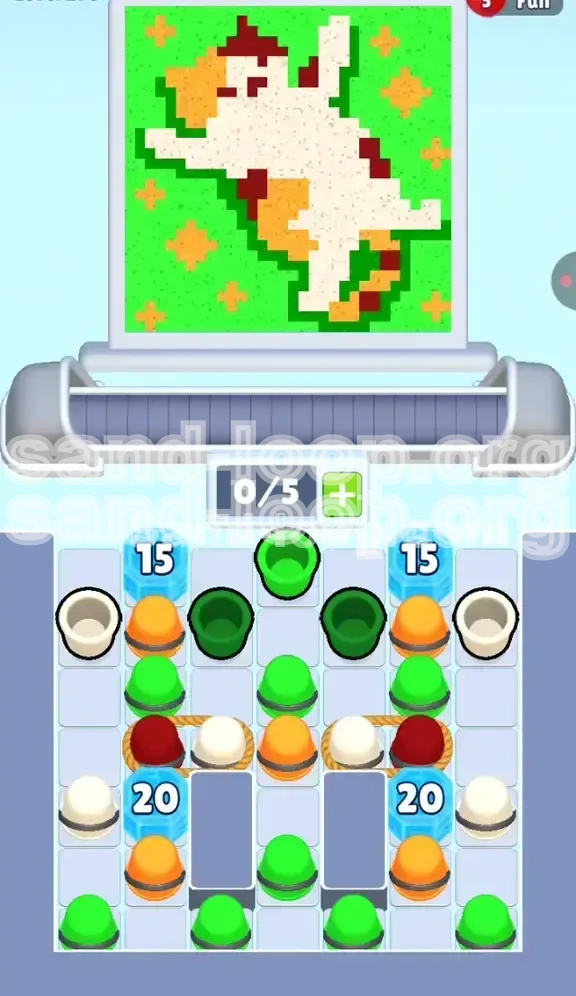
Sand Loop Level 270 is deceptively tranquil. The visual presents a charming Calico Cat lounging in a field of green, accented by bright orange stars and deep maroon patches. However, do not let the cute pixel art fool you; this level is a logistical nightmare designed to test your inventory management skills. Unlike standard levels where you can often clear a path by brute force, Level 270 is a rigid "Slot Management" puzzle.
The defining feature of this stage is the extreme disparity between the color you are given and the color you need immediately. The game floods your conveyor belt with Green cups, yet the main objective—the Cat's body—requires White. If you greedily fill your inventory with the wrong color, you will create a deadlock that forces a restart. This is not a level about speed; it is about discipline and precise numerical counting against heavy Ice Blockades.
The "Ice Breaker" Mechanic
The core challenge of Level 270 is the "Ice Breaker" mechanic. The board is choked by two distinct tiers of ice barriers. At the top, you face vertical "15-count" Ice Blocks, and midway through, you encounter massive "20-count" Ice Blocks. These numbers represent the specific amount of adjacent clears required to shatter them.
Many players fail because they treat these blocks like standard obstacles. In this level, the Ice Blocks act as a dam. Until you break the first set of 15-count blocks, you have extremely limited access to the bottom half of the board. You are essentially fighting a war of attrition in a very small space. If you waste moves clearing cups that do not touch the ice, you will run out of viable moves before the blocks break.
Inventory Capacity (The 5-Slot Limit)
Your conveyor belt has a maximum capacity of 5 slots. In most levels, keeping your belt full is a good strategy. In Level 270, keeping your belt full is a fatal error. Because the color demand fluctuates wildly between the Cat's White body and the Green background, having 4 or 5 Green cups when the nozzle switches to Orange will cost you the game.
Successful completion requires you to maintain a "2-slot buffer." This means never letting more than 3 cups sit on your belt unless you are 100% certain of the next 3 nozzle colors. This buffer allows you to pick up crucial "Star" colors without being forced to dump useful items.
The Color Distribution Trap
The level creates a psychological trap via color density. Approximately 60% of the available cups in the initial phase are Green (background), while only 25% are White (Cat body) and 15% are Red/Orange (Accents). The nozzle, however, prioritizes the main image: the Cat.
This creates a massive bottleneck. You will see plenty of Green cups, but you must resist the urge to grab them. If you fill your belt with Green, you won't have space for the White cups needed to break the ice. You must train yourself to ignore easy pickups and focus strictly on what the nozzle is currently demanding.
Visual Obstructions: The Rope Barrier
Midway through the puzzle, you will encounter a horizontal rope barrier binding five key cups together. These cups contain vital colors needed for the "20-count" ice phase. You cannot move these cups individually.
This rope acts as a "hard stop" for your progress. The only way to snap this rope is to clear the cups directly above it. This creates a cascade effect: you must fully clear the top section (breaking the 15-count ice) to trigger the gravity drop that snaps the rope. Attempting to clear the bottom section first is impossible, so adjust your strategy to focus exclusively on the top half for the first 30% of the game.
Strategic Objectives: How to Beat Level 270
To conquer Level 270, you need to shift your mindset from "painting the picture" to "unblocking the board." Your primary goal is not to fill in the cat's fur, but to shatter the ice that restricts your movement. If you focus solely on the art, you will run out of moves. If you focus on the ice, the art will complete itself as a byproduct.
Objective 1: Shatter the Upper Defenses (Top 15s)
Your first and most critical objective is to destroy the two "15-count" Ice Blocks located at the top of the board. These blocks are pinching the upper level, preventing cups from falling down to the main play area. You have a limited number of "active" cups available to hit these blocks.
Every move you make in the first phase must contribute to reducing this number. Look at the board: identify which cups are physically touching the ice. Those are your only targets. Any cup that is not touching the ice is effectively a "waste of a move" for the first 15-20 turns. Prioritize White and Red cups here, as they are usually adjacent to these initial blocks.
Objective 2: Trigger the Rope Snap
Once the upper ice is gone, your next target is the horizontal rope. This is a mechanical objective. You cannot clear the cups tied by the rope until the rope itself is gone.
The rope snaps when the cups resting on top of it are cleared. This means you must finish clearing the "neck" and "chest" area of the cat. As these cups vanish, the gravity shift will snap the rope, freeing the trapped cups below. Do not attempt to clear the background behind the rope yet; focus only on the vertical column of cups directly above the rope knot.
Objective 3: Survive the "20-Count" Grind
The bottom half of the level is guarded by the massive "20-count" Ice Blocks. This is the "slog" phase of the game. By this point, your nozzle will likely be cycling rapidly between Green (background) and Orange (stars).
Your objective here is efficiency. You need to generate 20 clear points on these blocks. The best strategy is "Lateral Clearing." Instead of pulling cups from deep within the stack, pull the cups that are side-by-side with the ice. A single cleared cup touching the ice does 1 damage. A chain reaction does 1 damage per cup. Slow, rhythmic clearing is safer here than trying to set up huge combos, which might clog your belt with the wrong colors.
Objective 4: The Star Cleanup
The final objective is the placement of the Orange Stars. These are tricky because they are small, isolated pixels surrounded by Green. If you fill the background with Green sand too early, you will "paint over" the star locations, making it nearly impossible to slot the Orange cups in the correct position later.
You must leave the "Star Zones" empty until you have the Orange cups in hand. This requires patience. You may have 90% of the background filled, but you must wait for the nozzle to demand Orange before finishing the last 10% around the stars.
Step-by-Step Walkthrough: The Complete Path
This section provides a linear, turn-by-turn logic to follow. The exact cup shuffle depends on your specific board randomization, but the *logic* remains constant.
Phase 1: The Surgical Strike (Turns 1-15)
Goal: Reduce the top "15" Ice Blocks to zero.
At the start, ignore the background. Do not pull Green cups even if they are easy to grab. Look at the nozzle. If it is asking for White or Red, scan the board for cups of that color that are touching the Ice Blocks. Pull *only* those.
If the nozzle asks for Green, check if there is a Green cup touching the ice. If yes, pull it. If no, wait or pull a cup that creates a chain reaction touching the ice. If you have no moves that touch the ice, pull a cup that clears space to *get* to the ice. Never fill your belt beyond 3 cups during this phase.
Phase 2: Freeing the Neck (Turns 16-30)
Goal: Clear the column above the rope.
Once the 15-count ice shatters, new cups will slide down. You will now see the rope barrier. The nozzle will likely shift to filling in the Cat's head and chest. Clear the cups directly above the rope. As you clear them, the rope will strain and eventually snap.
When the rope snaps, the trapped cups (usually Red and White) will merge into the main board. This creates a flood of new colors. Immediately pause and check your belt. If you have Green cups occupying space, you might need to dump them (if the game mechanic allows) or use them quickly to make room for the newly available Red/White cups.
Phase 3: The Ice Wall Grind (Turns 31-60)
Goal: Chip away the "20" Ice Blocks.
This is the hardest part. You are now working on the bottom half. The nozzle will probably be stuck on "Green" for a long time. Use this to your advantage. Pull Green cups that are adjacent to the "20" ice blocks. Clearing Green background here is efficient because it serves two purposes: it fills the art *and* it breaks the ice.
However, keep an eye on the "Stars." Do not clear the Green cups that are immediately next to an Orange Star. Leave those "holes" in the background open. You will fill them later. Focus your clearing efforts on the left and right sides of the ice blocks to maximize your reach.
Phase 4: The Star and Finish (Turns 60+)
Goal: Place Orange Stars and finish background.
Once the "20" blocks break, the board is fully open. The nozzle will cycle to Orange. This is your cue to finally fill those Star holes you carefully avoided in Phase 3. Place the Orange cups into the star slots.
After the stars are placed, the nozzle will likely demand Green one last time to finish the remaining patches of grass. At this point, the "Stress" is over. You can safely pull multiple Green cups to finish the level, as the Ice Blocks and complex Ropes are now a memory.
Color Order Strategy: Prioritizing the Palette
The order in which you process colors is the difference between a win and a loss. The game tries to force you into a bad order; you must resist.
1. The Priority of White (The Cat)
White is the currency of this level. The Cat's body is the largest contiguous color block. The game logic prioritizes filling the largest shapes first to reduce pixel count. Therefore, the nozzle will demand White early and often.
Action: Always keep 1-2 White cups in reserve if possible. If the nozzle is Green but you see a White cup available that touches an Ice Block, consider holding off on Green (if you have Green in inventory) to switch to White. White clears the ice faster because it appears more frequently in the "danger zones" near the top blockers.
2. Managing Red (The Ears and Tail)
Red is a "Bridge Color." It connects the White body to the Orange accents. The Red cups are usually located in the center of the board or trapped by the rope.
Action: Do not hoard Red. If the nozzle asks for Red, clear it immediately. Red cups are often blockers themselves; if you hold onto them, they take up a slot that could be used for White or Green. Red is rare enough that you don't need to plan for it far in advance, but common enough that ignoring it will clog your inventory.
3. The Danger of Green (The Background)
Green is the trap. It is abundant. It is everywhere. And it is your enemy until the late game.
Action: Treat Green as "filler." Only pull Green cups when you have open slots (2+ empty spaces) and the nozzle is currently Green. Never pull Green cups in anticipation of the nozzle changing to Green, because the change might take 10 turns, during which time you could have picked up useful White cups. In the final phase, Green becomes your friend, but in the first half, it is just clutter.
4. Timing the Orange (The Stars)
Orange is the "Keyhole Color." It is scarce and specific. The stars are small targets.
Action: If you pick up an Orange cup early, do not use it unless the nozzle is demanding it *and* you can place it correctly. Placing an Orange cup incorrectly (just to clear space) is a waste. The stars are usually isolated; if you miss the specific slot, you might not get another Orange cup for 20 turns. If your belt is full and you have an Orange cup, you must use your other colors first to free up a slot, rather than dumping the Orange cup.
Advanced Tactics & Speed Run Tips
Once you understand the basics, you can optimize your playstyle for faster clears and higher scores.
Speed Run Tip: The "Empty Belt" Start
Most speedrunners start Level 270 with an aggressive strategy: Do not fill your belt at all for the first 5 moves. Watch the nozzle cycle. If it starts on Green, wait. Do not pull Green cups. Wait for it to cycle to White. By having an empty belt, you can react instantly to the color you *need* rather than the color the game *gives* you. This prevents the "Green Lock" that slows down most players.
Optimization: Ice Breaking Combos
You can break ice blocks faster than 1 point per cup if you create a "Gravity Chain." If you clear a cup that causes a stack of 3 cups to fall, and *all* of those falling cups touch the ice, you deal 1+3 = 4 damage in a single turn.
Tactic: Look for "tall" stacks of cups next to the ice. Clear the bottom support cup. This causes the whole stack to slide and smash against the ice. This is significantly faster than clearing cups one by one from the top.
Stuck Solution: The "No Move" Scenario
If you are stuck and the nozzle is asking for a color you don't have (e.g., asking for White, but you only have Green/Red on the board and in your belt), you have entered a "Deadlock."
Solution: You must "waste" a turn. Look for the least useful cup on the board (usually a Green cup in a safe zone). Clear it to force the board to shuffle and spawn new cups. This resets the RNG (Random Number Generator). It is better to lose one turn wasting a move than to stare at a frozen screen for 2 minutes. Do not be afraid to make a non-optimal move to refresh the cup pool.
Scoring Tip: Maximize Multiplier
Your score multiplier increases with consecutive clears without "pausing" (waiting for the nozzle).
Tactic: To keep the multiplier high during the "20-count Ice" phase, try to predict the next color. The game often alternates in pairs (Green, Green, White, White). If you just cleared two Greens, anticipate White. Pull White cups immediately after the second Green clears, before the nozzle even switches. This "Pre-loading" keeps your combo timer running and results in a significantly higher score at the end of the level.