
Level 288
HARDHow to solve Sand Loop level 288? Get instant solution for Sand Loop 288 with our step by step solution & video walkthrough. Sand Loop 288 tips and guide.
Play Sand Loop Now
Experience the puzzle challenge firsthand
Game Screenshots
Sand Loop Level Guides
Sand Loop Level 288: Neon Cat Walkthrough Overview
Welcome to the ultimate strategy guide for Sand Loop Level 288, widely known as the "Neon Cat" challenge. This level marks a significant difficulty spike compared to previous stages, introducing a complex mechanic known as "Ice Block Endurance." Unlike standard levels where you focus purely on sorting and pouring, Level 288 forces you to balance resource management with tactical board clearing.
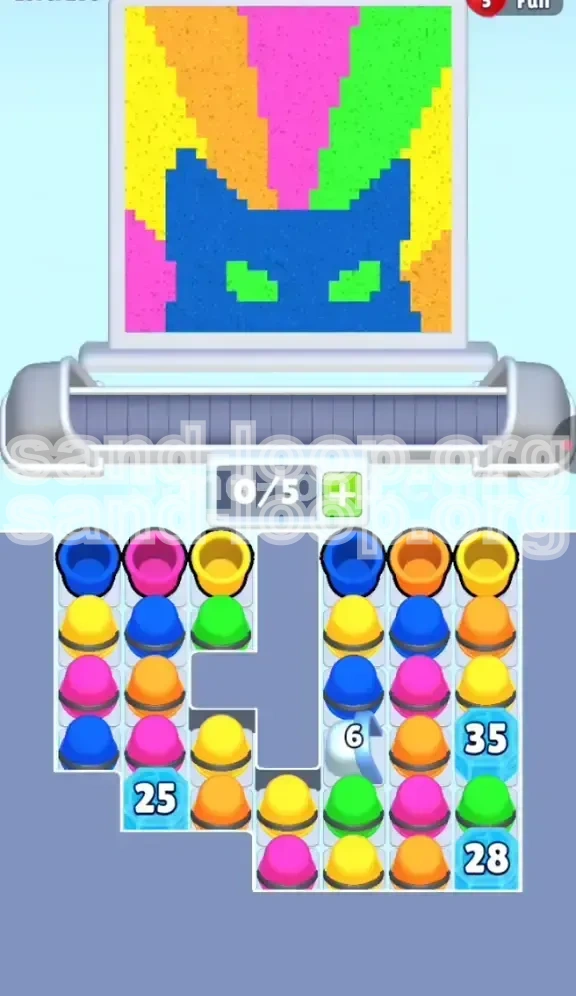
The level features a striking visual design: a large Blue Neon Cat head with glowing green eyes set against a "starburst" background of yellow, orange, pink, and green beams. The visual appeal is deceptive; the real challenge lies beneath the surface in the form of four Ice Blocks with high hit-points (HP) locking your crucial color supplies. To succeed, you must act quickly to break these seals while simultaneously filling the main image to avoid running out of moves.
The Ice Block Endurance Mechanic
The defining feature of Level 288 is the presence of four Ice Blocks that lock specific columns of your supply tray. These are not standard locks; they function like barriers with health points that must be "chipped away" by matching adjacent cups. You cannot access the colors trapped underneath these blocks until you destroy them.
Visual Analysis: The Neon Cat
Your target image is dominated by a massive Deep Blue area representing the cat's head. This is your primary color sink. Interspersed are tiny islands of Neon Green for the eyes and radiating stripes of warm colors (Yellow, Orange, Pink) for the background. The high contrast between the blue face and green eyes is the main aesthetic risk of this level.
The Soft-Lock Danger
The most common failure state in Level 288 is the "Soft Lock." Because the Ice Blocks trap essential background colors (Yellow, Orange, Pink) at the bottom of the tray, if you focus solely on pouring Blue for the cat's face, you will run out of available moves in the open area. The game will end not because you made a mistake, but because you have no valid matches left on the board.
Board Layout and HP Distribution
The tray is segmented asymmetrically. The top sections are open, providing immediate access to Blue cups. However, the bottom sections are guarded by Ice Blocks with HP values of 25, 6, 35, and 28. The right side is particularly problematic due to the "35 HP Tower," which requires a sustained effort to break.
Strategic Importance of the Right Side
While the left side has a 25 HP block, the right side is the critical bottleneck. It contains a weak 6 HP block adjacent to the massive 35 HP block. Prioritizing the destruction of the 6 HP block is the single most important opening move to create a cascade effect and stabilize the board flow.
Primary Objectives and Completion Strategy
To conquer the Neon Cat, you need a clear plan of action. Randomly clicking cups will lead to a swift loss. Your strategy must shift dynamically between "Mining Mode" (breaking ice) and "Painting Mode" (filling the canvas).
Objective 1: Breach the Right-Side Defenses
Your immediate goal is to shatter the 6 HP Ice Block on the right column. This block acts as a plug. Once removed, the cups above will fall, potentially triggering chain reactions that damage the adjacent 35 HP block. If you ignore this for even 10 moves, you will likely run out of space on the board.
Objective 2: Sustain the "Blue Rush"
While attacking the ice, you must manage the overflow of Blue cups. The cat's face is large (covering approximately 60% of the canvas), so you will be processing a high volume of Blue liquid. You must pour Blue consistently to keep your tray slots open, ensuring you don't clog your conveyor belt.
Objective 3: Isolate the Green Eye Color
The Neon Green eyes are the "danger zones" of this level. They are small, isolated pixels in a sea of blue. You must preserve Green cups until the Blue face is fully formed, or at least until there is a clear, distinct boundary. Pouring Green too early will result in color contamination, ruining the sharp definition of the eyes.
Objective 4: Unlock the Warm Palette
The background stripes require Yellow, Orange, and Pink. The majority of these are trapped under the 25 HP and 28 HP blocks. You must specifically target matches adjacent to these blocks, even if it means passing up "easier" matches in the center of the board.
Objective 5: Avoid Conveyor Clogging
Maintain a rhythm where you never fill your pouring slots to maximum capacity (5/5) until the very end. Keeping 2 or 3 slots open allows you to rapidly cycle cups from the tray to the conveyor, which is essential for finding the specific matches needed to chip away at the high-HP ice blocks.
Objective 6: The Final Polish
Once the ice is broken and the main colors are down, the final challenge is precise placement. You will likely have stray Green cups remaining. These are for the eyes. Ensure the Blue sand has completely settled before sending these final Green cups to achieve the perfect "glowing eye" effect.
Optimized Color Processing Order
The order in which you process colors is not just about aesthetics; it is a survival mechanism. Processing colors in the wrong order is the leading cause of failure in Level 288.
Phase 1: The Blue Foundation (First 50% of Gameplay)
Blue is your "dump" color. It has the highest volume and the largest target area. You should process Blue cups almost immediately as they appear. This does two things: it builds the base of your image and, more importantly, clears tray space to give you access to the cups hidden beneath.
Phase 2: The Warm Stripe Sequence (Mid-Game)
Once the right-side ice begins to crack, you will uncover Yellow, Orange, and Pink cups. Do not pour these randomly. Follow the background pattern. Typically, you should pour them in a sequence that matches the radiating beams (e.g., alternating Pink and Orange). Doing this prevents the colors from mixing in the dispenser nozzles.
Phase 3: The Green Isolation (End-Game)
Resist the urge to use the Green cups you uncover early. Place them in the conveyor slots and let them sit. Green should be the very last color you process. Why? Because the eyes are small. If you pour Green while you are still working on the face or background, you risk the dispenser dispensing Green over a Blue area, creating a muddy teal mess that cannot be fixed.
Understanding Dispenser Logic
The game's dispenser tries to optimize flow. If you have a full queue of Blue, it locks out other colors. By aggressively pouring Blue first, you force the dispenser to cycle through its queue, bringing the hidden warm colors (Pink/Yellow) to the front of the line faster.
Handling Color Contamination
If you accidentally pour a small amount of a wrong color (e.g., a splash of Pink on the Blue face), do not panic. However, you must prioritize covering that mistake immediately with the correct color (Blue) before it dries or before the next layer is applied. This "cover-up" tactic costs valuable moves, so accuracy is preferred.
Efficiency Metrics
Aim for a color distribution ratio of roughly 60% Blue, 25% Warm Colors (combined), and 15% Green. If you find yourself pouring more than 20% Green before the face is done, you are rushing the detail work and risking the integrity of the image.
Step-by-Step Walkthrough Instructions
Follow this actionable sequence to navigate the level from the first move to the final pour.
Step 1: Identify and Attack the 6 HP Block
As soon as the level loads, look at the right-most column. Identify the Ice Block with "6" HP. Look directly above it in the tray. You will likely see a stack of Blue and Orange cups. Your first 5 moves must be matches within this column. Do not touch the center of the board yet. Your goal is to reduce this block to 0 HP immediately.
Step 2: Manage the Cascade Effect
When the 6 HP block breaks, the cups above it will tumble down. This usually creates a "Combo" or "Chain Reaction." Watch the tray carefully. This tumble often brings new cups into alignment that are adjacent to the 35 HP block. Immediately capitalize on these new alignments. Do not wait; start chipping the 35 HP block while the momentum is high.
Step 3: Execute the "Blue Flood"
While the right side is settling, you will have accumulated Blue cups in the top-middle of the tray. Send these to the conveyor. Fill the slots with 3 Blue cups at a time. Pour them. This clears the tray. While the sand is pouring, scan the board for any matches touching the Left-Side 25 HP Ice Block. You need to start working on that to free up the Pink cups.
Step 4: The Mid-Game Transition
By now, the 35 HP block is likely damaged but still standing. The 6 HP block is gone. The 25 HP block on the left is maybe half-health. The board is tighter now. Look for "Stray Matches." These are single matches of Yellow or Orange that are not near any ice. Match them to shuffle the board. Shifting the cups might reveal a match adjacent to your remaining ice blocks.
Step 5: Breaking the Big Towers
This is the hardest part. The 35 HP and 28 HP blocks are stubborn. You are now low on open space. You need to make a choice: match two cups in the open, or match one cup next to ice? The answer is almost always: Match the cup next to the ice. Even if it feels inefficient, you must break the ice to get the fuel (colors) needed to finish the level.
Step 6: The Final Filling Spree
The moment the last Ice Block shatters (usually the 35 HP one), the bottom of the tray will flood with Yellow, Orange, and Pink. The board is now safe. You can switch to "Auto-Pilot" mode. Load the conveyor to max (5/5). Pour the warm colors to finish the starburst background. Once the background is 100% done, look at your remaining cups. They should be Green. Pour the Green to finish the eyes.
Pro Tips and Mistakes to Avoid
Even with a strategy, the margins for error in Level 288 are tight. Use these tips to stay ahead of the difficulty curve.
Mistake: Ignoring the "Quiet" Matches
Many players focus on the center of the board where the cups are abundant and easy to match. This is a trap. While you are matching easy Blues in the center, the turn counter is ticking, and your Ice Blocks remain at full strength. Avoid the temptation to make "clean" matches in the open; prioritize "ugly" matches against the ice walls.
Mistake: Queue Clogging with Green
Do not put Green cups in the conveyor slots until you are ready to pour them. If you fill your slots with Green cups while you are still mining ice, you have effectively blocked yourself from using the conveyor to cycle other colors. Keep Green cups in the tray until the very last second.
Tip: Use the "Pause and Scan" Technique
Every 5 moves, stop for 5 seconds. Don't click anything. Scan the entire board specifically for HP values on the Ice Blocks. If you lose track of which block has 6 HP and which has 28 HP, you might waste moves attacking the wrong target. Always know the HP status of your obstacles.
Tip: The 2-for-1 Ice Break
Sometimes, a match of Blue cups will touch *both* the 6 HP block and the 35 HP block simultaneously (usually the corner cup). This is the "Golden Move." Always prioritize a corner match over a straight vertical match. It deals double damage to the obstacles and saves you precious turns.
Tip: Speed Running the Opening
For experienced players looking to 3-star the level, the first 15 seconds are critical. Do not watch the sand pour. As soon as you send a cup to the conveyor, immediately look for the next match in the tray. You can queue up your next move while the current sand is still flowing. This "Buffer Time" management is what separates a good run from a great run.
Solution: What to Do When Stuck
If you reach a point where there are absolutely no matches adjacent to Ice and no moves in the open, you have likely encountered a gridlock. Look for a match that is *one row away* from the ice. Making this match won't damage the ice directly, but the subsequent gravity shift (cups falling) might align a new cup against the ice block. If this happens, you are relying on RNG (luck), so it's better to avoid this situation by attacking ice aggressively earlier in the level.