
Level 411
HARDHow to solve Sand Loop level 411? Get instant solution for Sand Loop 411 with our step by step solution & video walkthrough. Sand Loop 411 tips and guide.
Play Sand Loop Now
Experience the puzzle challenge firsthand
Game Screenshots
Sand Loop Level Guides
Level Overview: The Red Hibiscus Challenge
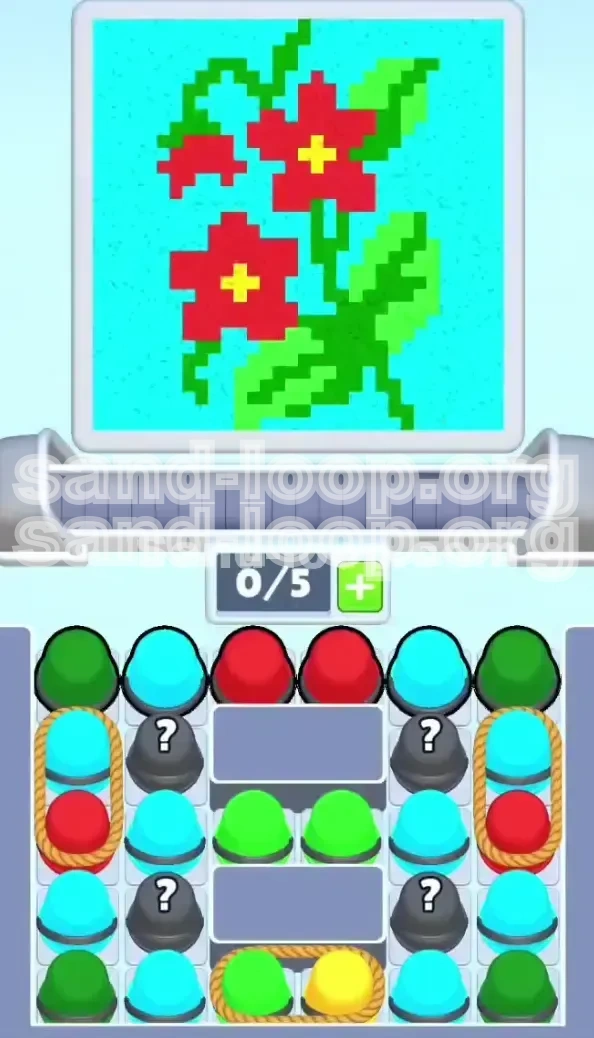
Welcome to Level 411, a stage that masquerades as a simple artistic task but functions as a rigorous test of inventory management. Visually, you are presented with a serene image: two vibrant red hibiscus flowers set against a vast, solid cyan background, accented by green foliage. Do not let the simplicity of the art fool you. The core difficulty of this level lies in the "Slot Economy." You are restricted to a mere 5 slots on your conveyor belt. When you are dealing with a puzzle that requires four distinct colors and complex rope mechanics, this lack of space creates a constant pressure to prioritize specific colors over others.
The canvas is divided into three specific color zones: the Upper Red Flower (approx. 15% surface area), the Lower Red Flower (approx. 20% surface area), the Green Foliage (approx. 5% surface area), and the massive Cyan Background (approx. 60% surface area). The challenge is not the pouring mechanics itself, but the logic required to clear the board without causing a belt deadlock. If you mismanage your slots by filling them with the wrong colors early on, you will find yourself stuck, unable to receive the specific cups needed to finish the flower details.
Understanding the Slot Constraint
The most critical statistic in this level is your inventory count: 5 slots. This is the bottleneck of the entire stage. Because the puzzle utilizes four different colors, having only five slots means you effectively have room for one "extra" cup beyond a complete set. This leaves zero margin for error. You cannot simply hoard cups. Every click to add a cup to the belt must be calculated. If your belt is full (5/5) and the cup you need is trapped behind a rope, you cannot retrieve it without first dumping something, potentially losing progress.
The Rope Mechanic Dynamics
Level 411 introduces "Roped Cups" as a primary obstacle. These are pairs of cups tethered together; tapping one sends both to your belt simultaneously. This effectively consumes two slots in a single action. In a level with only 5 slots, a single rope interaction occupies 40% of your total inventory. The ropes in this level typically pair a high-value color (like Red) with a high-volume color (like Cyan). You must plan for these "2-slot hits" carefully, or you will jam your belt.
The Question Mark Variables
At the start of the level, you will notice "Question Mark Cups" obscured by fog or shadow. These act as wildcards. They could contain the vital Red you need for the petals, or they could be more Cyan clutter. You cannot rely on them being helpful. The strategy here is to reveal them as early as possible to determine if they fit into your current color plan or if they need to be discarded immediately to free up space.
The Visual Trap
Psychologically, the Cyan background is a trap. Because it covers roughly 60% of the image, your brain will tell you to fill it first to "get it out of the way." This is the wrong approach. Filling the background first leaves you with no room to maneuver the cups required for the detailed flower work later. The background is the least urgent task despite its size. You must suppress the urge to clear the grey space immediately.
Clear Objectives: What Needs to Be Done
To beat Level 411, you need to follow a strict set of priorities that contradict standard painting logic. You are not painting from background to foreground; you are painting from most constrained to least constrained. Your primary objective is to secure the Red sand for the flowers. The Red cups are limited and often trapped behind ropes or hidden in the mystery cups. If you miss a Red cup, you might have to cycle through the entire remaining deck just to see another one.
Your secondary objective is the Green foliage. While less abundant than Red, it is specific and often roped to Yellow. Speaking of Yellow, the centers of the hibiscus flowers represent your tertiary objective. These are tiny targets, easy to miss, and the Yellow sand is the most restricted resource in the level, usually locked at the very bottom of the screen. The Cyan background is your last priority, serving as the "dump" color to use when you have spare slots or need to cycle the belt.
Prioritize the Skeleton First
Do not aim for 100% completion on any single area immediately. Your goal in the first phase is to establish the "skeleton" of the image. This means outlining the Red flowers and filling the Green stems. You want to place enough color to define the shapes so you don't lose track of them, but not so much that you burn through all your sand capacity. The skeleton provides the visual cues you need to place the remaining colors accurately later.
Manage the Queue Flow
You must keep the conveyor belt moving. A static belt is a death sentence in puzzle stages. Your objective is to maintain a flow where cups are entering, pouring, and leaving in a rhythm. If you stare at the screen for more than 3-4 seconds without tapping, you are likely overthinking or stuck. Keep the queue moving by constantly evaluating if the incoming cup is useful or trash.
Identify Color Blockers
Recognize that Cyan is the "Blocker." It is the color that will clog your arteries. Whenever you see a Cyan cup, your default thought should be "Do I have space for this?" If your belt has 4/5 slots filled and a Cyan cup appears, you generally ignore it unless it is part of a rope holding a Red cup. Identifying these blockers early prevents the "Full Belt" deadlock that forces a restart.
Target the Yellow Centers
The Yellow centers are small, perhaps only 2-3% of the total canvas, but they are mandatory for victory. You cannot finish the level with grey spots in the middle of the flowers. Your objective is to create a specific window of opportunity to retrieve the Yellow cup. This means you must have exactly 2 empty slots open at a specific point in the game to accept the Green/Yellow rope pair. Missing this window means failing the level.
Step-by-Step Instructions: The Execution Phase
This section breaks down the level into a linear sequence of actions. Follow these steps in order to maximize your efficiency. The guide assumes a standard spawn rate, but you must adapt if the Random Number Generator (RNG) gives you a bad hand. The key is flexibility within the framework.
Phase 1: The Initial Clear (Loose Cups)
Start the level by scanning the very top row of the cup dispenser. You will likely see two loose Red cups. Tap them immediately. Do not worry about the rope cups yet. Adding these two Red cups to your belt fills 2/5 of your slots. As they travel toward the pour point, scan the left and right edges for loose Green cups. Tap one Green cup if you see it. This brings your slot count to 3/5. Pour the Red sand into the upper flower petals. Do not try to fill them completely; just get a solid base layer down. Pour the Green sand into the stem area. This clears the initial row and reveals the Question Mark cups underneath.
Phase 2: The Reveal and Assessment
Now that the top row is clear, look at the revealed Question Mark cups. There are usually two of them.
- Scenario A: If a Question Mark cup reveals itself to be Red, tap it immediately. You need Red more than anything else.
- Scenario B: If it reveals Green, and you still have the stem unfinished, tap it.
- Scenario C: If it reveals Cyan, do not tap it. Leave it on the rack.
The goal here is to keep your belt fluid. If you add a Cyan cup now, you risk clogging a slot that could be used for a high-value color later. If you leave the Cyan cup on the rack, it acts as a placeholder, preventing new (potentially better) cups from spawning in that spot until you are ready for them.
Phase 3: The Vertical Rope Execution
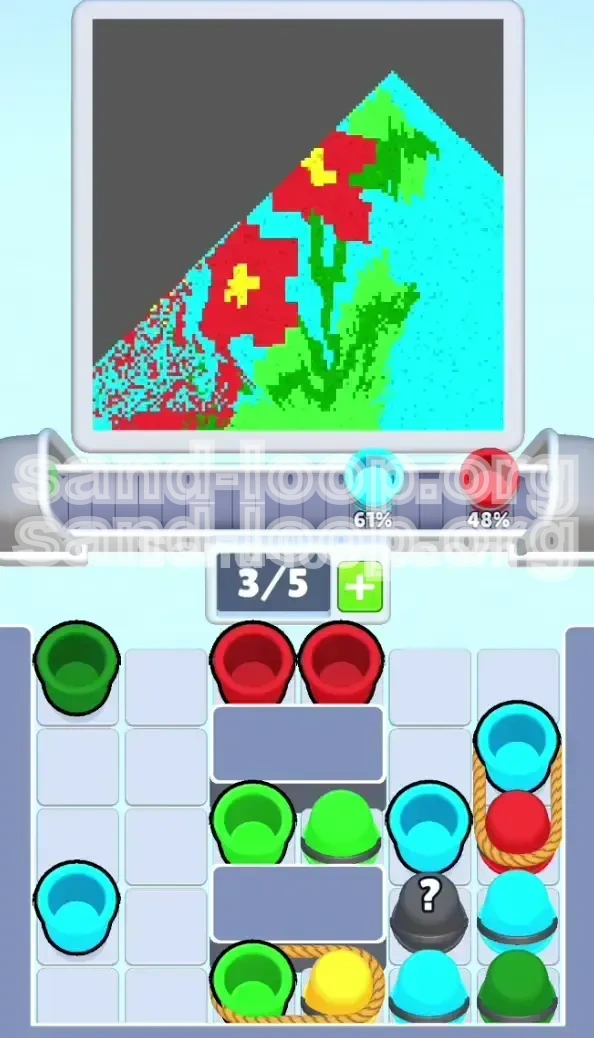
After the loose cups are managed, you will face the "Vertical Ropes" on the left and right sides of the screen. These bind a Cyan cup to a Red cup. This is a forced transaction. You must take the Cyan to get the Red.
Ensure you have at least 2 empty slots (3/5 or less filled). Tap the left vertical rope. Two cups will fly onto the belt. Immediately pour the Red cup into the main flower body. While the Red is pouring, look at the Cyan cup. Use it to fill small corners of the background frame or edges of the canvas that are out of the way. Do not pour the Cyan into the main open background area yet. You want to dispose of the Cyan cup quickly to free up the slot, so pour it into the nearest small grey gap available.
Phase 4: The Green/Yellow Trap
This is the critical turning point of the level. Look at the bottom center of the cup rack. You will see a horizontal rope connecting a Green cup and a Yellow cup.
Condition Check: Do not tap this rope until you have exactly 2 empty slots on your belt.
Once you have the space, tap the rope. The Green and Yellow cups will load. The Yellow cup is small and pours fast. Be ready. The moment the Yellow sand starts flowing, drag it immediately to the center of the hibiscus flowers. If you miss the center, you waste the cup. Since Yellow is extremely rare in this level, wasting it usually means a restart. As soon as the Yellow is poured (it takes only a second), pour the Green cup into the remaining leaf areas to finish the foliage.
Phase 5: The Cyan Grind
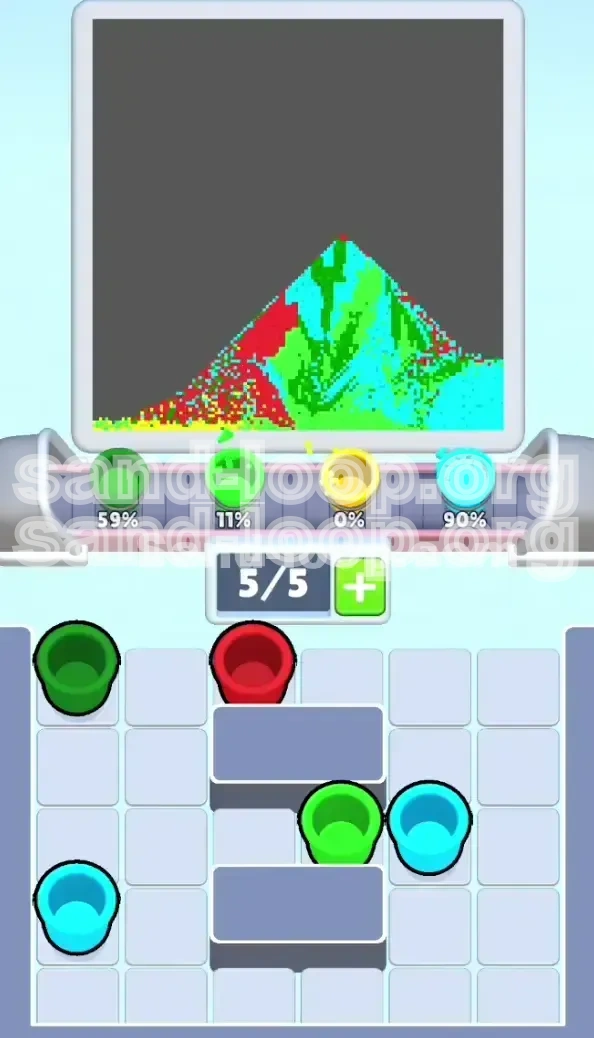
With the flowers detailed and the foliage finished, the rest of the level is a "Cyan Grind." The only color remaining to be dealt with is Cyan. At this stage, slot management no longer matters. You can fill your belt to 5/5 with Cyan cups. Tap the remaining Question Mark cups (which are likely Cyan) and any remaining ropes. Pour the sand aggressively. Since the background is a single solid color with no internal details, you don't need to be precise with your mouse movements. Just hold the pour over the grey areas and let the sand flood in until the level completes.
Color Order: The Logic Behind the Pour
Why follow this specific order? In "Sand Loop," efficiency is defined by the ratio of "Slot Usage" to "Canvas Coverage." You want to get the most canvas coverage for the least amount of slot investment.
1. Red Priority (High Constraint, High Impact)
Red is your highest priority not just because it is the main subject, but because it is heavily constrained. It is tied up in ropes and hidden in mystery cups. By processing Red first, you are utilizing your empty slots to absorb the "cost" of the ropes (the Cyan cups attached to Red). If you wait until your belt is half-full of Cyan to start hunting for Red, you won't have the room to untie the ropes.
2. Green Foliage (Medium Constraint, Low Impact)
Green is secondary. It usually appears as a loose cup or is paired with the critical Yellow cup. It covers a small area. You do this second because it clears the way for the Yellow cup (which is often attached to it) and clears the "clutter" around the flowers, making it easier to focus on the background later.
3. Yellow Centers (Extreme Constraint, Minimal Impact)
Yellow is done just before the end because it is the hardest color to retrieve. It is physically locked at the bottom of the level. You cannot touch it until you have cleared the rows above it (by processing Red and Green). Doing it earlier is impossible. Doing it later is risky because you might accidentally fill your slots with Cyan and have no room for the Green/Yellow rope pair.
4. Cyan Background (No Constraint, Massive Impact)
Cyan is last because it is everywhere. It is the "trash" color that clogs your belt. By saving it for last, you turn its abundance into an advantage. You want a full belt of Cyan at the end because it allows you to pour continuously without stopping to reload the belt. It turns the final 30 seconds of the level into a relaxing, rhythmic finish rather than a stressful puzzle.
Key Tips: Strategic Advice
To master Level 411, you need to move beyond the basics and understand the "flow" of the game. These tips are designed to help you manage the RNG (Random Number Generation) element of the cup spawn.
The "Slot Buffer" Rule
Always try to keep 1 slot open. If you are at 5/5, you are at the mercy of the game. If you are at 4/5, you have one "buffer" slot to react. The only time you should intentionally hit 5/5 is during the final "Cyan Grind" phase. During the first 50% of the level, treat 4/5 as your maximum capacity. This buffer allows you to grab a sudden Red cup if it spawns on the edges.
Pre-Loading the Pour
This is a pro-tip for speed. As your cup is traveling on the conveyor belt to the pouring nozzle, you can hover your mouse (or finger) over the target area. You don't have to wait for the cup to "click" into place. By hovering over the flower petal as the Red cup is moving, you ensure that the sand starts flowing the millisecond it arrives. This saves precious seconds, which is crucial when you have a small window to pour before the next cup arrives.
Rope Tap Timing
Be aware of the conveyor speed. When you tap a rope, there is a slight animation delay before the cups land on the belt. If you tap a rope when your belt is completely empty, those cups will go to the back of the line. If you tap when the belt is moving, you can sometimes "slot" them in more efficiently. However, the safest bet is to ensure space before the tap. Never tap a rope hoping the current cup will pour fast enough to make room. Lag can ruin this strategy.
Identify "Dead" Sand
Sometimes, you pour sand into an area, but it doesn't fill the grey pixel completely because of pixel-perfect edges. If you see a "hole" in a Red flower that is too small to fit the stream of sand, don't waste a whole cup trying to fill it. Leave it. You can fix these micro-holes at the very end with a spare Cyan cup or a final driblet of Red. Trying to force a thick sand stream into a 1-pixel hole is a waste of capacity.
Common Mistakes to Avoid
Most failures in Level 411 come from panic. The screen fills up with cups, the belt gets full, and players start making random taps. Avoid these specific pitfalls.
The "Full Belt" Panic
This is the number one killer. You have 4 cups on the belt. A new cup spawns. You panic and tap it because it's Red, but now you have 5 cups and you can't pour the Cyan cup that is clogging the middle. The belt stops. You lose. Solution: If your belt is full, stop tapping. Look at the cup at the pour point. Pour it. Even if it's not the perfect color, getting rid of it is better than being stuck.
The Premature Background Fill
You start the level, and you see a Cyan cup. You think, "I'll just get a head start on the background." You pour it. Then another Cyan appears. You pour that too. Suddenly, you have poured 40% of the background, but you haven't touched the flowers. Now, the Red cups are spawning, but your belt is full of Cyan. You have to dump the Red to get more Cyan to finish the background, but then you lose the Red. Solution: Ignore the Cyan background until the flowers are structurally complete.
The Missed Yellow Center
You finally get the Green/Yellow rope. You tap it. The Yellow cup arrives. You get distracted by a phone notification or sneeze. The cup pours into the wrong spot, or you miss the tiny center entirely. Now you have a Yellow cup in the queue that is useless, and the flower center is still grey. Solution: The Yellow cup is the most high-risk item in the level. Pause the game (if possible/allowed) or take a breath before tapping that final rope. Ensure your cursor is hovering over the flower center before you trigger the spawn.
Wasting the Question Marks
Players often tap Question Mark cups just to "see what they are." If you tap a Question Mark and it turns out to be Cyan, you have just wasted a slot and added a blocker to your belt. Solution: Only tap Question Marks if you have a specific plan for the color it might be. If your belt is full, let the Question Marks sit on the rack. Information is free, but acquiring it costs a slot.
Stuck Solutions: Troubleshooting
If you find yourself 60% through the level and stuck with a full belt and no moves, use these recovery tactics.
The "Dump and Cycle" Maneuver
If you are stuck, you likely have 2 or 3 Cyan cups on your belt that you don't need right now. You have a "dead" cup—something you can't use (like a second Yellow cup). Intentionally pour the dead cup into a trash area (an already filled corner of the background) to destroy it. This frees up a slot. Then, pour a Cyan cup into the background to free another slot. Your goal is to cycle the belt until you see a color you actually need (Red or Green). It is better to waste 10 seconds cycling than to restart the whole level.
The "Pixel Snipe" Technique
Stuck because you have a huge area of background left but only tiny, 1-pixel gaps in the flowers? You don't need a fresh cup for that. You can use the dregs of a cup. When a cup is 99% empty, it still has a tiny trickle of sand left. You can use this trickle to fill those tiny 1-pixel holes in the Red flowers without using a full new cup. This preserves your slots for the big background fills.
Resetting the RNG
If the level spawns an impossible setup (e.g., three ropes in a row when you only have 2 slots), sometimes you have to cut your losses. However, before restarting, check the top of the rack. Is there a loose cup you can tap to break the chain of ropes? Often, an impossible setup becomes possible if you just clear the one loose cup sitting on top of the trouble.
Speed Run Tips: For the Fast Time
Once you have beaten the level and want to optimize your time, ignore the "safe" advice. Speed running requires risk.
The Aggressive Rope Tap
Don't wait for the "perfect" 2-slot opening. If you have 1 slot open and the Green/Yellow rope is available, tap it. Then, immediately pour the cup currently at the spout (hopefully it's a fast color). If you time it right, the first cup leaves just as the rope cups arrive. This shaves seconds off your time but requires precise timing. If you mess up, you jam the belt.
Batch Pouring
Don't fill one flower 100% then move to the next. Fill the top flower to 50%, then the bottom to 50%, then the leaves. This keeps the pixel saturation even. It prevents the situation where you are over-pouring and wasting sand on a full area while another area is still empty. It keeps your "pixels per second" rate high.
Ignore Perfection
In a speed run, "done" is better than "perfect." If a flower petal is 98% filled and the grey spot is tiny, leave it. You can clean it up with a background color spill-over or a final random spray. Focusing on getting 100% coverage on every detail before moving on kills your momentum. Fill the big shapes, dump the trash, and keep the belt moving.