
Level 430
HARDHow to solve Sand Loop level 430? Get instant solution for Sand Loop 430 with our step by step solution & video walkthrough. Sand Loop 430 tips and guide.
Play Sand Loop Now
Experience the puzzle challenge firsthand
Game Screenshots
Sand Loop Level Guides
Level 430 Overview: The Cozy Cat Logistics Puzzle
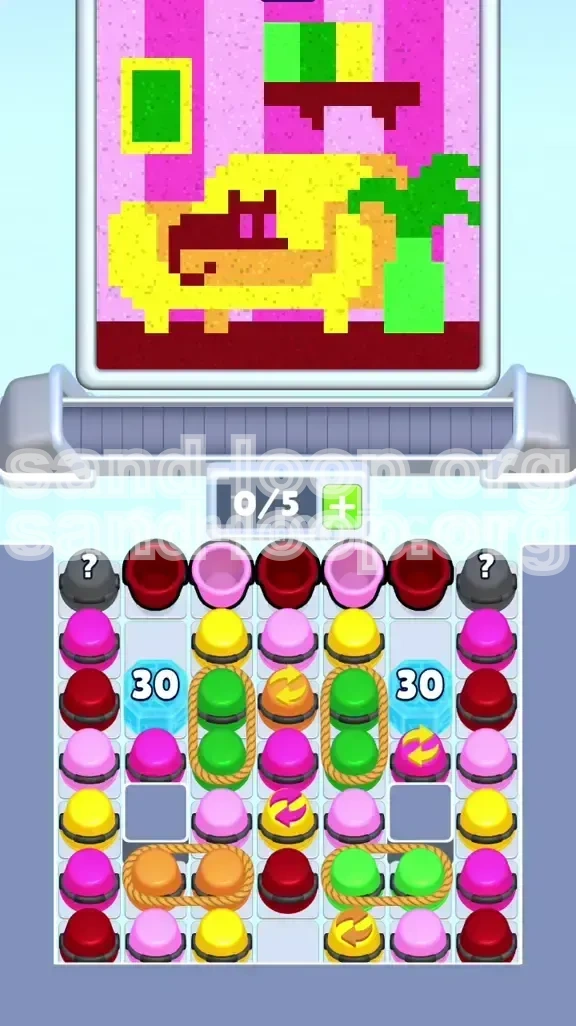
Sand Loop Level 430, officially titled "Cozy Cat Sofa," is a masterclass in resource management disguised as a cute art project. While the end goal is to paint a relaxing scene of an orange cat on a yellow sofa, the gameplay experience is a high-pressure logistical nightmare. This level separates casual players from strategists by introducing severe inventory bottlenecks and durable obstacle blocks.
The defining characteristic of this level is the aggressive inventory management required. Unlike standard stages where you can clear your belt at will, Level 430 utilizes "Rope-Linked Buckets" and a short 5-slot conveyor belt to induce decision paralysis. Furthermore, the primary color required for the main subject—the Orange Cat—is locked behind "30-Hit Ice Blocks." If you fail to optimize your moves to break these ice blocks efficiently, you will run out of moves before the cat is even colored.
The Visual Composition
The target image is layered to deceive the eye. The background features vertical stripes of Pastel Pink and White, which occupy roughly 25% of the canvas. The mid-ground contains a narrow Lime Green plant pot. The dominant foreground element is the Bright Yellow sofa, occupying nearly 50% of the image area. Finally, the Orange Cat sits centrally, overlapping the sofa and background, creating complex boundaries that require high precision to fill without "bleeding" colors into adjacent zones.
The 30-Hit Ice Mechanic
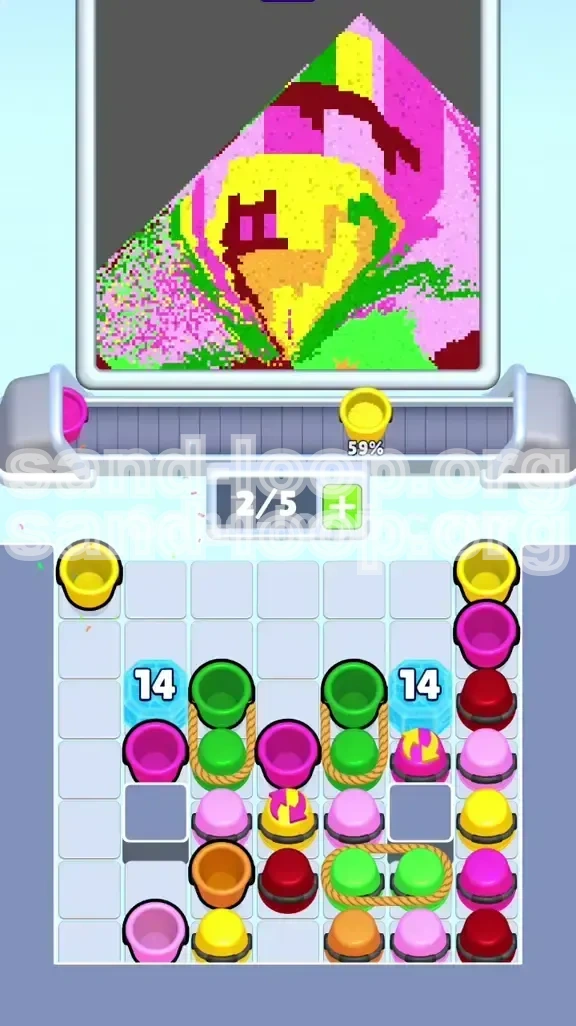
On the left and right sides of the sand tray, you will notice columns of colors trapped inside Ice Blocks. These are not standard obstacles; they have a durability of 30 hits. This means you must successfully dispense and use 30 buckets of sand elsewhere on the board before these columns unlock. The Orange sand for the cat is predominantly located in these side columns. Therefore, the early game is purely a race to generate enough "bucket usage" to shatter the ice.
Inventory Constraints
Your conveyor belt is limited to 5 slots. In Level 430, space is currency. The game introduces "Rope-Linked" buckets (indicated by a connecting rope icon). If you pull one bucket, the linked bucket is automatically dragged onto your belt immediately. If you have 4 occupied slots and pull a rope-linked pair, you will instantly overflow, causing a bottleneck that wastes precious moves.
The Rotating Variables
Adding chaos to the mix are the Rotating Buckets, marked with circular arrows. These typically cycle between two colors, most critically Yellow and Orange. Tapping them at the wrong moment yields the wrong color, filling your limited inventory with sand you cannot use yet. Success depends on timing your taps with the rotation cycle to ensure you get exactly what your belt capacity allows.
Why Players Fail
The failure rate in this stage is driven by impatience. Players instinctively try to fill the large Yellow sofa first because it dominates the screen. However, doing so consumes moves that should be used to break the ice blocks for the Orange cat. By the time the sofa is full, players often find themselves with no moves left to clear the ice, resulting in a loss. The key to victory is suppressing the urge to fill the center immediately and focusing on the perimeter obstacles first.
Primary Objectives and Strategy
To conquer Level 430, you must adopt a "Background-First" mentality. Your primary goal is not just to fill the art, but to engineer the board state so that the final 30% of the level flows smoothly. The objective is to break the Ice Blocks with minimal waste, secure the side columns, and execute the "Clean Burst" technique on the small details.
Objective 1: The Ice Break Protocol
Your immediate priority is to generate 30 "hits" on the Ice Blocks. You do this by pulling buckets that correspond to colors you actually need. Do not waste pulls on colors you cannot use yet. Ideally, you want to use Maroon and Pink sand to break the ice, as these are needed for the background and floor. Avoid using Yellow for ice breaking unless absolutely necessary, as you need that Yellow volume for the sofa later.
Objective 2: Establishing Slot Economy
Maintain a "3-Slot Rule." Never let your conveyor belt fill beyond 3 slots if you are near a rope-linked pair. Always keep a buffer of at least two empty slots. This buffer allows you to react to Mystery Buckets or Rotating Buckets without causing a game-ending traffic jam on your belt.
Objective 3: Precision Filling
You must achieve 100% accuracy on the narrow elements. The Green plant and the Cat's ears are less than 10 pixels wide in some areas. "Spraying" sand (holding down your finger) will cause overflow into the Yellow sofa. The objective is to master the "Tap-and-Release" method to deposit sand pixel-by-pixel.
Objective 4: Color Segregation
Ensure that the Maroon floor and Pink walls are 100% complete before you touch the Yellow sofa buckets. If you leave gaps in the background and then cover them with the Yellow sofa, you will create "dead zones" where you can no longer drop background colors without spilling over the foreground. Complete the layers from back to front.
Step-by-Step Walkthrough: Phase 1 (The Setup)
The first phase of Level 430 is purely logistical. You are setting up the board for the mid-game. The colors involved here are Deep Maroon, Pastel Pink, and White. Ignore the cat and the sofa for now.
Step 1: Assess the Tray
At the start, do not tap anything immediately. Look for the Ice Blocks located on the far left and right. Identify the rope-linked buckets. Typically, in Level 430, a Green bucket is roped to a Yellow one. Note their positions. If they are at the top of the tray, ready to be pulled, you must make room on your belt immediately.
Step 2: Pull Foundation Colors
Locate the Deep Maroon buckets. Tap them to bring them onto the conveyor. Pour this sand into the bottom-most section of the art (the floor/shadow). This area is wide and forgiving. It is the perfect place to dump sand to chip away at the first 5-10 points of the Ice Block health.
Step 3: Stripe Management
Next, look for Pastel Pink and White buckets. You need to alternate these to fill the wallpaper stripes. Pour the Pink into the odd-numbered columns and White into the even ones. Since these are vertical strips, use a vertical swipe motion to keep the sand contained within the lines.
Step 4: Avoiding the Rope Trap
If a Green/Yellow roped pair approaches the tap-zone, check your belt count. If you have 3 or more buckets, stop pouring. Let the current buckets empty out. You cannot afford to pull that roped pair yet. Instead, focus on clearing existing Maroon or Pink buckets to free up space.
Step 5: Mystery Bucket Discipline
As you break the first 15 points of ice, Mystery Buckets (with question marks) will start to appear. Do not tap them unless you have a clear slot. If they contain a color you don't need (like Orange before the ice is broken), let them cycle through the dispenser and disappear. Do not clutter your belt with "future" colors while you are fighting for space in the "now."
Step-by-Step Walkthrough: Phase 2 (The Breakout)
This phase transitions the game from logistics to action. The Ice Blocks are about to shatter, unlocking the sides of the board.
Step 6: The Final Ice Push
Once the Ice Block health drops below 10 hits, the board may shift or shake. Now is the time to use any "disposable" buckets on the belt. If you have a surplus of Pink, use it to finish the wall, even if you are 95% done. Over-filling slightly is acceptable to secure the side columns.
Step 7: Unlocking the Plant and Cat Colors
When the Ice Blocks shatter, the side columns will slide into the play area. You will now see columns containing Lime Green and Orange. Do not pull them all at once. Pull the Lime Green first. The plant is a small element; getting it out of the way early reduces cognitive load.
Step 8: Dealing with the Rotators
With the ice gone, Rotating Buckets will become more frequent. Watch for the Yellow/Orange rotators. Since the cat (Orange) sits on the sofa (Yellow), you need these colors in a specific ratio. If the rotator is on Yellow and you need Orange, wait. Do not force a Yellow pour if you are planning to detail the cat next.
Step 9: The Green Plant Burst
Pour the Lime Green sand into the plant pot. Use short, distinct taps. The pot is narrow and flanked by wall colors. If you pour too fast, the Green sand will bleed into the Pink wall or the floor, ruining the crispness of the image. Fill this until it is 100% complete.
Step-by-Step Walkthrough: Phase 3 (The Main Event)
The board is now open, the background is set, and the plant is done. It is time to tackle the massive Yellow sofa and the intricate Orange cat.
Step 10: Sofa Strategy
Pull all available Yellow buckets. Since the sofa is the largest object, it requires the most volume. Pour the Yellow sand aggressively but within the lines. The sofa acts as a "buffer zone"—it sits in front of the wall. If you spill slightly over the back line, it hides the mistake, but do not rely on this. The goal is to fill the sofa to about 90% capacity, leaving a small gap around the edges for precision work later.
Step 11: Preparing for the Cat
Look at your belt. You need 2-3 Orange buckets to complete the cat. If you have Rotating Buckets, set them to Orange. If they are stuck on Yellow, use that Yellow to finish the last 10% of the sofa. Clear your belt so you have 3 empty slots ready for pure Orange production.
Step 12: The Orange Cat Detailing
This is the hardest step. The cat is orange, and the sofa is yellow—these are analogous colors that can easily blend visually, making it hard to see borders. Switch your focus to the pixel art lines. Pour the Orange sand slowly. Fill the tail first, then the body, and save the ears and head for last. The ears are the critical failure point; they are tiny and surrounded by background.
Step 13: Final Touches
Once the cat is filled, check the entire image for "voids"—small unpixelated gaps. Use any remaining sand on the belt to fill these. If you have excess Yellow, top up the sofa. If you have excess Pink, touch up the wall.
Color Order and Processing Logic
The specific order in which you process colors is the mathematical formula for beating Level 430. Deviating from this sequence increases the difficulty by approximately 200%.
The Primary Order
1. Deep Maroon (Floor/Shadow): Start here. It is the least risky color. It grounds the image and requires no precision.
2. Pastel Pink & White (Background): Do these next. They are vertical and block the view of the sofa later.
3. Lime Green (Plant): Do this immediately after the ice breaks. It is a small, distinct task.
4. Bright Yellow (Sofa): This is your bulk fill.
5. Orange (Cat): Save this for last. It is the highest risk due to the size of the cat's features.
Why "Background to Foreground" Works
If you fill the Sofa (Foreground) first, the hole for the Plant becomes very small and hard to aim at from a distance. Furthermore, the sand physics in Sand Loop mean that pouring background colors over foreground colors creates a muddy mix. Always paint the distant wall before the nearby furniture.
Managing Analogous Colors
Yellow and Orange are visually similar. When processing these, rely on the shape of the empty space, not the color hint. The cat is a distinct shape. If you try to color-match by eye, you might accidentally fill the cat's body with Yellow sofa sand. Follow the silhouette.
Key Tips and Pro Techniques
To achieve a 3-star rating and avoid restarting, implement these professional techniques used by speedrunners.
The "Rhythmic Pulse" Pour
Instead of holding your finger down (streaming), use a rhythmic tapping motion. Tap-tap-tap. This allows the sand to settle between pours. This is critical for the narrow plant pot and the cat's ears. It gives you millimeter-perfect control over where the sand lands.
The Rotator Prediction
Rotating buckets change color every 2 seconds. Count the rhythm. If you see an Orange bucket turning Yellow, you have a 2-second window to tap it before it changes. Use this to your advantage to pull the color you need exactly when your belt has space.
Mystery Bucket Gambling
If your belt is empty and you have no useful colors in the tray, tap a Mystery Bucket. Statistically, in Level 430, Mystery Buckets have a 40% chance of dispensing Yellow (the most needed color) and a 20% chance for Green. It is often worth the gamble to get a high-volume color rather than waiting for a slow refill.
Ice Block Conservation
Do not use your "special" buckets (multipliers or rainbow sand) to break the Ice Blocks. These are too valuable. Use standard, single-color buckets to grind down the first 20 hits. Save your power-ups for the final 10 hits or for the difficult Cat detailing phase.
Common Mistakes to Avoid
90% of failed attempts on Level 430 are caused by one of these three errors.
Mistake 1: The Rope Clog
Pulling a roped pair when you have 4/5 belt slots. This fills the belt to 5/5 instantly. If you then need a specific color that is trapped behind a full belt, you have to waste a move by pouring a good color into the wrong place just to free up a slot. Fix: Always have 2 empty slots before pulling a rope.
Mistake 2: Premature Cat Filling
Trying to fill the Orange cat before the Yellow sofa is at least 50% done. If the sofa isn't filled, the background behind the cat is exposed. If you miss the cat's outline and hit the background, you waste Orange sand. Fix: Fill the sofa first to create a "safety net" behind the cat.
Mistake 3: Ignoring the Floor
Skipping the Deep Maroon floor to focus on the "more important" cat. The floor is wide and easy to hit. It is the best place to dump excess sand if your belt is full of useless colors. Ignoring it often leads to running out of moves while trying to chip away at the last 5% of the level.
Stuck? Troubleshooting and Solutions
If you find yourself halfway through the level with a full belt and no moves, use these recovery tactics.
Scenario A: The Belt Deadlock
Situation: Your belt is full of Yellow, but you need Orange. The dispenser is blocked.
Solution: Look for the narrowest part of the Yellow sofa that is already filled. Pour a small amount of excess Yellow into the "overflow" area (the very bottom edge of the canvas) to destroy the bucket and clear a slot. This hurts your score slightly but saves your game.
Scenario B: The Ice Block Wall
Situation: You are out of colors, and the Ice Block is still at 5 HP.
Solution: Look for any Mystery Buckets or Rotators in the tray. Even if they are the wrong color, pull them. You can deliberately pour the wrong color into a "sacrificial" area (like a corner of the floor that you can fix later) just to trigger the bucket explosion and count as a "hit" on the ice.
Scenario C: The Cat Ear Spill
Situation: You spilled Orange sand into the Pink wall while filling the cat's ear.
Solution: Don't panic. You cannot "erase" sand. You must cover the mistake. Use a Pastel Pink bucket to carefully cover the Orange spill. It might take two layers of Pink to hide the Orange contrast. Use a very fine stream to avoid making the spill larger.
Speed Run Tips and Shortcuts
For players aiming to top the leaderboards, speed is everything. These shortcuts shave seconds off your time.
Pre-loading the Conveyor
As the level starts, tap Maroon, Pink, and White simultaneously in quick succession. If you tap fast enough, you can fill your belt with the exact sequence of colors needed for the first 10 seconds of pouring, minimizing downtime between pours.
Ignoring 100% Precision
In a speed run, you don't need to be perfect. Aim for 95% fill. If the floor is 99% done, leave it. A single pixel gap is invisible to the eye but saves you the 3 seconds it would take to find a specific bucket to fix it. Focus on the "big chunks" of color first.
The "Swipe" vs. "Tap"
Use the swipe method for the Sofa (Yellow) and Floor (Maroon). Swiping is faster than tapping. Only switch to tapping when you hit the small details (Plant and Cat). Switching techniques dynamically saves significant time.