
Level 439
HARDHow to solve Sand Loop level 439? Get instant solution for Sand Loop 439 with our step by step solution & video walkthrough. Sand Loop 439 tips and guide.
Play Sand Loop Now
Experience the puzzle challenge firsthand
Game Screenshots
Sand Loop Level Guides
Level 439 "Desert Cat" Master Walkthrough: Strategies & Mechanics
Understanding the "Bottleneck" Mechanics
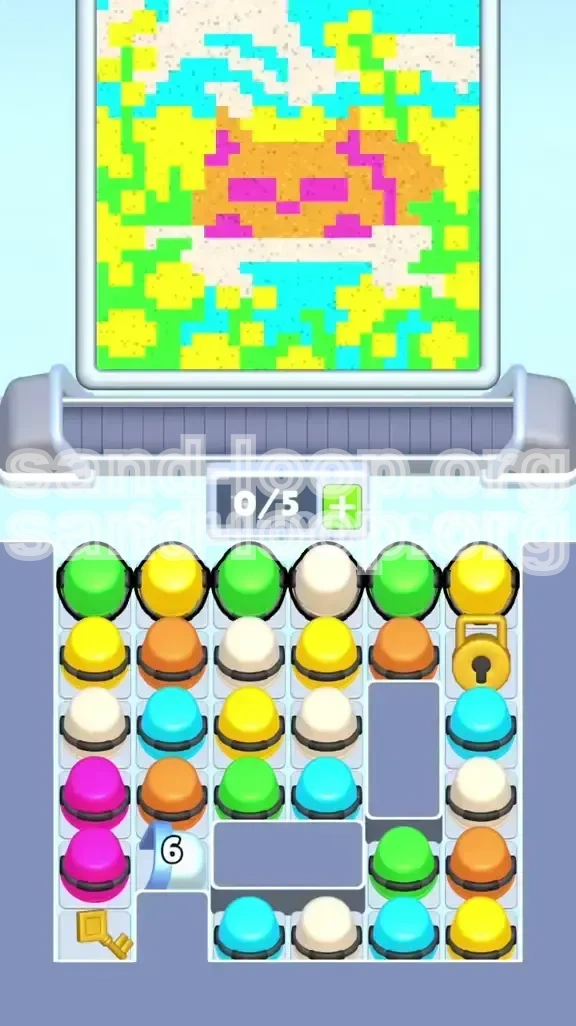
Level 439 introduces a restrictive resource management system often referred to by high-level players as the "Bottleneck Scenario." Unlike standard levels where tray space is fluid, here you are forced to operate with a permanent resource deficit. The conveyor belt is programmed to flood your tray with high-volume "noise" colors—specifically Lime Green and Bright Yellow—at a rate that exceeds your pouring capacity. The core mechanic challenge is not the painting itself, but maintaining "Tray Liquidity." If your 5-slot tray reaches maximum capacity with common colors, you enter a "Deadlock State" where you cannot accept essential items like the Gold Key or Pink cups. To succeed, you must treat the first 30 seconds not as a painting exercise, but as a logistical excavation to clear space.
The Left-to-Right Dependency Logic
The physical layout of the tray is divided by static Gray Blocks that create a hard dependency on movement. The level is designed linearly: you cannot effectively access the resources on the right side of the tray until you have solved the puzzle on the left. The left quadrant houses the "Detail Package" (Pink and White), while the right quadrant is guarded by a Padlock protecting the bulk "Background Colors" (Cyan and Yellow). Many players fail by trying to work on both sides simultaneously, only to find they lack the Key to open the right side. You must adopt a strict mental map: Left Side First (Details), Right Side Second (Background). Attempting to circumvent this order by pouring background colors early will clog the limited tray space needed to maneuver the Key.
The Gold Key and Padlock System
A unique feature of Level 439 is the Key-and-Padlock mechanic which serves as the level's progression gate. The Gold Key is buried under the initial debris of Green and Yellow cups on the left. You must actively discard (tap to remove) approximately 10-15 cups of noise colors to physically expose the Key. Once exposed, the Key acts as a one-use inventory item. Dragging this Key to the Padlock on the right side triggers a "State Change," instantly unlocking a reserve of Cyan and deep Yellow sand. A critical mechanic to note is that the unlocking action is irreversible and immediately spawns 3 new cups on the belt. If you trigger this without 2 empty slots in your tray, the new cups will bypass your tray and get stuck in the conveyor loop, causing a significant time delay.
Ice Block Durability Physics
Encasing the critical White cup is an Ice Block with a durability value of '6'. This block does not melt passively; it requires active kinetic energy to break. You can reduce its durability by tapping it directly or by pouring colors adjacent to it. The strategic trap here is that the Ice Block is located in the high-traffic left zone. If you focus solely on digging for the Key, you may neglect the Ice Block, leaving the White cup inaccessible when you eventually need it for the cat's chest markings. The most efficient way to handle this is to treat the Ice Block as a "background task"—every time you discard a Green cup, give the Ice Block a quick tap. Breaking it by the 40% completion mark is crucial to avoid late-game soft locks.
Analyzing the Three-Zone Canvas Structure
To achieve a clear victory, you must visualize the target canvas as three distinct layers that must be filled in a specific order to prevent color contamination.
- Zone 1: The Detail Layer (Face/Ears): This is the high-risk zone. It requires Pink and White. Because these areas are small and surrounded by large areas of Orange and Yellow, any over-pour will bleed into the background.
- Zone 2: The Subject Layer (Cat Body): This is the mid-ground, dominated by Ginger Orange. It serves as the buffer between the details and the background.
- Zone 3: The Atmospheric Layer (Sky/Sand): The largest area, comprising Cyan, Yellow, and Lime Green. This acts as the "sink" for excess sand.
Step 1: The Excavation Phase (0-25% Completion)
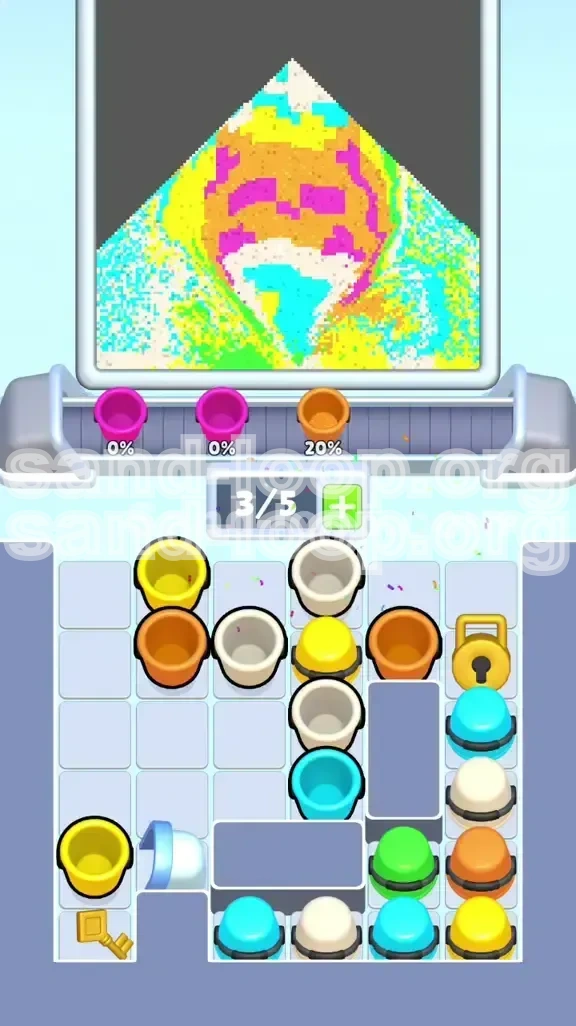
As the level begins, the conveyor belt will aggressively push Lime Green and Yellow cups. Do not pour these onto the canvas yet. Instead, rapidly tap and drag these cups into the "discard" area of the conveyor belt to cycle them out. Your sole objective in this phase is to clear the debris pile on the left side of the tray. You are digging for the Pink cups and the Gold Key. Keep your tray as empty as possible—ideally holding only 2 cups at a time. If you accidentally pour a color, target the extreme corners of the canvas to avoid encroaching on the cat's silhouette. This phase is complete when the Pink cups are visible and the Ice Block is shattered.
Step 2: The Precision Deployment (25-50% Completion)
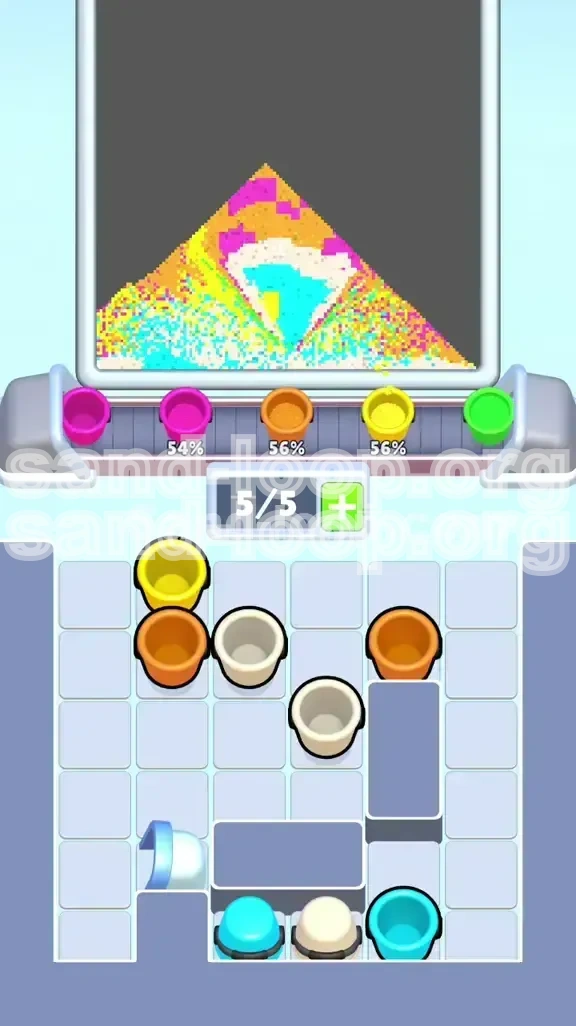
Once the Pink cups are accessible, the gameplay shifts from fast-paced sorting to surgical precision. Pick up the Pink cup but do not pour immediately. Hover over the cat's ear canals and use short, 0.5-second taps to release small amounts of sand. The goal is to fill the ear shape without overflowing. Overflowing Pink will mix with the background Yellow to create a muddy orange that ruins the contrast score. Immediately after securing the ears, retrieve the White cup (now free from ice) and apply it to the chest and paw tips. These white areas act as the visual anchor for the rest of the painting. Do not touch the Orange or Cyan yet.
Step 3: The Key Transaction and Unlock (50-60% Completion)
This is the most critical moment for resource management. Ensure you have at least 2 empty slots in your tray. Drag the Gold Key from the left slot to the Padlock on the right. The moment the lock opens, a Cyan cup and a Yellow cup will be spawned. Pause for a split second to let the physics settle. Do not grab the Yellow yet; prioritize the Cyan. Cyan is needed for the bottom shadow of the cat and the base of the image. Pouring Cyan first establishes a hard boundary at the bottom of the canvas, preventing the subsequent Orange body color from bleeding into the floor area.
Step 4: The Orange Mass Fill (60-85% Completion)
With the details protected and the base established, you can now enter "Bulk Mode." The Orange cups are abundant and should be used to fill the main body of the Fennec cat. Since Orange is roughly 40% of the canvas, you can be more aggressive here. Use wide, sweeping motions to deposit the sand. However, maintain awareness of the "Negative Space"—the gaps between the cat's legs and tail. These gaps must remain open for the background colors to show through. If you fill the entire silhouette with solid Orange, the cat will look flat and you will struggle to fit the background colors later.
Step 5: Atmospheric Blending (85-100% Completion)
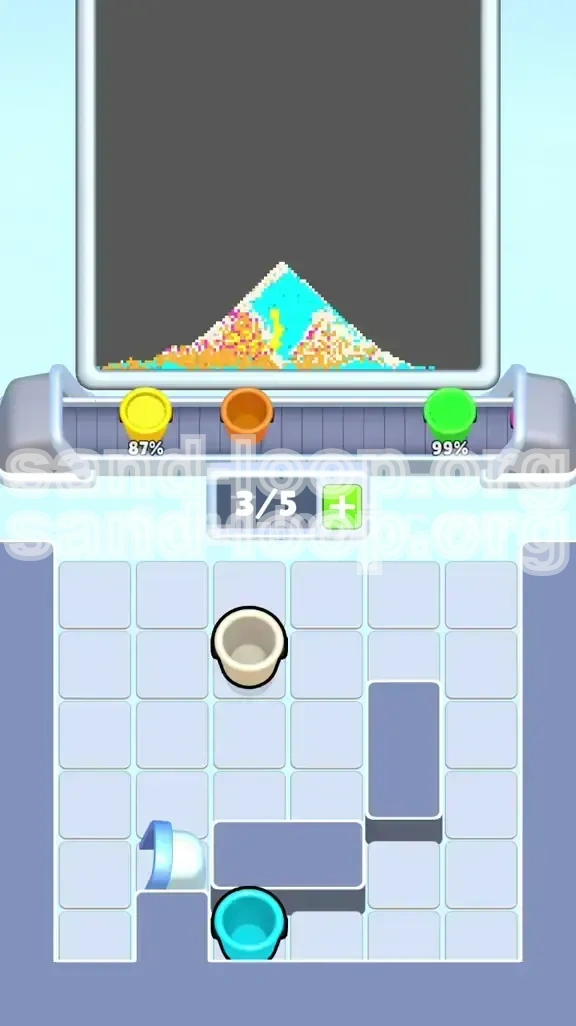
In the final stretch, you will be managing the overflow of Yellow and Lime Green. These colors represent the desert sun and sparse vegetation. Use these to fill the top corners and blend the edges of the Orange body. The challenge here is "Micro-gaps." You will likely find yourself stuck at 96-98% completion. At this point, stop looking at the tray and scan the canvas for pixels that don't match. If you have a full tray of unwanted colors, perform a "Sacrificial Pour"—dump a cup into a 99% full area just to free up a slot to grab the specific color you need to finish.
The Priority Hierarchy for Color Processing
To avoid decision paralysis during the heat of the moment, memorize this strict color hierarchy. Always process colors in this order when multiple options are present in your tray:
- Pink (Tier 1): Highest scarcity and highest risk. Pour immediately.
- White (Tier 2): Low quantity, high detail requirement. Pour second.
- Cyan (Tier 3): Structural color for the base. Pour before background colors.
- Orange (Tier 4): The "filler" color. Keep in tray for bulk pouring but don't prioritize over details.
- Yellow/Lime Green (Tier 5): "Trash" colors until the endgame. Keep these moving off the belt to make space.
The "Bleed Effect" Prevention Strategy
Color bleeding is the primary cause of failed runs in Level 439. This occurs when a light pigment (like Yellow) is poured underneath a heavy pigment (like Pink), causing the heavy pigment to spread and lose its shape. The counter-strategy is "Top-Down Loading." Always pour the most detailed, lowest-volume colors (Pink/White) first. Once they are settled into the canvas "pores," you can pour the heavier, larger volume colors (Orange/Yellow) around them. Never pour background sand first; it creates a slippery foundation that details cannot adhere to.
Tray Management Math: The 1.5 Slot Rule
Mathematically, holding 5 cups gives you zero flexibility. A randomized belt can send you a Pink cup at any second. If you are holding 5 cups, you cannot grab the Pink, and it will cycle off the screen. To optimize your win rate, maintain an average of 1.5 empty slots. This means if you have 3 cups, you are "full." If you have 4 cups, you are in the "danger zone." The only exception to this rule is the final 10% of the level, where you can fill the tray to drain the final resources. Keeping this buffer allows you to react to the random number generation (RNG) of the conveyor belt without suffering a catastrophic deadlock.
The "Sacrificial Pour" Tactic
When you are in a deadlock (Tray Full, Needed Color on Belt but inaccessible), you must use the Sacrificial Pour. Identify a section of the canvas that is already 100% complete (e.g., the tip of the tail or a corner). Take a cup from your full tray—preferably a common color like Yellow—and pour the entire contents into that completed area. The physics engine will reject the excess sand, and the cup will empty, freeing up a tray slot. While this seems wasteful, the alternative (waiting for the belt to cycle) takes 15-20 seconds, which often causes a timeout failure. Wasting 5% of a cup is better than restarting the level.
Error 1: The Premature Background Fill
The most common mistake is filling the Yellow/Green background (40% of the canvas) before addressing the Pink ears (5% of the canvas). Players do this because Yellow cups are abundant. However, once the background is full, you cannot easily overlay the Pink ears. The Pink sand will slide off the already full Yellow pixels and scatter into the Orange body zone, ruining the color separation. Always prioritize the smallest, hardest-to-fill areas first. The background is forgiving; the ears are not.
Error 2: Ignoring the Ice Block Timer
The Ice Block does not reset. If you reach the 90% completion mark and realize you still need the White cup, but the Ice Block is still at 50% durability, you have effectively soft-locked your run. You will be forced to wait for the Ice Block to break, but you won't have the tray space to hold the cup once it opens because you are busy managing other colors. The solution is to check the Ice Block every time you discard a cup in the first minute. Treat it as a rhythm: Discard Green, Tap Ice, Discard Yellow, Tap Ice.
Error 3: The Key Jam
Using the Gold Key while your tray is full (5/5) is a fatal error. When the lock opens, it releases new items. If your tray is full, these items have nowhere to go. They often get stuck on the conveyor belt or stack up on top of the Padlock, obscuring your view and blocking the belt flow. Furthermore, the game's physics may glitch, preventing you from picking up the newly unlocked Cyan cup. Always ensure you have 2 empty slots before initiating the Key transaction to allow the unlocked resources to flow smoothly into your tray.
Diagnostic: Finding the "Phantom Pixel" at 98%
Being stuck at 98% is frustrating because the missing gap is often invisible to the naked eye. To find it, switch to a color that is already complete (e.g., Yellow). Pour a stream of Yellow over the areas you think are done. If the sand "slides" over the surface without disappearing, that area is truly full. If the sand "sticks" and vanishes into the canvas, you have found your micro-gap. This diagnostic method allows you to systematically scan the canvas without guessing.
Troubleshooting: Stuck at 30% (The Pink Lock)
If you are stuck at 30%, it means you cannot access the Pink cups. This usually happens because the initial Green/Yellow debris was poured into the tray instead of being discarded. Your tray is now full of noise, blocking access to the lower layers. The solution is to aggressively waste. Pour your entire tray's contents into the corner of the canvas. It doesn't matter if it's messy; you need to empty the tray to reach the Pink layer below. Once the tray is empty, you can finally grab the Pink cups and resume the correct strategy.
Speed Run Strategy: The "Bulk Key Drag"
For experienced players aiming for a sub-60 second time, you can utilize a risky shortcut called the "Bulk Key Drag." Instead of slowly clearing the left side, focus entirely on the center Gray Blocks. By aggressively clearing a path through the middle, you can expose the Gold Key within the first 10 seconds. This allows you to unlock the Cyan and Yellow supply on the right much earlier than intended. You can then work on the background (Right Side) and the Cat Details (Left Side) simultaneously. This requires high-speed tray management and is not recommended for beginners, but it is the fastest known route for completion.
Speed Run Strategy: Predictive Belt Loading
The conveyor belt in Level 439 follows a semi-random pattern with weighted probabilities. After a "Pink" cup, the game is statistically more likely to generate a "White" or "Orange" cup, and less likely to generate another "Pink." Use this knowledge to pre-emptively manage your tray. If you just poured a Pink cup and have a slot open, don't grab the next Green cup immediately if you see a White cup approaching 3 slots down. Wait the 2 seconds for the White cup to arrive. Predictive loading prevents the "stop-start" rhythm that kills your speed run momentum.