
Level 194
HARDHow to solve Sand Loop level 194? Get instant solution for Sand Loop 194 with our step by step solution & video walkthrough. Sand Loop 194 tips and guide.
Play Sand Loop Now
Experience the puzzle challenge firsthand
Game Screenshots
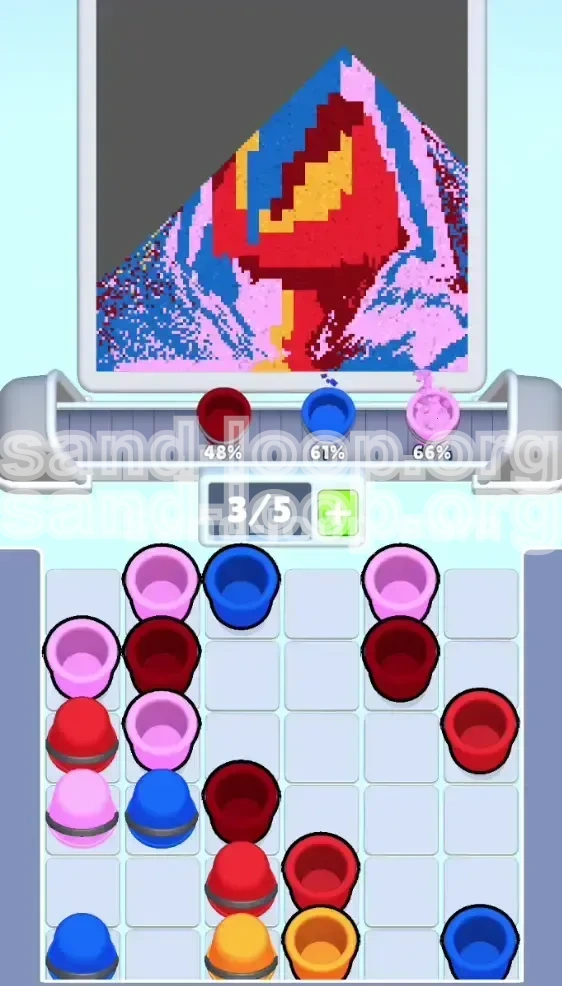
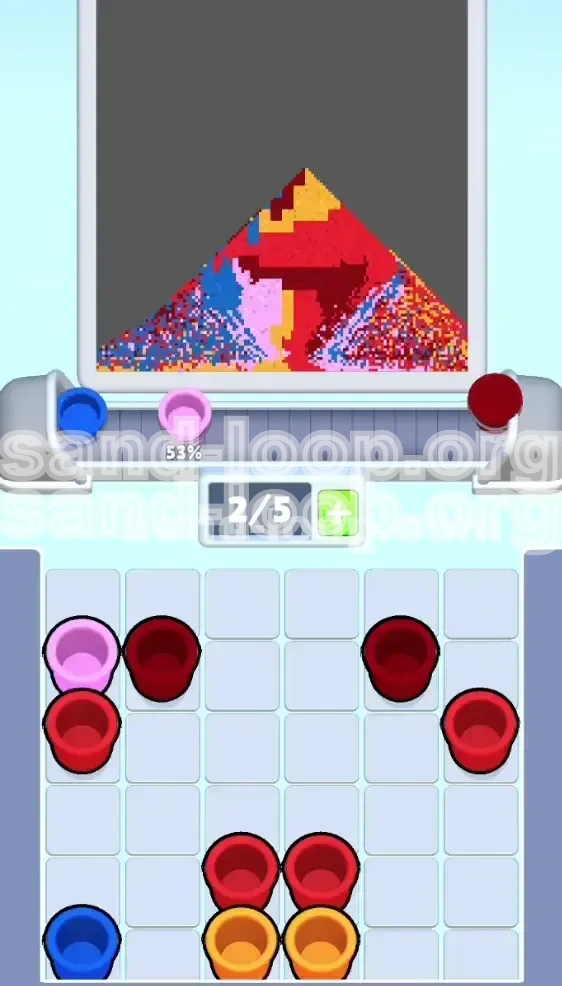
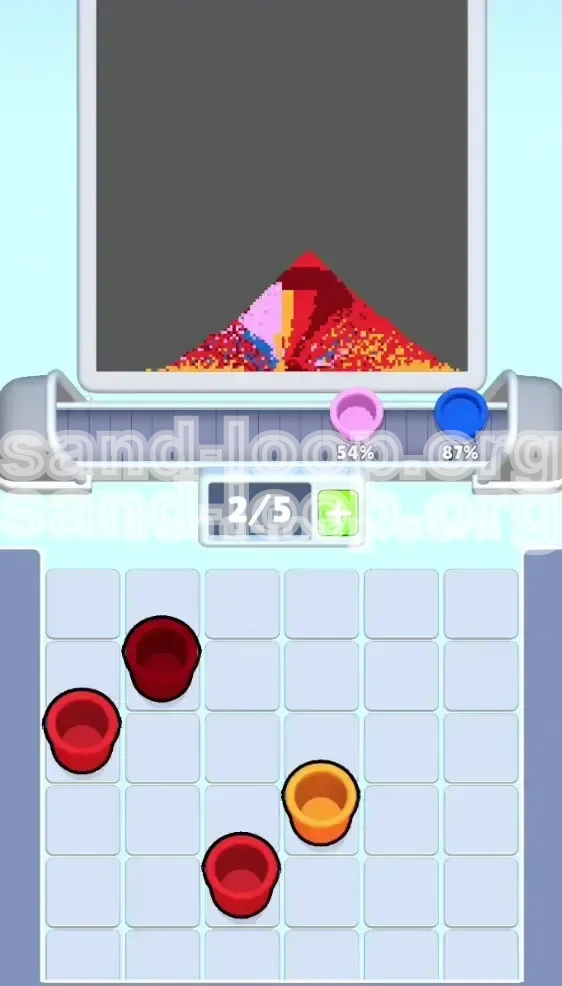
Sand Loop Level Guides
Sand Loop Level 194 Walkthrough: The Abstract Red Bloom
Welcome to the definitive guide for Sand Loop Level 194. This stage is a significant difficulty spike that tests your resource management and spatial planning skills. Unlike previous levels where you could afford to be reactive, Level 194 requires you to be proactive—specifically regarding the excavation of the central column.
The level features a complex image known as the "Abstract Red Bloom." It depicts a stylized, perhaps alien-like fruit or flower with a vibrant red core, intersected by a vertical blue stripe and radiating blue spokes, all set against a noisy pastel pink background. The challenge is not the artistic complexity, but the logistical nightmare of the color distribution. The critical Yellow highlights are buried deep beneath layers of other colors, forcing you to play a delicate balancing act between painting the background and digging for the essentials.
Core Challenge: The Vertical Depth Problem
The primary obstacle in Level 194 is the depth of the supply stacks. In standard levels, necessary colors are distributed relatively evenly. Here, the two Yellow cups you absolutely need to finish the level are located at the very bottom of the central columns (Row 6 or 7 depending on stack height). This creates a "Vertical Dependency." You cannot access the Yellows until you have cleared approximately 40-50% of the total board volume.
The Supply Tray Layout
The supply tray is deceptive. It looks like a standard distribution, but a closer inspection reveals a bottleneck in the center. The two middle columns are packed with a hierarchy of colors: Pink on top, followed by Blue, then Red/Dark Red, and finally the Yellow at the base. The side columns are predominantly Pink with some Blue. This layout forces you to funnel your attention into the center early on, or risk getting stuck with a full belt of unusable paint.
The "Slot Limit" Threat
Your tray capacity is limited to 5 slots (0/5). Because the Yellows are buried, you will be forced to pull cups from the upper layers just to dig down. If you are not careful, these intermediate cups (Reds and Blues) will clog your tray. Once your tray is full, you cannot pull the Yellow cups when they finally become accessible. This is the most common cause of failure. Managing your free slots is just as important as painting the correct color.
Visualizing the Target Image
Keep a mental image of the target. It is not a random pattern. It is a structured layering exercise. The Pink is the canvas. The Blue forms the skeletal structure (spokes). The Red is the body. The Yellow is the soul. Understanding that the Red body must be essentially complete before the Yellow highlights can be applied is crucial for pacing your gameplay.
Strategic Objectives and Color Priority
Completing Level 194 is not about speed; it is about efficiency and order. If you paint colors in the wrong sequence, you will back yourself into a corner. The following section breaks down exactly what you need to achieve to clear the stage.
Objective 1: Establish the Pink Background
Your initial goal is to clear the "noise." The Pink background covers about 60% of the canvas. Fortunately, you have an abundance of Pink cups. Your first objective is to clear the top rows of Pink to open up access to the center column. However, you must do this without blocking the belt. Treat Pink as your "dump" color—use it to fill time and space, but do not hoard it.
Objective 2: Construct the Blue Skeleton
The Blue paint serves two purposes: the vertical stripe bisecting the image and the "spokes" radiating outward. This is the framework of the painting. You must place these accurately. A missed Blue spoke means you will have to fix it later, which is difficult when your tray is full of Red. Aim to complete about 70% of the Blue elements before you focus heavily on the Red center.
Objective 3: Excavate the Red Bulb
The Red and Dark Red cups form the central bulb. This is the container for your Yellow paint. You cannot apply the Yellow until the Red is mostly poured. Therefore, your third objective is to aggressively pull Red cups from the center column. This is the "digging" phase. You are pulling Red not just to paint, but to clear the path to the bottom of the stack.
Objective 4: Secure the Yellow Highlights
This is the final and most critical objective. The Yellow cups are extremely rare (usually only 2 cups in the entire level). They are buried beneath all the Reds. You must time your excavation so that the Yellow cups are exposed exactly when the Red bulb is ready for highlights. If you expose them too early, they take up valuable slots. If you are too late, you can't pick them up.
Objective 5: Slot Management Mastery
Throughout the entire level, your underlying objective is to maintain tray fluidity. Never let your tray sit at 5/5 capacity for long. Always be thinking two steps ahead: "If I pull this Red cup, where will I put the Pink cup I need to clear next?" Efficient rotation of cups is the hidden metric of success in this stage.
Step-by-Step Walkthrough: The Excavation Strategy
This guide follows a phased approach. We will divide the game into three distinct phases: The Opening, The Dig, and The Finale. Follow these steps in order to minimize the risk of getting stuck.
Phase 1: The Opening (Top Layer Clearance)
The game begins with a specific configuration of cups on the top row (Row 1). You will typically see a pattern of Pink-Pink-Blue-Blue-Pink-Pink.
- Step 1: Target the Center Blues. Immediately tap the two Blue cups in the center-top. These correspond to the top of the vertical stripe and the start of the spokes. Pouring them first clears the center column for the next layer.
- Step 2: Clear the Flanking Pinks. Once the Blues are pouring, move to the Pink cups on the far left and far right. Pouring these prevents the belt from clogging immediately and establishes the background corners.
- Step 3: Assess Row 2. As Row 1 clears, Row 2 will move into position. You will likely see a mix of Pink and Dark Red. Do not touch the Dark Reds yet if you can avoid it. Focus on clearing any Pink cups that are accessible on the sides to keep your slot count low (aim for 2-3/5 occupied).
- Step 4: Monitor the Nozzle. As the nozzle moves to the background areas, insert more Pink cups. Your goal in Phase 1 is to let the nozzle paint the background while you prepare the center column for deep excavation.
Phase 2: The Dig (Mid-Game Management)
This is the most dangerous part of the level. The Red layer begins to thicken, and the temptation is to fill the red body completely. Resist this urge. You must dig.
- Step 5: The Central Chipping. You will see the center stack is now dominated by Dark Red and Bright Red. You must pull these, even if the nozzle is not currently over the red bulb. If you have a free slot, pull a Red cup. Hold it if necessary, or pour it if the nozzle drifts to the center. You must physically remove these cups to reach the Yellows below.
- Step 6: Avoiding the "Red Wall". A common mistake is pulling 4 Red cups in a row and filling the tray. Then, a Yellow cup is exposed, but you have no slot to pick it up. To avoid this, pull a Red, then pull a Pink from the side. Pour the Pink, then pull another Red. This "staggered pulling" keeps your slots open.
- Step 7: Completing the Spokes. While managing the Red stack, keep an eye out for Blue cups in the lower corners of the tray (Row 5 or 6). These are for the bottom spokes. You can grab these opportunistically if you have an open slot and the nozzle is near the bottom of the image. They are low priority compared to digging the center, but they help free up space.
- Step 8: The Yellow Window. As you pull Red cups, you will eventually see the Yellow cups appear at the bottom of the center stack. STOP. Do not pull them yet. Look at your tray. Do you have 2-3 free slots? Is the red bulb on the canvas about 90% complete? If yes, proceed. If not, pour off some Red or Pink first.
Phase 3: The Finale (Precision Placement)
You have exposed the Yellows. The Red bulb is mostly full. The background is done. Now you must execute the final moves with precision.
- Step 9: Retrieving the Gold. Pull the two Yellow cups. They should travel down the belt. Your tray should now be holding the Yellows and maybe one other color.
- Step 10: The Highlight Pour. Wait for the nozzle to move to the top-center or the specific "highlight" spots on the red bulb (indicated by the target image's divots). Pour the Yellow cups exactly here. This creates the contrast that defines the "Abstract Red Bloom."
- Step 11: Cleanup. Once the Yellows are poured, the level is essentially won. You will likely have a few leftover Pink or Red cups in the tray. Pour them into any remaining gray areas.
- Step 12: Final Spokes. If you ignored the corner Blue cups in Phase 2, now is the time to pull and pour them to complete the radiating spokes at the bottom of the image. With the Yellows gone, the pressure is off, and you can finish the level at your leisure.
Key Tips and Analysis for Mastery
To consistently beat Level 194, you need to understand the mechanics at play. These tips go beyond the basic steps and explain the "why" behind the strategy.
Tip 1: The "Current/Total" Slot Awareness
Always keep one eye on the slot counter (e.g., 3/5). In this level, a full tray is a death sentence. Treat "5/5" as a critical failure state. If you are at 4/5, you must pour something immediately before you pull another cup, regardless of what color is coming up next. This discipline prevents you from being locked out of the Yellow cups.
Tip 2: Understanding the "Color Salad" Risk
"Color Salad" is a term for when your tray contains a random mix of colors (e.g., Pink, Red, Blue, Red, Pink) that don't match the current nozzle position. This causes you to miss pouring opportunities. To fix this, try to sync your pulls with the nozzle. If the nozzle is on the left (Pink zone), pull from the left. If it's in the center (Red zone), pull from the center. This minimizes the time cups sit in your tray.
Tip 3: The "Filler" Strategy
Sometimes, you have to pull a Red cup to dig, but the nozzle is on the Pink background. What do you do? You use a "Filler." Keep a Pink cup in your tray specifically to fill these gaps. When the nozzle is over the background, pour the Pink. When it moves back to the center, you are ready with the Red you dug up earlier. This active management of the queue is what separates pros from beginners.
Tip 4: Identifying the "Divot"
The target image has a specific "divot" or empty spot in the top-center of the red bulb. This is not a mistake; it is the placeholder for the Yellow highlight. Do not try to fill this spot with Red. It will look wrong, and you won't have enough paint for the rest of the bulb. Save that specific spot for the Yellow pour. Recognizing this geometric feature is key to timing your Phase 3 transition.
Tip 5: The Side Column Buffer
The side columns (Column 1 and Column 6/7 depending on grid size) are your buffer zone. They are mostly Pink. When your tray is chaotic, or you need to burn time, go to the side columns. Pulling from here is safe because it's hard to mess up the background. Use the sides to stabilize your tray state before attempting another risky dig into the center.
Common Mistakes to Avoid
Players often fail Level 194 for predictable reasons. By recognizing these patterns, you can self-correct during the game.
Mistake 1: Premature Center Filling
You start the game and immediately pull all the Red cups because they look important. This is wrong. The Red bulb cannot be completed until the end because the background and spokes must be painted first (or concurrently). Focusing only on Red clogs your tray with colors you can't use yet, preventing you from clearing the top Pink layers.
Mistake 2: Ignoring the Spokes
Conversely, some players get obsessed with the background and ignore the Blue spokes. Suddenly, they reach the end of the level, and the Blue cups are buried under completed sections or have cycled off the belt. You must grab the easy Blue cups (top and bottom) as they appear. Do not assume you can "get them later." Later, the belt might be full of Red.
Mistake 3: The "Yellow Panic"
You finally dig down and see the Yellow cups. In a panic, you pull them immediately, even though your tray is full (4/5). Now you have 5/5, and the nozzle is on the Pink background. You are forced to pour a cup (likely Pink or Red) to free up a slot, but you have now wasted the Yellow cup's opportunity or misplaced it. Only pull Yellow when you have a clear path to the target area.
Mistake 4: Poor Cup Rotation
This is a subtle mistake. You pull a cup, look at it, decide you don't want to pour it, and pull another. Now you have 2 cups. You pull a third. Now you have 3. You are "holding" too much. In Level 194, you should aim to pull-pour-pull-pour. Holding more than 3 cups for an extended period usually means you are waiting for a nozzle movement that isn't happening fast enough.
Mistake 5: Misjudging the Corner Blues
The Blue cups located in the bottom corners (Row 6) are often ignored because they are far from the center action. However, if you ignore them completely, they remain on the board, taking up visual space and potentially confusing your color assessment. Grab them when the nozzle swings to the bottom. They are easy points and clear the clutter for the final Yellow push.
Troubleshooting and Speed Run Tips
If you are stuck or just looking to improve your time, this section covers advanced techniques and shortcuts.
What To Do If You Get Stuck
Scenario: Your tray is full (5/5), the Yellows are exposed but unpicked, and the nozzle is stuck on the Pink background.
Solution: You are in a "Lockout." You have no choice but to sacrifice a cup. Look at your tray. Is there a Red cup? If the Red bulb is 100% finished, you can discard the Red (pour it into a red spot, even if it overfills slightly, or just hold it). Better yet, do you have a Blue cup? Pour the Blue into a spoke. If you absolutely cannot move, you may need to restart the level, as the timing dependency has been broken. The preventative fix is ensuring you never enter the Yellow excavation phase with more than 3/5 slots filled.
Speed Run Strategy: The "Flow State"
To speed run Level 194, you must minimize "thinking time." Enter a flow state where you are reacting to the nozzle position rather than the cup color. As the nozzle moves left, pull left. As it moves center, pull center. This rhythmic tapping naturally sorts the cups. Do not stop to analyze the stack. Trust the rhythm. The only time you break the rhythm is to specifically dig for the Yellow, which should happen in one fluid burst of pulling 2-3 center cups rapidly.
Shortcut: The "Bulk Pull" Technique
In the mid-game, instead of pulling one Red cup, waiting, and pulling another, try to pull two or three center cups in rapid succession if you have the slots. This "Bulk Pull" instantly exposes the lower layers (including the Yellows) much faster. It is risky because it fills your tray, but if you immediately pour them as the nozzle hits the center, you save valuable seconds on the clock. This is an advanced move for confident players.
Optimizing the Background
Don't over-paint the Pink. The Pink background is very forgiving. You do not need 100% pixel-perfect coverage. If a spot is 90% pink, move on. The nozzle moves slowly; wasting time on perfect background edges often causes you to miss the window for the center excavation. Focus your precision on the Red and Yellow; treat the Pink as a bulk-fill task.
Recognizing the "End Game" State
Know when the level is effectively over so you don't panic. As soon as the two Yellow cups are poured correctly, the level is mathematically solved. The remaining cups are just cleanup. If you are running out of time, focus purely on getting those Yellows poured. Even if the background is messy, if the Red bulb and Yellow highlights are correct, you have a high probability of clearing the stage or getting a high score.